Stock Analysis · Auckland International Airport Ltd (AUKNY)
Overview
Auckland International Airport Ltd is the owner and operator of New Zealand’s largest airport, the main international gateway into the country and a major domestic aviation hub. The business is not only about aircraft movements and terminals. It also includes retail concessions, car parking, property rental, and a broader land development platform around the airport precinct. That mix matters for long-term analysis because it gives the company several earnings streams tied to passenger traffic, airline activity, and commercial use of airport land.
The company’s revenue is typically split across three main areas, with aeronautical activities and commercial operations forming the core, while property adds a more stable base. Based on recent annual reporting, the approximate mix is:
- Aeronautical revenue: about 40% to 45% — airport charges paid by airlines and passengers, including landing charges, terminal use, and other airfield-related fees.
- Retail, parking, and transport-related commercial revenue: about 30% to 35% — duty-free and specialty retail, food and beverage concessions, car parking, ground transport access, and similar passenger-facing services.
- Property and related rental income: about 20% to 25% — leases and returns from hotels, offices, warehouses, logistics space, and development land around the airport.
This structure gives Auckland Airport a useful combination of traffic-linked income and infrastructure-style recurring revenue. Over the past several years, total revenue has climbed sharply from the post-pandemic recovery phase to above NZ$1.0 billion in the latest fiscal year, while operating income and net income also recovered meaningfully. The business remains centered on one strategic asset, but that asset has a national importance that is difficult to replicate.
The broad trend is clear: revenue and operating earnings have rebounded strongly since 2022 as travel recovered. Profitability improved materially after the reopening period, although results have also been influenced by taxes, financing costs, and major investment activity.
Key Figures
| Metric | Value | Sector ⓘ |
|---|---|---|
| Date | Oct 24, 2026 | |
| Context | ||
| Sector | Industrials | |
| Industry | Airports & Air Services | |
| Market Cap ⓘ | $7.93B | |
| Beta ⓘ | 0.55 | |
Value (Cheapness) | ||
| P/E Ratio ⓘ | 40.09 | 22.29 |
| P/B Ratio ⓘ | 0.73 | 1.98 |
| FCF Yield ⓘ | -12.49% | 6.26% |
| Dividend Yield ⓘ | 1.76% | 1.92% |
| EBIT / EV ⓘ | N/A | 4.83% |
| PEG ⓘ | 35.21 | |
Growth (Business expansion) | ||
| Revenue Growth ⓘ | 2.70% | 9.30% |
| RPS Growth (5Y CAGR) ⓘ | 31.73% | 7.76% |
| EPS Growth (5Y CAGR) ⓘ | 5.01% | -13.17% |
| BVPS Growth (5Y CAGR) ⓘ | 3.61% | 6.13% |
| Margin Growth (5Y Trend) ⓘ | -28.35% | 0.74% |
| FCF Growth (5Y CAGR) ⓘ | N/A | 10.79% |
| DPS Growth (5Y CAGR) ⓘ | -9.24% | 9.41% |
Quality (Business durability) | ||
| ROIC (Latest) ⓘ | N/A | 10.75% |
| ROA (Latest) ⓘ | 5.38% | 5.41% |
| ROIC (5Y Median) ⓘ | 2.67% | 9.37% |
| ROA (5Y Median) ⓘ | 1.92% | 4.95% |
| Net Debt / EBIT (Latest) ⓘ | 2.62 | 2.04 |
| Net Debt / EBIT (5Y Median) ⓘ | 6.07 | 2.27 |
| Net Debt / EBITDA (Latest) ⓘ | 1.83 | 1.39 |
| Net Debt / Assets ⓘ | 18.35% | 19.27% |
| EBITDA / Interest ⓘ | 11.32 | 9.58 |
| Operating Margin (Latest) ⓘ | 51.68% | 10.49% |
| Operating Margin (5Y Median) ⓘ | 49.68% | 10.30% |
| Debt to Equity (Latest) ⓘ | 25.54% | 64.82% |
| Profit Margin (Latest) ⓘ | 33.63% | 6.67% |
| Free Cash Flow (Latest) ⓘ | -$989.81M | |
Momentum (Price trend) | ||
| 3Y Return ⓘ | +11.32% | +67.77% |
| 12M Return (excl. last month) ⓘ | +1.41% | +12.05% |
| 6M Return ⓘ | -2.13% | 0.00% |
| Price vs. 200-Day MA ⓘ | +1.41% | +0.67% |
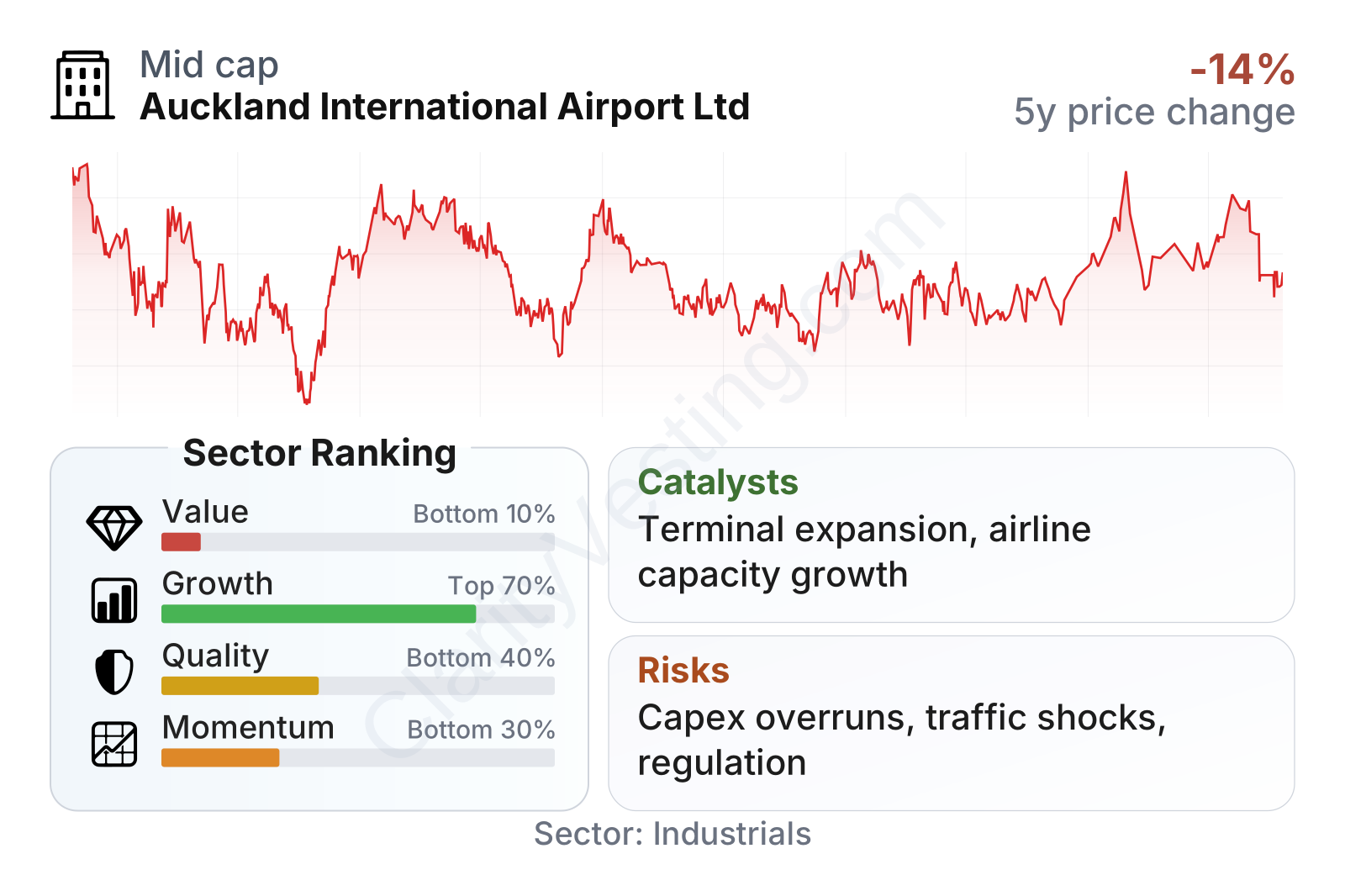
Auckland Airport is a large infrastructure company with relatively low share-price volatility, as reflected by a beta around 0.5. The overall profile is mixed. Growth ranks around the middle of the sector, helped by a strong multiyear recovery in revenue per share, while quality is weaker on capital-efficiency measures but stronger on margins. Value metrics look stretched on earnings and cash flow, even though the price-to-book ratio is low versus the sector. That combination usually means the market is balancing a premium for asset quality and strategic importance against the drag from heavy spending and modest near-term cash generation.
Growth
The airport sector has long-term structural support from tourism, business travel, migration, and trade connectivity. In Auckland Airport’s case, the company sits at the center of New Zealand’s international air network, which gives it exposure to passenger growth over time as the country’s travel flows continue normalizing and expanding. That does not make growth linear every year, but it does place the business in a sector with clear long-duration demand drivers.
The company’s recent trajectory shows that the biggest rebound phase has already happened. Year-over-year revenue growth was extremely strong as borders reopened, then slowed into more normal levels. That is still consistent with a business moving from recovery into a steadier expansion phase rather than losing relevance.
Five-year growth measures still look favorable compared with much of the sector, especially on revenue per share, even though the latest annual growth rate is below the sector median. In plain terms, Auckland Airport has already captured much of the reopening surge, so the next leg of growth is more likely to come from capacity expansion, pricing, commercial monetization, and property development rather than from a simple return to normal travel.
A major part of the long-term case is the company’s strategy to expand and modernize airport infrastructure. Management has been investing heavily in terminal and airfield capacity to accommodate future passenger volumes and improve operational resilience. For an airport, that strategy is logical: the core asset is valuable because it is hard to reproduce, but it must keep expanding to avoid becoming a bottleneck. If traffic continues rising over time, those investments can support both higher volumes and stronger non-aeronautical revenue per traveler.
The weak point is cash generation in the short term. Free cash flow has been negative, which is not unusual during a period of heavy capital spending, but it does mean growth is currently being funded ahead of the return. That makes execution important. If the new capacity is delivered on time and absorbed by rising traffic, today’s spending could support a much larger earnings base later. If demand softens or costs continue climbing, the payoff period becomes longer.
Recent company updates have also pointed to continuing airline capacity growth and ongoing development across the airport precinct. Those are meaningful opportunities because they can lift not just passenger numbers, but also higher-margin commercial and property income tied to the same captive traffic base.
Risks
This article is for informational purposes only and does not constitute financial advice. Some content is AI-generated. See Disclaimer