Stock Analysis · Aura Minerals Inc. Common Shares (AUGO)
Overview
Aura Minerals is a gold and copper producer focused on mining, processing, and selling metals from operations in Latin America. The company owns and operates producing mines, advances development projects, and from time to time expands through acquisitions or new construction. For long-term readers, the business is relatively easy to understand: Aura extracts ore, processes it into saleable metal, and its financial results are then driven mainly by production volumes, operating costs, and commodity prices.
Its revenue is largely tied to metal sales, with gold as the main contributor and copper as the second pillar. Based on the company’s recent reporting and operating profile, the revenue mix appears to be concentrated as follows:
- Gold: approximately 70% to 80% of revenue. This includes gold produced at the company’s main operating mines and sold into global bullion markets.
- Copper: approximately 20% to 30% of revenue. This mainly reflects copper concentrate or copper-related output from its copper-focused assets.
- Other by-products: a small residual share from metals such as silver and other by-product credits where applicable.
Aura’s operating footprint gives it diversification across several mines rather than dependence on a single asset, which matters in mining because grades, maintenance, weather, and permitting can all affect output from one site at a time. At the same time, it remains a concentrated company compared with the largest global miners, so individual project execution still plays an outsized role in its results.
One noticeable trend in recent years is that revenue has risen sharply, while net income has been much more volatile. That is common in mining when expansion spending, taxes, financing costs, and non-cash accounting items move faster than sales. Recent performance suggests the business has become much larger in revenue terms, but the key question for the long run is whether that larger platform can consistently translate into durable cash generation and cleaner bottom-line profits.
The business has scaled up meaningfully since 2021, with revenue more than doubling by 2025. However, the path from sales to net income has been uneven, showing that growth has come with heavier costs, taxes, and financing effects. For a miner, that makes operating discipline just as important as production growth.
Key Figures
| Metric | Value | Sector ⓘ |
|---|---|---|
| Date | Oct 24, 2026 | |
| Context | ||
| Sector | Basic Materials | |
| Industry | Gold | |
| Market Cap ⓘ | $7.06B | |
| Beta ⓘ | 0.32 | |
Value (Cheapness) | ||
| P/E Ratio ⓘ | 24.28 | 16.92 |
| P/B Ratio ⓘ | 15.84 | 1.66 |
| FCF Yield ⓘ | 2.49% | 5.83% |
| Dividend Yield ⓘ | 1.33% | 2.07% |
| EBIT / EV ⓘ | 6.62% | 6.38% |
| PEG ⓘ | N/A | |
Growth (Business expansion) | ||
| Revenue Growth ⓘ | 76.40% | 11.25% |
| RPS Growth (5Y CAGR) ⓘ | 17.47% | 4.49% |
| EPS Growth (5Y CAGR) ⓘ | 29.86% | -15.24% |
| BVPS Growth (5Y CAGR) ⓘ | -3.84% | 5.49% |
| Margin Growth (5Y Trend) ⓘ | -27.50% | -1.54% |
| FCF Growth (5Y CAGR) ⓘ | 10.99% | 0.37% |
| DPS Growth (5Y CAGR) ⓘ | 4.33% | 5.91% |
Quality (Business durability) | ||
| ROIC (Latest) ⓘ | N/A | 9.59% |
| ROA (Latest) ⓘ | 19.06% | 4.92% |
| ROIC (5Y Median) ⓘ | N/A | 7.91% |
| ROA (5Y Median) ⓘ | 3.86% | 3.92% |
| Net Debt / EBIT (Latest) ⓘ | 0.43 | 1.36 |
| Net Debt / EBIT (5Y Median) ⓘ | 0.90 | 1.69 |
| Net Debt / EBITDA (Latest) ⓘ | 0.35 | 0.93 |
| Net Debt / Assets ⓘ | 12.30% | 13.69% |
| EBITDA / Interest ⓘ | 15.10 | 12.38 |
| Operating Margin (Latest) ⓘ | 37.85% | 13.24% |
| Operating Margin (5Y Median) ⓘ | 14.65% | 11.82% |
| Debt to Equity (Latest) ⓘ | 100.34% | 40.30% |
| Profit Margin (Latest) ⓘ | 23.18% | 6.38% |
| Free Cash Flow (Latest) ⓘ | $175.56M | |
Momentum (Price trend) | ||
| 3Y Return ⓘ | +1459.41% | +73.47% |
| 12M Return (excl. last month) ⓘ | +190.59% | +27.59% |
| 6M Return ⓘ | -10.41% | -4.02% |
| Price vs. 200-Day MA ⓘ | +15.17% | -0.65% |
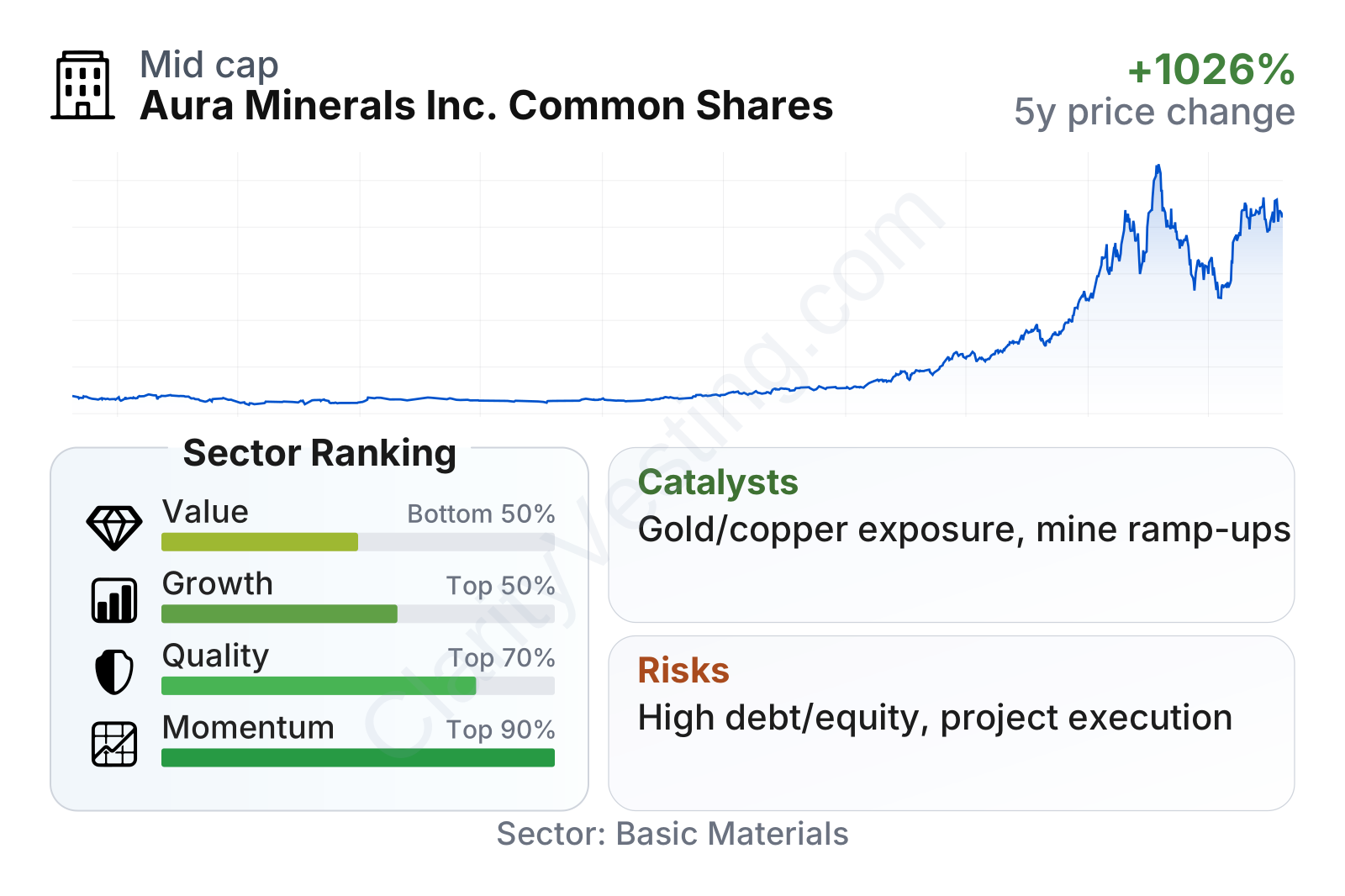
Aura now sits in the large end of the mid-tier miner range by market value, and its share price momentum has been exceptionally strong over the past one to three years. The broader metric profile is more mixed: growth and market momentum stand out positively, quality is above average in several profitability and balance-sheet coverage measures, while traditional valuation ratios look less appealing than many sector peers. That combination usually points to a company the market is rewarding for improved operating performance rather than one that looks statistically cheap.
The stock’s low beta suggests it has recently moved less violently than many equities, but that should not be confused with low business risk. Mining companies can still face abrupt changes in earnings when metal prices, mine plans, or country conditions shift.
Growth
Gold and copper are both supported by long-term demand drivers, although for different reasons. Gold benefits from its role as a store of value and from central bank and jewelry demand, while copper is closely linked to electrification, power grids, electric vehicles, and industrial development. That means Aura operates in a part of the mining sector that has structural relevance beyond short-term commodity cycles.
Aura’s strategy also makes logical sense for growth. The company has been combining production from existing mines with expansion projects and development assets. For a miner of its size, that can be attractive because a successful mine build or ramp-up can materially change the company’s earnings base. The challenge, as always in mining, is that the same projects can also create cost overruns or delays if execution slips.
Recent sales growth has been unusually strong. Revenue growth accelerated sharply through 2025 and remained far above the sector median into 2026, showing that Aura is not just benefiting from a stable asset base but has been going through a meaningful step-up in scale. Over a five-year period, revenue per share growth has also been well ahead of the typical company in the gold sector.
Cash generation has improved as well. Free cash flow was modest earlier, then increased substantially by 2026. That matters because in mining, reported earnings can be noisy, but free cash flow is a clearer sign that operations are funding themselves after capital spending. If this level of cash generation proves sustainable, it would strengthen the case that Aura’s recent expansion is becoming financially productive rather than simply larger on paper.
Another growth catalyst is the company’s exposure to both gold and copper rather than to a single metal. If gold prices remain firm and copper demand continues to benefit from electrification and infrastructure spending, Aura has two separate commodity engines supporting future growth. In addition, any successful ramp-up of newer or expanded operations could have an outsized impact because the company is still small enough for one major project to move the overall needle.
Recent company updates have also pointed to continued development activity and operational progress across the portfolio. For a long-term view, the important point is not any single quarterly headline but the broader pattern: Aura appears to be moving from a smaller producer toward a more scaled multi-asset mining platform.
Risks
This article is for informational purposes only and does not constitute financial advice. Some content is AI-generated. See Disclaimer


