Stock Analysis · Atlantic Union Bankshares Corp (AUB)
Overview
Atlantic Union Bankshares Corp is a regional bank holding company based in Virginia. Through Atlantic Union Bank and related subsidiaries, it provides traditional banking services to consumers, small and mid-sized businesses, commercial real estate clients, and wealth customers. Its business is built around gathering deposits, making loans, earning interest on those balances, and collecting fees from services such as treasury management, mortgage banking, and wealth management.
For a bank like Atlantic Union, revenue is best understood through its major operating streams rather than product sales. Based on recent company reporting, the largest sources of revenue are approximately:
- Net interest income: about 80% to 90% of total revenue. This is the spread between interest earned on loans and securities and interest paid on deposits and borrowings. It is the core engine of the business.
- Noninterest income: about 10% to 20% of total revenue. This includes service charges on deposit accounts, wealth management and trust revenue, mortgage banking income, card and interchange fees, and other banking-related fees.
- Within lending activity, commercial and industrial, commercial real estate, and residential mortgage lending are key asset categories that support interest income, while deposit services support both funding and fee generation.
Atlantic Union is a midsized regional bank, not a national giant. That matters because its results depend heavily on the health of the Mid-Atlantic economy, local business activity, loan demand, deposit competition, and credit quality in its footprint.
Over the last several years, the company’s total revenue has expanded materially, but costs have also risen, especially funding costs and operating expenses. Net income has remained positive, though profitability has been less smooth than top-line growth alone might suggest.
The business mix still looks centered on classic spread banking: rising revenue has been accompanied by a noticeable increase in interest expense, showing how much the higher-rate environment has pressured funding costs across regional banks.
Key Figures
| Metric | Value | Sector ⓘ |
|---|---|---|
| Date | Nov 21, 2026 | |
| Context | ||
| Sector | Financial Services | |
| Industry | Banks - Regional | |
| Market Cap ⓘ | $5.32B | |
| Beta ⓘ | 0.81 | |
Value (Cheapness) | ||
| P/E Ratio ⓘ | 10.28 | 12.01 |
| P/B Ratio ⓘ | 0.00 | 1.48 |
| FCF Yield ⓘ | 10.31% | 8.77% |
| Dividend Yield ⓘ | 3.87% | 3.01% |
| EBIT / EV ⓘ | 9.69% | 8.31% |
| PEG ⓘ | 1.08 | |
Growth (Business expansion) | ||
| Revenue Growth ⓘ | 6.40% | 6.70% |
| RPS Growth (5Y CAGR) ⓘ | 14.43% | 12.35% |
| EPS Growth (5Y CAGR) ⓘ | -1.30% | -0.27% |
| BVPS Growth (5Y CAGR) ⓘ | 2.58% | 4.83% |
| Margin Growth (5Y Trend) ⓘ | -28.26% | -4.16% |
| FCF Growth (5Y CAGR) ⓘ | -28.58% | 4.69% |
| DPS Growth (5Y CAGR) ⓘ | 4.61% | 8.82% |
Quality (Business durability) | ||
| ROIC (Latest) ⓘ | 7.73% | 9.49% |
| ROE (Latest) ⓘ | 0.02% | 14.02% |
| ROA (Latest) ⓘ | 0.00% | 1.53% |
| ROIC (5Y Median) ⓘ | 5.74% | 7.80% |
| ROE (5Y Median) ⓘ | 7.71% | 12.09% |
| ROA (5Y Median) ⓘ | 0.97% | 1.28% |
| Net Debt / EBIT (Latest) ⓘ | 1.19 | 0.88 |
| Net Debt / EBIT (5Y Median) ⓘ | 3.75 | 0.73 |
| Net Debt / EBITDA (Latest) ⓘ | 280.80 | 0.71 |
| Operating Margin (Latest) ⓘ | 27.92% | 23.37% |
| Operating Margin (5Y Median) ⓘ | 22.95% | 24.29% |
| Debt to Equity (Latest) ⓘ | 12.87% | 59.34% |
| Profit Margin (Latest) ⓘ | 34.75% | 26.65% |
| Free Cash Flow (Latest) ⓘ | $549.04M | |
Momentum (Price trend) | ||
| 3Y Return ⓘ | +28.01% | +73.29% |
| 12M Return (excl. last month) ⓘ | +17.86% | +18.35% |
| 6M Return ⓘ | +0.05% | +3.24% |
| Price vs. 200-Day MA ⓘ | -4.42% | +2.17% |
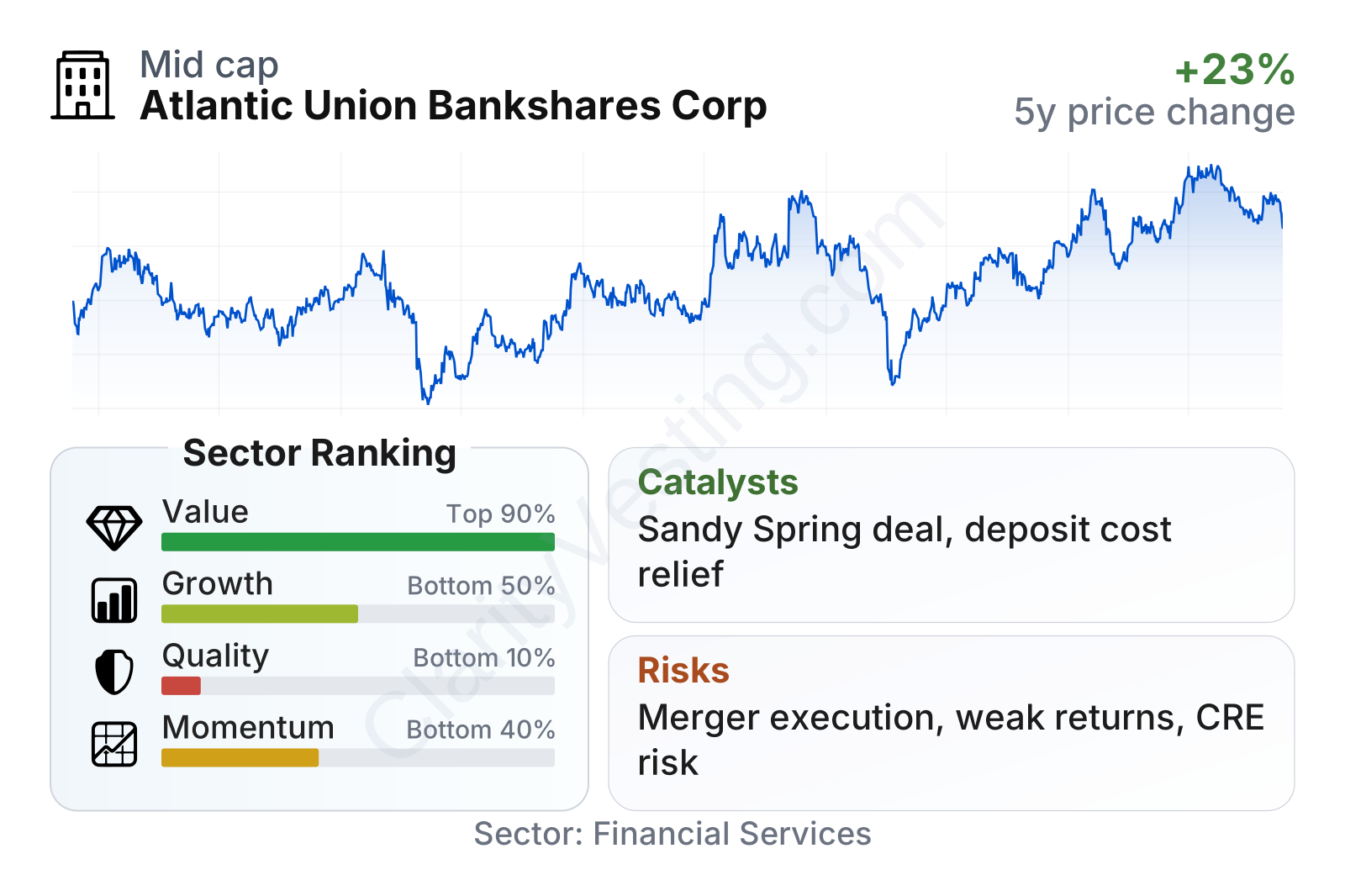
Atlantic Union sits in the larger end of the regional bank group, with a market value in the mid-single-digit billions and a below-market beta, which suggests the shares have historically moved somewhat less violently than the broader equity market. On valuation, the stock screens favorably versus many regional banks: earnings multiple is around the sector median, dividend yield is above the median, and operating earnings relative to enterprise value look solid. Growth is more mixed. Revenue has been rising, and five-year revenue per share growth has been better than the sector median, but book value growth has been slower and profitability-based quality measures rank weakly. That combination points to a bank that appears optically inexpensive, but where the market is also reacting to uneven returns.
The share price path also reflects the wider regional banking cycle. It sold off sharply during the 2023 bank stress period, recovered through 2024, weakened in part of 2025, and then moved higher again in 2026. That pattern is consistent with a company whose valuation is closely tied to confidence in deposit stability, credit quality, and earnings normalization.
Growth
Regional banking is not a high-growth sector in the way software or semiconductors can be, but it remains structurally important and can still grow steadily through population shifts, commercial activity, loan production, fee expansion, and acquisitions. Atlantic Union operates in attractive Mid-Atlantic markets, including Virginia and nearby areas where population, business formation, infrastructure activity, and professional services demand can support banking growth over time.
The company’s strategy is straightforward and sensible for a long-duration banking franchise: build density in familiar markets, deepen commercial relationships, gather low-cost deposits, add fee-based services, and use selective acquisitions to broaden scale. For a regional bank, scale matters because it can improve operating efficiency, technology spending capacity, and customer retention.
A notable current catalyst is the announced combination with Sandy Spring Bancorp, which is expected to expand Atlantic Union’s presence in Maryland and the greater Washington area. If integration goes well, that deal could add balance-sheet scale, increase deposit share in attractive markets, and create cost-saving opportunities over time. It also has the potential to strengthen the company’s competitive position with commercial clients that prefer a bank larger than a community bank but more locally focused than a national institution.
Another positive factor is the possibility of a friendlier earnings backdrop if funding pressure eases. Regional banks have spent the last few years paying more for deposits as interest rates rose and competition intensified. If deposit costs stabilize or fall faster than loan yields, net interest income could improve even without aggressive balance-sheet growth.
Earnings per share have not followed a straight line. They declined from 2021 through 2024 before improving in 2025, which suggests the core franchise has been resilient but has had to absorb a tougher rate and cost environment. That makes future earnings growth more dependent on margin recovery, disciplined expenses, and successful integration of expansion efforts than on simple loan growth alone.
Book value per share has trended upward over the longer period after an earlier dip, which is important for banks because book value gives a useful anchor for capital strength and balance-sheet compounding. The pace has not been especially fast, but the recovery indicates the franchise has continued to build underlying equity value.
Risks
This article is for informational purposes only and does not constitute financial advice. Some content is AI-generated. See Disclaimer


