Stock Analysis · Altarea SCA (ATRRF)
Overview
Altarea SCA is a French real estate group focused on developing, owning, and managing property projects. Its activities span residential housing, commercial real estate, and fee-based real estate services. In practical terms, the company helps create apartments, retail destinations, offices, mixed-use urban projects, and related property management or service activities. While the U.S. ticker ATRRF trades over the counter, the business itself is primarily tied to the French property market.
Altarea’s revenue mix can shift from year to year because property development is cyclical and project timing matters. Based on the company’s recent annual disclosures, the largest source of revenue is residential development, followed by commercial real estate and then other services and asset-related activities. A simple way to think about the business is the following:
- Residential development: roughly 60% to 70% of revenue in recent years. This includes development and sale of new homes, urban regeneration projects, and related housing operations.
- Commercial real estate: roughly 20% to 30% of revenue. This area includes retail, offices, logistics, and large mixed-use projects, with income influenced by development completions, disposals, and rental-related activities.
- Services and other activities: roughly 5% to 15% of revenue. This can include property services, management activities, and other real estate-linked operations.
What stands out is that Altarea is not a pure landlord collecting mostly recurring rent. A meaningful part of its activity depends on development and asset rotation, which makes results more volatile than those of a traditional rent-focused real estate company. Over the past few years, revenue remained in the multibillion-euro range, but profitability became much less stable as the French real estate market weakened and financing conditions tightened. More recently, operating results recovered from the 2023 low, but net profit stayed thin because financing costs and a difficult market still weigh on the business.
The business flow shows a company still generating significant gross profit on a large revenue base, but with much narrower profit left at the end than earlier in the cycle. The rebound in operating income after the 2023 setback is encouraging, yet interest expense remains a meaningful drag, which is important in a rate-sensitive sector like real estate.
Key Figures
| Metric | Value | Sector ⓘ |
|---|---|---|
| Date | Oct 17, 2026 | |
| Context | ||
| Sector | Real Estate | |
| Industry | REIT - Residential | |
| Market Cap ⓘ | $2.20B | |
| Beta ⓘ | 0.81 | |
Value (Cheapness) | ||
| P/E Ratio ⓘ | 50.90 | 17.38 |
| P/B Ratio ⓘ | 23.33 | 0.85 |
| FCF Yield ⓘ | 26.44% | 7.38% |
| Dividend Yield ⓘ | 8.98% | 4.85% |
| EBIT / EV ⓘ | N/A | 3.78% |
| PEG ⓘ | N/A | |
Growth (Business expansion) | ||
| Revenue Growth ⓘ | -9.30% | 5.30% |
| RPS Growth (5Y CAGR) ⓘ | -53.92% | 6.02% |
| EPS Growth (5Y CAGR) ⓘ | -38.47% | -11.37% |
| BVPS Growth (5Y CAGR) ⓘ | -72.35% | 0.45% |
| Margin Growth (5Y Trend) ⓘ | -2.99% | -0.22% |
| FCF Growth (5Y CAGR) ⓘ | -39.42% | 5.40% |
| DPS Growth (5Y CAGR) ⓘ | -40.30% | 5.02% |
Quality (Business durability) | ||
| ROIC (Latest) ⓘ | 12.22% | 5.69% |
| ROE (Latest) ⓘ | 37.56% | 7.56% |
| ROA (Latest) ⓘ | 0.77% | 2.85% |
| ROIC (5Y Median) ⓘ | 4.57% | 4.22% |
| ROE (5Y Median) ⓘ | 13.28% | 6.03% |
| ROA (5Y Median) ⓘ | 0.10% | 2.44% |
| Net Debt / EBIT (Latest) ⓘ | 5.64 | 7.59 |
| Net Debt / EBIT (5Y Median) ⓘ | 6.43 | 8.40 |
| Net Debt / EBITDA (Latest) ⓘ | 4.66 | 5.27 |
| Net Debt / Assets ⓘ | 31.59% | 37.76% |
| EBITDA / Interest ⓘ | 2.67 | 4.10 |
| Operating Margin (Latest) ⓘ | 9.55% | 35.29% |
| Operating Margin (5Y Median) ⓘ | 6.72% | 37.31% |
| Debt to Equity (Latest) ⓘ | 179.32% | 88.87% |
| Profit Margin (Latest) ⓘ | 1.86% | 19.61% |
| Free Cash Flow (Latest) ⓘ | $582.40M | |
Momentum (Price trend) | ||
| 3Y Return ⓘ | +18.82% | +30.75% |
| 12M Return (excl. last month) ⓘ | -2.13% | +4.36% |
| 6M Return ⓘ | -19.37% | -2.52% |
| Price vs. 200-Day MA ⓘ | N/A | -2.34% |
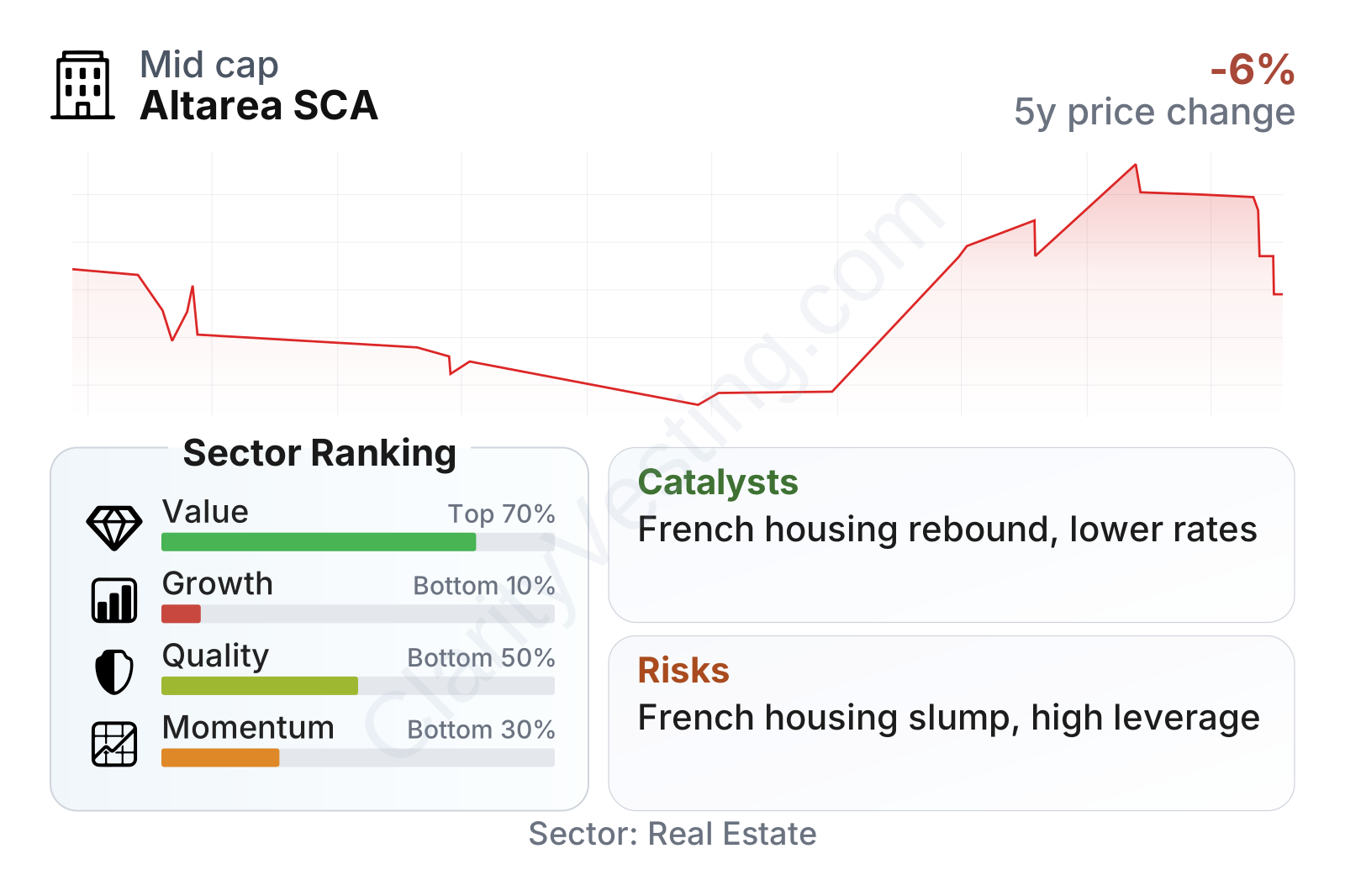
Altarea sits in the mid-cap range and its share price has been less volatile than the broader real estate group on a beta basis. The current profile is mixed. On one side, free cash flow yield and dividend yield screen strongly versus the sector median, and leverage relative to EBIT or EBITDA is not extreme for property-related businesses. On the other side, recent growth metrics are very weak, margins are far below sector norms, and price momentum has been soft over the last six to twelve months. The valuation multiples shown in the table also look unusually high, which suggests the market price is being compared against depressed earnings and book-related figures rather than against a clean normalized cycle.
Growth
Altarea operates in sectors that should remain structurally relevant over the long term. Housing demand in major French urban areas is supported by demographics, limited land availability in attractive zones, and continuing need for new, energy-efficient buildings. Urban regeneration and mixed-use redevelopment also fit well with public policy trends around land recycling, lower-carbon construction, and denser city planning. Those are real long-term supports for the business.
That said, the near-term growth backdrop has been difficult. French residential development has been pressured by high interest rates, weaker affordability for homebuyers, and slower transaction volumes. Commercial development has also faced more selective demand, especially where office and retail markets are changing. This helps explain why Altarea’s recent growth ranking is near the bottom of its sector despite operating in markets that still matter over a longer horizon.
Management’s strategy remains logically positioned for a future recovery: focus on prime metropolitan markets, maintain a broad platform across housing and commercial projects, and preserve flexibility to restart development as financing and demand improve. If borrowing costs continue easing in Europe and housing demand stabilizes, Altarea could benefit from operating leverage because development groups often see profitability improve quickly when volumes return.
The long-term revenue-per-share trend has clearly deteriorated, which reflects the severity of the recent property downturn and likely changes in project mix. This is not the pattern of a business currently compounding smoothly, but it does underline how cyclical the company is: if the French development market normalizes, this measure has room to recover from a depressed base.
The dividend record also shows a sharp reset from earlier levels. That is consistent with a business preserving balance-sheet flexibility during a difficult phase rather than trying to maintain distributions at any cost. A more durable improvement would require stronger earnings conversion and a healthier residential market, not just one better reporting period.
A potential catalyst is any sustained recovery in French new-home sales, lower financing rates, or public support measures aimed at housing supply. Another positive factor is Altarea’s established platform in large urban projects, where barriers to entry can be meaningful because they require land expertise, local relationships, and execution capacity over many years.
Risks
This article is for informational purposes only and does not constitute financial advice. Some content is AI-generated. See Disclaimer


