Stock Analysis · Atlanticus Holdings Corporation (ATLC)
Overview
Atlanticus Holdings Corporation is a specialty finance company focused on consumer credit. Its core activity is helping banks and other lending partners offer credit products to consumers who are often outside the traditional prime-credit market. In simple terms, Atlanticus uses underwriting, servicing, and technology capabilities to support lending programs aimed largely at borrowers with lower or non-prime credit profiles.
The business is built around managing receivables and earning income from those credit programs over time. Based on recent company filings, revenue is mainly generated from finance charges and fees tied to credit receivables, with smaller contributions from servicing and other related income streams.
The main revenue sources are broadly as follows:
- Interest income and fees on finance receivables: approximately 85% to 95% of revenue in recent periods. This includes interest charges, late fees, and other customer-related charges generated by the company’s credit card and point-of-sale lending receivables.
- Servicing and other income: approximately 5% to 15% of revenue. This includes income connected to administering accounts, program-related fees, and other ancillary activities.
Atlanticus is not a broad consumer bank. It is a more specialized credit platform with a meaningful concentration in second-look and non-prime lending. That focus can create higher yields than traditional lenders, but it also requires tighter control of credit losses, funding costs, and collections.
Over the last several years, the company’s business mix has remained consistent, while total revenue has expanded sharply again after a softer 2022-2023 period. Profitability is still solid, but a much larger share of revenue is now being absorbed by interest expense as the company funds a growing receivables base in a higher-rate environment.
Key Figures
| Metric | Value | Sector ⓘ |
|---|---|---|
| Date | Oct 17, 2026 | |
| Context | ||
| Sector | Financial Services | |
| Industry | Credit Services | |
| Market Cap ⓘ | $1.38B | |
| Beta ⓘ | 1.99 | |
Value (Cheapness) | ||
| P/E Ratio ⓘ | 11.83 | 12.26 |
| P/B Ratio ⓘ | 2.40 | 1.23 |
| FCF Yield ⓘ | 67.78% | 10.40% |
| Dividend Yield ⓘ | N/A | 3.02% |
| EBIT / EV ⓘ | 4.10% | 8.14% |
| PEG ⓘ | N/A | |
Growth (Business expansion) | ||
| Revenue Growth ⓘ | 83.30% | 9.35% |
| RPS Growth (5Y CAGR) ⓘ | 14.02% | 12.19% |
| EPS Growth (5Y CAGR) ⓘ | -5.34% | -9.53% |
| BVPS Growth (5Y CAGR) ⓘ | 19.47% | 4.99% |
| Margin Growth (5Y Trend) ⓘ | -25.70% | -3.86% |
| FCF Growth (5Y CAGR) ⓘ | 32.51% | 4.81% |
| DPS Growth (5Y CAGR) ⓘ | -11.23% | 8.79% |
Quality (Business durability) | ||
| ROIC (Latest) ⓘ | 3.20% | 9.49% |
| ROE (Latest) ⓘ | 22.32% | 13.90% |
| ROA (Latest) ⓘ | 2.11% | 1.55% |
| ROIC (5Y Median) ⓘ | 4.51% | 7.86% |
| ROE (5Y Median) ⓘ | 26.95% | 12.17% |
| ROA (5Y Median) ⓘ | 4.04% | 1.30% |
| Net Debt / EBIT (Latest) ⓘ | 19.23 | 0.96 |
| Net Debt / EBIT (5Y Median) ⓘ | 13.12 | 0.73 |
| Net Debt / EBITDA (Latest) ⓘ | 18.19 | 0.92 |
| Operating Margin (Latest) ⓘ | 17.73% | 22.30% |
| Operating Margin (5Y Median) ⓘ | 35.16% | 24.63% |
| Debt to Equity (Latest) ⓘ | 848.46% | 58.56% |
| Profit Margin (Latest) ⓘ | 21.08% | 26.57% |
| Free Cash Flow (Latest) ⓘ | $936.46M | |
Momentum (Price trend) | ||
| 3Y Return ⓘ | +209.84% | +88.33% |
| 12M Return (excl. last month) ⓘ | +22.19% | +19.38% |
| 6M Return ⓘ | +36.83% | +4.75% |
| Price vs. 200-Day MA ⓘ | +18.44% | +3.50% |
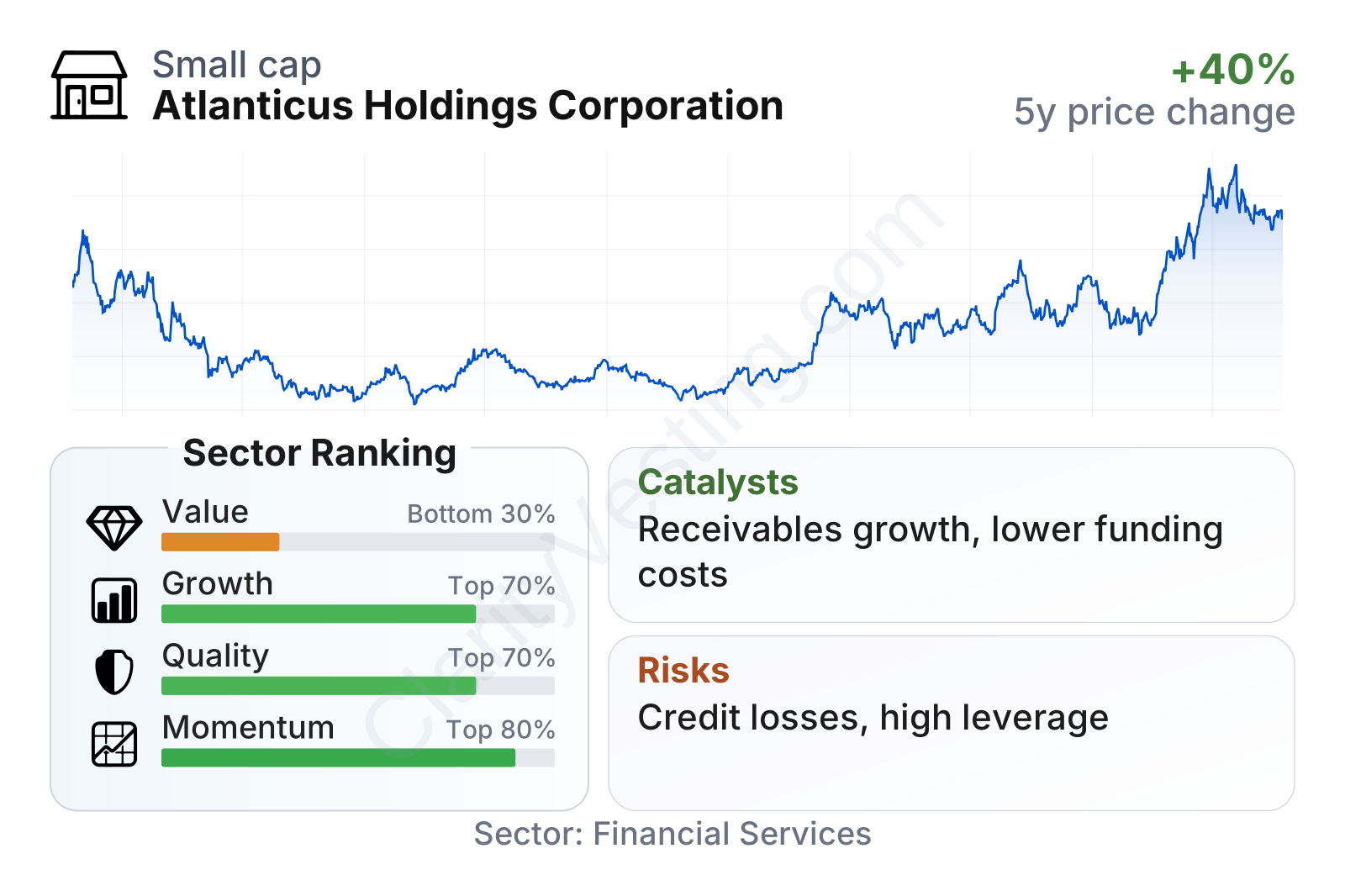
Atlanticus is a small-cap financial company with unusually strong recent share-price momentum and very fast top-line growth relative to much of the credit services sector. Profitability metrics remain above sector medians in return-on-equity and return-on-assets, but the balance sheet is far more leveraged than most peers. On valuation, the earnings multiple is near or slightly below the sector median, while the price-to-book multiple sits clearly above it, showing that the market is recognizing stronger returns but also assigning a premium to a riskier credit model.
The stock’s price history also shows how volatile sentiment can be. After dropping sharply in 2022, the shares recovered in stages and then moved much higher into 2026. That pattern fits a lender whose earnings outlook can change quickly as credit conditions, funding costs, and growth expectations shift.
Growth
Atlanticus operates in a part of financial services that has room to grow over time. Many consumers and merchants still need credit solutions outside the traditional prime-lending channel, especially in point-of-sale financing and private-label credit programs. That creates a durable opportunity for platforms that can price risk well and manage collections efficiently.
The company’s strategy is straightforward and commercially logical: partner with banks and merchants, originate high-yield receivables in underserved segments, and scale the platform while using underwriting data and servicing infrastructure to manage losses. If executed well, that model can grow faster than mainstream consumer lenders because it serves borrowers and merchants that are often less fully covered by larger institutions.
Recent operating trends support the view that the business is still expanding. Revenue growth has been very strong on a year-over-year basis, and free cash flow growth over a multiyear period has also been well ahead of the sector median. Book value per share has compounded at a strong pace, which matters for a lender because it shows that equity capital has been building even while the business scales.
Earnings per share show a more mixed picture than revenue. Results were materially higher in 2021, declined through 2023, and then improved again in 2024 and 2025. That suggests the company can grow, but not in a straight line. The recent rebound indicates that origination growth and portfolio expansion are translating back into stronger bottom-line performance, even if margins are not as rich as they were a few years ago.
Book value per share has risen steadily year after year, which is one of the more constructive long-term signals in the case of Atlanticus. For a finance company, this usually reflects retained earnings, portfolio growth, and the ability to expand without destroying shareholder capital. In this case, the increase has been meaningfully faster than the broader sector median over the past five years.
A practical catalyst is the company’s continued expansion in receivables and partner programs. When a lender like Atlanticus adds merchant relationships or expands existing programs, revenue can scale quickly because the asset base produces recurring finance income. Another catalyst is any stabilization or decline in funding costs. Since interest expense has risen sharply over the last few years, an easier rate backdrop could improve earnings conversion from revenue growth.
Recent company updates have also pointed to continued growth in managed receivables and program activity, which is important because the business model becomes more attractive when Atlanticus can keep growing originations without a proportional rise in credit losses.
Risks
This article is for informational purposes only and does not constitute financial advice. Some content is AI-generated. See Disclaimer


