Stock Analysis · Allegheny Technologies Incorporated (ATI)
Overview
Allegheny Technologies Incorporated, known as ATI, makes advanced specialty materials and complex metal components used in demanding environments. Its products are designed to keep their strength under extreme heat, pressure, corrosion, and fatigue, which makes them important in aircraft engines, airframes, defense systems, medical products, energy equipment, and certain industrial applications.
ATI has reshaped itself over the last several years away from lower-value commodity-style metals and toward higher-margin aerospace and defense markets. Today, the business is centered on specialty alloys such as titanium-based and nickel-based materials, along with precision forgings and rolled products used in critical parts where failure is not acceptable.
Based on ATI’s recent annual reporting structure, revenue mainly comes from two operating segments.
- High Performance Materials & Components: approximately 65% to 75% of revenue in recent periods. This segment includes titanium and titanium alloys, nickel-based alloys, forgings, castings, powder alloys, and highly engineered components for jet engines, aerospace structures, defense platforms, oil and gas, medical, and specialty energy uses.
- Advanced Alloys & Solutions: approximately 25% to 35% of revenue in recent periods. This segment includes flat-rolled specialty materials, stainless and electrical steel products, nickel alloys, and other engineered materials serving aerospace, defense, electronics, and industrial markets.
The mix matters because the first segment is generally tied to markets with stricter technical requirements and longer product approval cycles. That often creates stronger pricing power and more stable competitive positioning than standard metal products.
The company’s recent financial flow also shows a favorable direction: revenue and gross profit have expanded since 2021, while operating income has improved meaningfully. There are some year-to-year accounting distortions in the historical series, but the broader pattern points to a business that is producing more profit from a more focused product mix.
Key Figures
| Metric | Value | Sector ⓘ |
|---|---|---|
| Date | Oct 03, 2026 | |
| Context | ||
| Sector | Industrials | |
| Industry | Metal Fabrication | |
| Market Cap ⓘ | $25.73B | |
| Beta ⓘ | 1.01 | |
Value (Cheapness) | ||
| P/E Ratio ⓘ | 52.93 | 22.45 |
| P/B Ratio ⓘ | 14.68 | 1.98 |
| FCF Yield ⓘ | 2.05% | 6.31% |
| Dividend Yield ⓘ | N/A | 1.96% |
| EBIT / EV ⓘ | 2.62% | 4.81% |
| PEG ⓘ | 1.20 | |
Growth (Business expansion) | ||
| Revenue Growth ⓘ | 10.60% | 9.10% |
| RPS Growth (5Y CAGR) ⓘ | 10.08% | 7.75% |
| EPS Growth (5Y CAGR) ⓘ | 2.95% | -13.59% |
| BVPS Growth (5Y CAGR) ⓘ | 29.55% | 6.22% |
| Margin Growth (5Y Trend) ⓘ | 0.69% | 0.72% |
| FCF Growth (5Y CAGR) ⓘ | N/A | 10.98% |
| DPS Growth (5Y CAGR) ⓘ | 10.96% | 9.48% |
Quality (Business durability) | ||
| ROIC (Latest) ⓘ | 15.35% | 10.92% |
| ROA (Latest) ⓘ | 8.86% | 5.41% |
| ROIC (5Y Median) ⓘ | 14.07% | 9.21% |
| ROA (5Y Median) ⓘ | 7.41% | 4.94% |
| Net Debt / EBIT (Latest) ⓘ | 2.03 | 2.07 |
| Net Debt / EBIT (5Y Median) ⓘ | 2.42 | 2.28 |
| Net Debt / EBITDA (Latest) ⓘ | 1.54 | 1.43 |
| Net Debt / Assets ⓘ | 24.55% | 19.27% |
| EBITDA / Interest ⓘ | 9.35 | 9.53 |
| Operating Margin (Latest) ⓘ | 14.74% | 10.50% |
| Operating Margin (5Y Median) ⓘ | 13.11% | 10.27% |
| Debt to Equity (Latest) ⓘ | 116.80% | 65.48% |
| Profit Margin (Latest) ⓘ | 10.09% | 6.62% |
| Free Cash Flow (Latest) ⓘ | $526.30M | |
Momentum (Price trend) | ||
| 3Y Return ⓘ | +360.27% | +58.56% |
| 12M Return (excl. last month) ⓘ | +163.35% | +15.63% |
| 6M Return ⓘ | +30.21% | +4.19% |
| Price vs. 200-Day MA ⓘ | +13.94% | +0.93% |
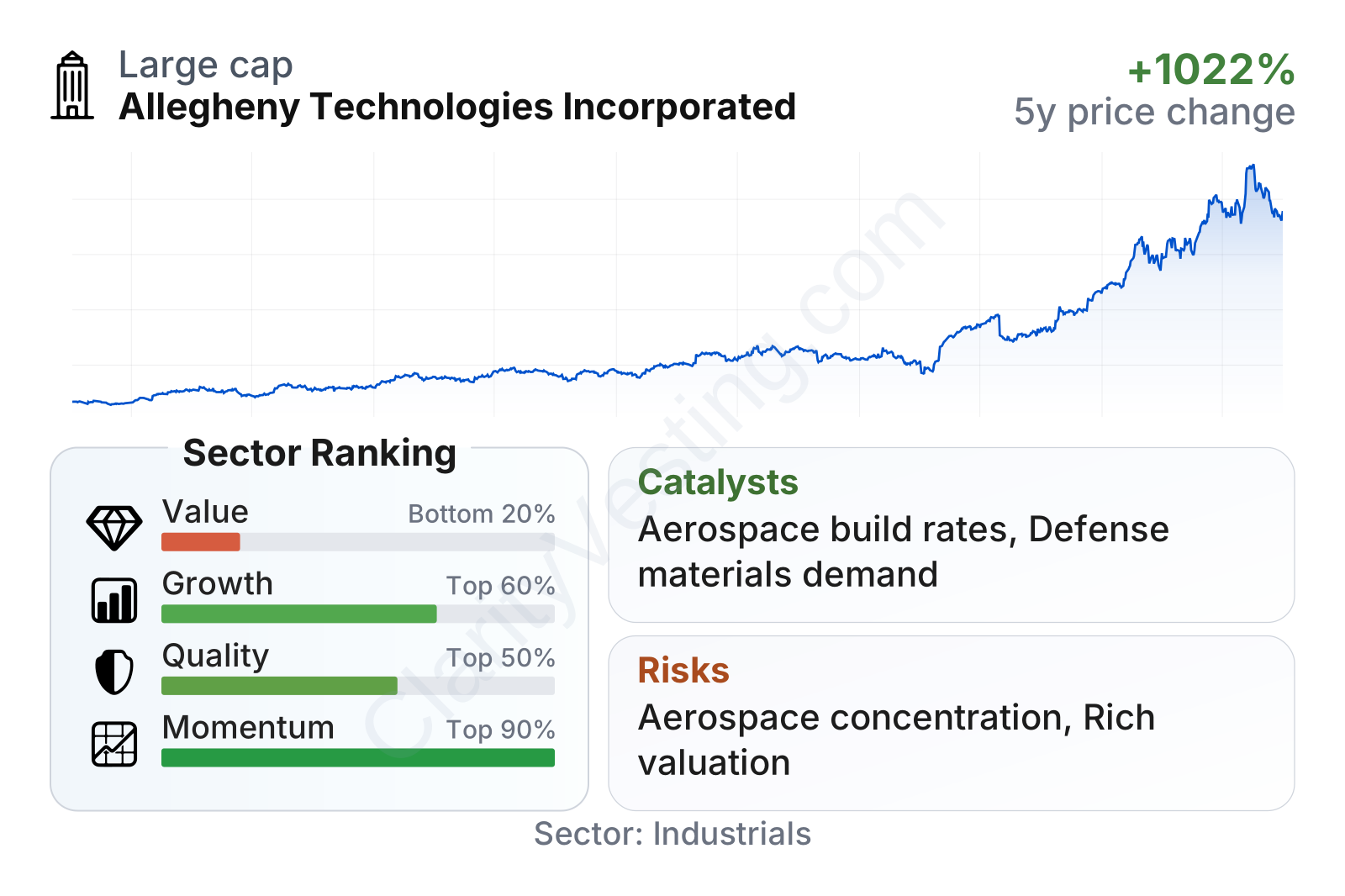
ATI is now a large industrial company with a market value above $25 billion and a stock volatility close to the broader market. The overall profile is mixed but understandable: growth, profitability, and market momentum look strong, while traditional valuation measures are expensive relative to much of the sector. Quality indicators are solid, especially returns on capital and operating margin, which suggests the business improvement is not only coming from higher sales but also from better economics.
The stock’s multiyear run has been extremely strong, reflecting both improving fundamentals and rising expectations. That strong share-price performance is important context for every other metric in the table, because it helps explain why valuation ratios now sit well above sector medians.
Growth
ATI operates in areas that benefit from long-cycle demand rather than short-lived trends. The biggest driver is commercial aerospace, where aircraft production and engine build rates continue to recover as manufacturers work through large backlogs. Defense is another supportive market because governments continue to prioritize air superiority, munitions, naval systems, and supply-chain resilience. These end markets tend to require advanced alloys and forged components with high technical barriers, which fits ATI’s repositioned portfolio well.
The company’s strategy also makes sense for future growth. ATI has been concentrating on products where qualification requirements are high and where customers are less likely to switch suppliers purely on price. In practice, that means more exposure to aerospace engines, structural components, and defense materials, and less exposure to lower-value metal categories. This strategy does not remove cyclicality, but it can improve margins and reduce direct commodity competition.
Revenue growth has moderated from the sharp rebound phase seen in 2022, but the trend remains positive. More recent growth rates are around the low-double-digit area on a year-over-year basis, slightly ahead of the sector median. That is a healthier pattern than a one-time surge followed by contraction, because it suggests ATI is still expanding even after the initial aerospace recovery phase.
Cash generation has improved even more clearly. Free cash flow moved from negative territory a few years ago to well above $500 million on a trailing basis. For a capital-intensive manufacturer, that is an important sign: it indicates that profit improvements are increasingly turning into cash, which can support debt management, capacity investment, and shareholder returns.
A notable catalyst is the ongoing push by the United States and allied nations to secure domestic and allied sources of critical materials used in aerospace and defense. ATI’s U.S.-based specialty metals and component capabilities fit this environment well. Another visible opportunity comes from higher engine content per aircraft and from next-generation engine programs that require advanced high-temperature materials. Recent company communications have also highlighted strong aerospace and defense demand, continued focus on titanium and nickel-based products, and investments intended to support future throughput.
Risks
This article is for informational purposes only and does not constitute financial advice. Some content is AI-generated. See Disclaimer