Stock Analysis · Alphatec Holdings Inc (ATEC)
Overview
Alphatec Holdings is a medical technology company focused on spine surgery. Its products are used by surgeons and hospitals to treat spinal disorders through implants, instruments, biologics, and technology-enabled surgical planning and navigation. In simple terms, Alphatec is trying to become a more complete spine surgery platform rather than a company that sells only a single type of implant.
The business is concentrated in spine care, which makes it more specialized than larger diversified medical device groups. That focus can help execution if the company continues to gain surgeon adoption, but it also means results depend heavily on performance in one clinical category.
Based on the company’s recent annual filing and product descriptions, revenue is primarily generated from U.S. sales of spine-related surgical products and services. The company does not break out detailed revenue by every product family in a simple percentage table, but the business mix can be understood as follows:
- Surgical implants and fixation systems — the largest revenue source, likely the clear majority of sales. This includes products used in cervical, thoracolumbar, and deformity procedures.
- Access systems, instruments, and procedural technologies — a meaningful secondary contributor. This includes systems that help surgeons reach the spine and perform procedures more efficiently.
- Biologics and enabling technologies — a smaller but still important part of the platform, including products intended to support fusion and tools that improve workflow, imaging, and navigation.
One notable operating trend is that revenue has expanded rapidly over the last several years, while gross profit has also climbed. At the same time, selling, general, and administrative expense remains very large, showing that Alphatec is still spending heavily to build commercial scale and support adoption.
Key Figures
| Metric | Value | Sector ⓘ |
|---|---|---|
| Date | Oct 03, 2026 | |
| Context | ||
| Sector | Healthcare | |
| Industry | Medical Devices | |
| Market Cap ⓘ | $1.59B | |
| Beta ⓘ | 0.85 | |
Value (Cheapness) | ||
| P/E Ratio ⓘ | N/A | 24.06 |
| P/B Ratio ⓘ | N/A | 3.08 |
| FCF Yield ⓘ | 0.26% | 3.07% |
| Dividend Yield ⓘ | N/A | 2.05% |
| EBIT / EV ⓘ | -3.39% | 0.63% |
| PEG ⓘ | 0.48 | |
Growth (Business expansion) | ||
| Revenue Growth ⓘ | 15.10% | 7.50% |
| RPS Growth (5Y CAGR) ⓘ | 19.13% | 8.70% |
| EPS Growth (5Y CAGR) ⓘ | -19.32% | -18.20% |
| BVPS Growth (5Y CAGR) ⓘ | -26.57% | 3.95% |
| Margin Growth (5Y Trend) ⓘ | N/A | -0.58% |
| FCF Growth (5Y CAGR) ⓘ | N/A | 0.88% |
| DPS Growth (5Y CAGR) ⓘ | N/A | 6.80% |
Quality (Business durability) | ||
| ROIC (Latest) ⓘ | -9.43% | 3.29% |
| ROA (Latest) ⓘ | -13.94% | 3.02% |
| ROIC (5Y Median) ⓘ | -28.91% | 4.75% |
| ROA (5Y Median) ⓘ | -27.68% | 1.93% |
| Net Debt / EBIT (Latest) ⓘ | N/A | 1.33 |
| Net Debt / EBIT (5Y Median) ⓘ | N/A | 1.83 |
| Net Debt / EBITDA (Latest) ⓘ | 36.07 | 0.99 |
| Net Debt / Assets ⓘ | 61.36% | 5.33% |
| EBITDA / Interest ⓘ | 0.33 | 9.63 |
| Operating Margin (Latest) ⓘ | -8.46% | 9.25% |
| Operating Margin (5Y Median) ⓘ | -35.31% | 7.80% |
| Debt to Equity (Latest) ⓘ | -5004.76% | 28.99% |
| Profit Margin (Latest) ⓘ | -13.50% | 3.60% |
| Free Cash Flow (Latest) ⓘ | $4.16M | |
Momentum (Price trend) | ||
| 3Y Return ⓘ | -21.30% | +37.48% |
| 12M Return (excl. last month) ⓘ | -42.08% | +20.85% |
| 6M Return ⓘ | -12.08% | +9.73% |
| Price vs. 200-Day MA ⓘ | -14.48% | +4.69% |
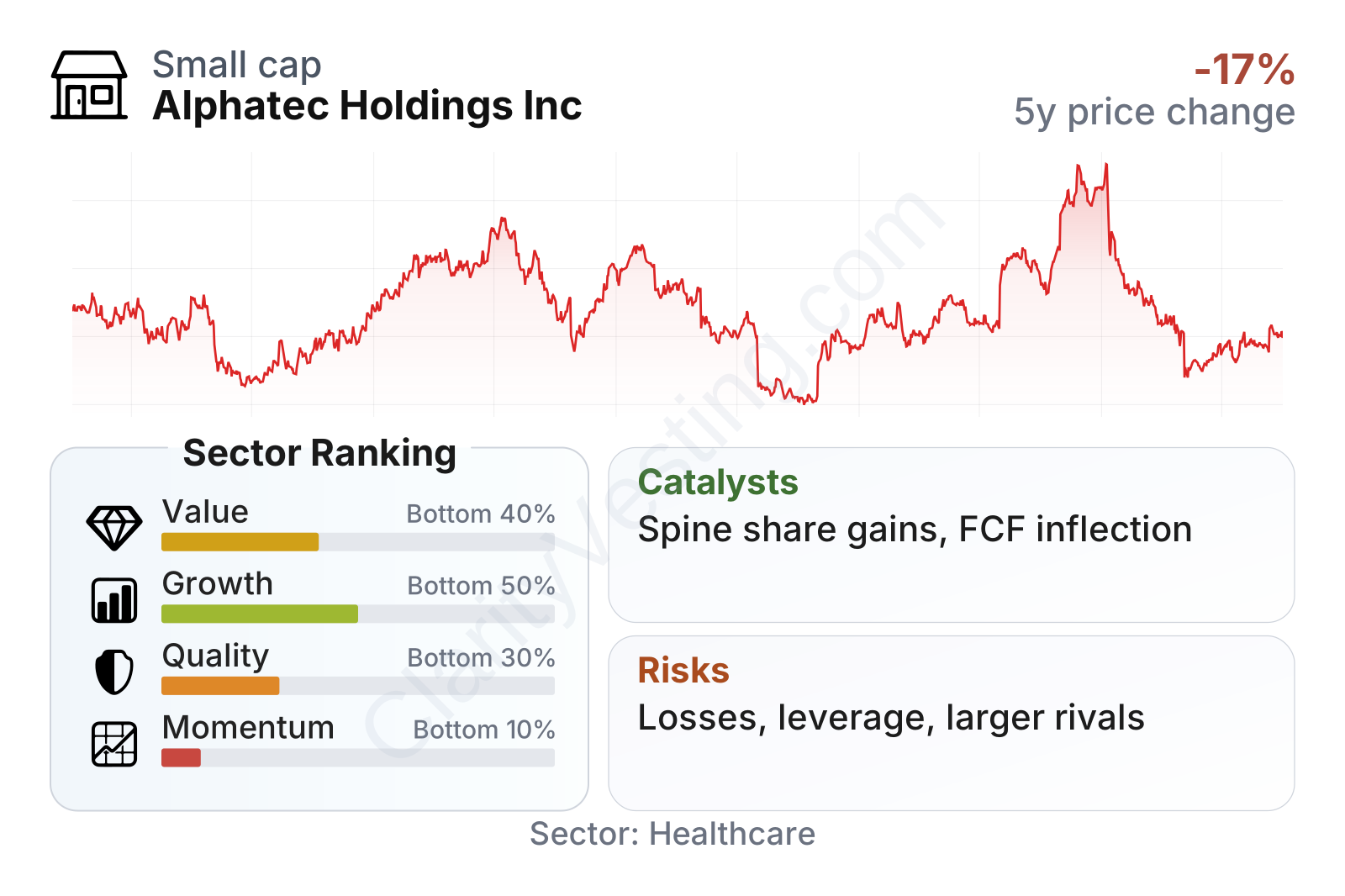
Alphatec is a small-cap medical device company with below-average valuation and quality scores relative to much of the healthcare sector, while its growth profile looks materially better than the median. Revenue growth is running at about 15% year over year, roughly double the sector median, and its five-year revenue-per-share growth has also been strong. The weak side is profitability and balance-sheet quality: returns on capital and assets remain negative, margins are still below sector norms, and leverage-related measures are stretched. Market performance has also been weak, with the stock trailing the broader healthcare group over multiple recent periods.
Growth
Spine surgery is part of a large and durable healthcare need. Demand is supported by an aging population, degenerative spinal conditions, and continuing interest in procedures that can improve outcomes or reduce surgical complexity. That does not make the market easy, but it does mean Alphatec operates in a category with long-term clinical relevance rather than a short-lived trend.
The company’s strategy is coherent. Alphatec has been building a broader procedural ecosystem: implants, access tools, biologics, and technology used before and during surgery. That matters because surgeons and hospitals often prefer integrated workflows. A company that can cover more of the procedure may be able to deepen relationships, increase revenue per case, and make switching less attractive.
The growth record has been strong even though it is slowing from the extremely high expansion rates seen earlier in the decade. Recent year-over-year growth remains in the mid-teens, which is still solid for a medical device company of this size. Annual revenue rose from about $243 million in 2021 to about $764 million in 2025, showing that Alphatec has already proven it can scale well beyond its earlier base.
Another encouraging sign is cash generation. Free cash flow was deeply negative in prior years but recently turned slightly positive on a trailing basis. That does not mean the business has fully matured, yet it is an important milestone because it suggests operating scale may finally be starting to offset years of heavy investment.
A recent catalyst is Alphatec’s continuing effort to expand its procedural portfolio and surgeon adoption through launches and technology additions highlighted in company communications. The opportunity is straightforward: if the platform keeps gaining share in spine procedures, growth can remain above sector averages for longer than the market typically assigns to a small device company. In addition, as hospitals look for workflow efficiency and more standardized procedures, integrated offerings may become more valuable.
Risks
This article is for informational purposes only and does not constitute financial advice. Some content is AI-generated. See Disclaimer


