Stock Analysis · Auto Trader Group plc (ATDRF)
Overview
Auto Trader Group plc operates the best-known digital automotive marketplace in the United Kingdom. In simple terms, it runs an online platform where car dealers and private sellers advertise vehicles, and where buyers search, compare, and contact sellers. Over time, the business has expanded beyond classified listings into software, data, financing-related tools, and digital retail services that help dealers manage stock and improve sales efficiency.
The company’s revenue is still centered on its marketplace, especially services sold to retailers. Based on recent annual reporting, the main sources of revenue can be summarized as follows:
- Retailer marketplace and advertising services: about 75% to 80% of revenue. This includes listing packages, prominence products, and data-driven tools sold mainly to franchised and independent car dealers.
- Auto Trader Connect and software/data products: about 10% to 15%. This covers dealer software, data services, and integrations that help retailers manage inventory and pricing.
- Manufacturer and agency advertising: about 5% to 10%. These are marketing solutions for car brands and related commercial partners.
- Private seller, vehicle finance, and other services: about 5% to 10% combined. This includes consumer listings and newer transaction-related services.
What makes the business model attractive is that much of the revenue is recurring and supported by network effects: dealers want to advertise where buyers already are, and buyers prefer the marketplace with the broadest vehicle selection. That dynamic has helped Auto Trader convert a high share of revenue into operating profit and cash over many years.
From 2022 to 2026, revenue moved from roughly £433 million to about £624 million, while operating income also increased meaningfully. The pattern suggests a scalable platform where costs have risen more slowly than sales, even though growth has moderated compared with earlier periods.
The financial profile shown above points to a business with unusually high profitability for an online marketplace. Revenue has expanded steadily, operating income has followed, and interest expense has remained modest relative to earnings, which helps explain why net income has also trended upward.
Key Figures
| Metric | Value | Sector ⓘ |
|---|---|---|
| Date | Oct 03, 2026 | |
| Context | ||
| Sector | Communication Services | |
| Industry | Internet Content & Information | |
| Market Cap ⓘ | $4.57B | |
| Beta ⓘ | 0.69 | |
Value (Cheapness) | ||
| P/E Ratio ⓘ | 13.24 | 18.20 |
| FCF Yield ⓘ | N/A | 14.71% |
| Dividend Yield ⓘ | 1.95% | 2.86% |
| EBIT / EV ⓘ | 5.46% | 4.85% |
| PEG ⓘ | N/A | |
Growth (Business expansion) | ||
| Revenue Growth ⓘ | 2.70% | 5.50% |
| RPS Growth (5Y CAGR) ⓘ | 13.40% | 4.55% |
| EPS Growth (5Y CAGR) ⓘ | -11.77% | -18.01% |
| Margin Growth (5Y Trend) ⓘ | -6.54% | 1.32% |
| FCF Growth (5Y CAGR) ⓘ | 2.36% | 5.96% |
| DPS Growth (5Y CAGR) ⓘ | 10.02% | 5.09% |
Quality (Business durability) | ||
| ROIC (Latest) ⓘ | N/A | 8.64% |
| ROIC (5Y Median) ⓘ | 51.06% | 8.11% |
| Net Debt / EBIT (Latest) ⓘ | N/A | 1.92 |
| Net Debt / EBIT (5Y Median) ⓘ | N/A | 2.85 |
| Net Debt / EBITDA (Latest) ⓘ | N/A | 1.25 |
| Net Debt / Assets ⓘ | 21.92% | 18.77% |
| EBITDA / Interest ⓘ | N/A | 8.75 |
| Operating Margin (Latest) ⓘ | N/A | 15.58% |
| Operating Margin (5Y Median) ⓘ | 62.75% | 13.53% |
| Debt to Equity (Latest) ⓘ | N/A | 59.53% |
| Profit Margin (Latest) ⓘ | 47.08% | 8.78% |
| Free Cash Flow (Latest) ⓘ | N/A | |
Momentum (Price trend) | ||
| 3Y Return ⓘ | -14.25% | +43.39% |
| 12M Return (excl. last month) ⓘ | -41.51% | +1.92% |
| 6M Return ⓘ | -0.40% | +2.94% |
| Price vs. 200-Day MA ⓘ | -23.43% | +0.74% |
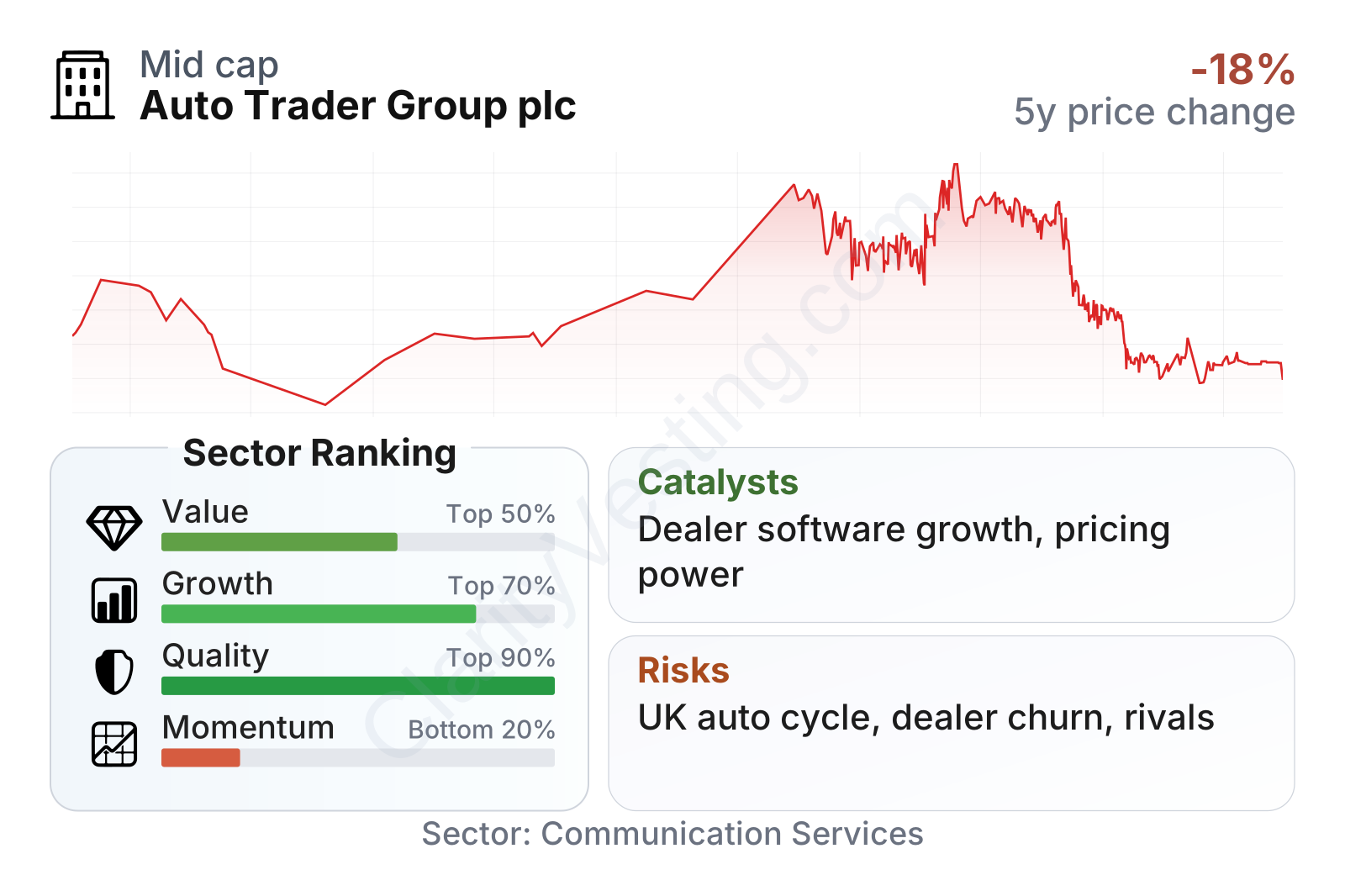
Auto Trader stands out most clearly on business quality. Its margins and long-term returns on capital are far above typical levels in its sector, which fits the image of a platform with strong pricing power and limited capital needs. Profit margin is exceptionally high, and the company has also grown revenue per share at a strong pace over five years.
Growth is more mixed in the short term. Recent year-over-year revenue growth has been positive but slower than the sector median, and free cash flow growth has not been especially fast lately. Even so, dividend growth over five years has been solid, and earnings performance looks better than many peers when viewed over a multiyear period.
Valuation metrics look moderate rather than stretched. The earnings multiple is below the sector median, while operating earnings relative to enterprise value are slightly better than average. On the other hand, the share price trend has been weak: the stock has lagged the sector over 12 months and three years, and it has been trading well below its longer-term average price trend. That combination often signals a company that remains fundamentally strong but faces doubts about near-term momentum.
Growth
Auto Trader operates in a part of the automotive market that is still benefiting from digitalization. Car shopping has shifted heavily online, and dealers increasingly rely on software, analytics, and digital merchandising rather than only physical forecourts and traditional advertising. That wider trend supports demand for Auto Trader’s core marketplace as well as its newer products in data, software, and transaction enablement.
The company’s strategy appears coherent for this environment. It is using its large audience, dealer relationships, and pricing data to become more deeply embedded in the dealer workflow. Instead of being only a place to post ads, Auto Trader is trying to become a decision platform: helping retailers source vehicles, price them, present them digitally, and convert shopper interest into sales. That broadens revenue opportunities without requiring a completely new customer base.
A notable growth catalyst is the expansion of products around digital retail, financing journeys, and connected dealer tools. If Auto Trader can increase revenue per retailer by bundling software and marketplace services, growth may depend less on broad UK car sales volumes alone. Another supportive factor is the company’s strong consumer brand in used cars, which is hard to replicate quickly.
Recent annual reporting also points to continued execution in retailer products and audience engagement. The company has emphasized product development, data-driven capabilities, and closer integration with retailer systems. For a platform business, that matters because it can raise switching costs and make the service more central to day-to-day operations.
The broader used-car market can also provide support. Even when new-car markets are uneven, used vehicles often remain an active category because they serve a wider range of budgets. That does not eliminate cyclicality, but it gives Auto Trader some resilience compared with businesses tied only to new vehicle production.
Risks
This article is for informational purposes only and does not constitute financial advice. Some content is AI-generated. See Disclaimer