Stock Analysis · Astrana Health Inc (ASTH)
Overview
Astrana Health Inc is a healthcare company focused on value-based care. In simple terms, it works with doctors, health plans, patients, and care networks to manage medical costs and improve outcomes, especially for people covered by Medicare, Medicaid, and other government-supported or commercial insurance programs. The company was previously known as Apollo Medical Holdings and has built its business around coordinating care for patients through physician groups, clinics, and risk-bearing arrangements where it can share in savings if care is delivered efficiently.
Its business model is broader than a standard clinic operator. Astrana combines medical care delivery, physician enablement, care management, and health plan relationships. That makes it partly a provider organization and partly a healthcare platform that helps independent doctors participate in more complex reimbursement systems.
The main sources of revenue are largely tied to healthcare services and risk-based arrangements. Based on recent annual reporting, the mix appears to be concentrated in care delivery and capitated or managed care-related revenue, with a smaller contribution from other healthcare support activities.
- Care partners and provider services revenue: approximately 80% to 90% of total revenue. This includes medical services delivered through affiliated physician groups, clinics, and provider networks, as well as amounts linked to managing patient populations under delegated or coordinated care arrangements.
- Capitation and risk-bearing medical revenue: a meaningful portion within the core business, often embedded in the largest line items rather than always shown as a fully separate bucket. This reflects fixed per-member payments and shared responsibility for patient care costs.
- Care management and other services: approximately 10% to 20% of revenue. This can include administrative support, management services, and other healthcare-related activities connected to physician enablement and network operations.
The broad picture is clear even if exact sub-segment percentages can shift from quarter to quarter: Astrana makes most of its money by managing patient care at scale, especially in arrangements where better coordination can protect margins and create recurring revenue.
The business has expanded rapidly in recent years, but the flow of revenue to final profit has become less efficient. Revenue and gross profit have moved higher, while interest expense and operating costs have also risen, which helps explain why strong top-line growth has not translated into equally strong earnings growth.
Key Figures
| Metric | Value | Sector ⓘ |
|---|---|---|
| Date | Oct 24, 2026 | |
| Context | ||
| Sector | Healthcare | |
| Industry | Medical Care Facilities | |
| Market Cap ⓘ | $1.85B | |
| Beta ⓘ | 1.03 | |
Value (Cheapness) | ||
| P/E Ratio ⓘ | 46.69 | 25.42 |
| P/B Ratio ⓘ | 1.78 | 3.08 |
| FCF Yield ⓘ | 8.55% | 3.12% |
| Dividend Yield ⓘ | N/A | 1.85% |
| EBIT / EV ⓘ | 5.58% | 0.56% |
| PEG ⓘ | N/A | |
Growth (Business expansion) | ||
| Revenue Growth ⓘ | 48.50% | 7.50% |
| RPS Growth (5Y CAGR) ⓘ | 39.44% | 8.60% |
| EPS Growth (5Y CAGR) ⓘ | 1.96% | -17.73% |
| BVPS Growth (5Y CAGR) ⓘ | 20.09% | 3.72% |
| Margin Growth (5Y Trend) ⓘ | -7.93% | -0.57% |
| FCF Growth (5Y CAGR) ⓘ | 19.57% | 0.96% |
| DPS Growth (5Y CAGR) ⓘ | -30.50% | 6.69% |
Quality (Business durability) | ||
| ROIC (Latest) ⓘ | 4.39% | 3.17% |
| ROA (Latest) ⓘ | 1.79% | 2.98% |
| ROIC (5Y Median) ⓘ | 7.16% | 4.56% |
| ROA (5Y Median) ⓘ | 4.93% | 1.87% |
| Net Debt / EBIT (Latest) ⓘ | 4.54 | 1.34 |
| Net Debt / EBIT (5Y Median) ⓘ | 0.26 | 1.86 |
| Net Debt / EBITDA (Latest) ⓘ | 3.04 | 1.00 |
| Net Debt / Assets ⓘ | 25.35% | 5.06% |
| EBITDA / Interest ⓘ | 2.83 | 9.55 |
| Operating Margin (Latest) ⓘ | 3.31% | 9.25% |
| Operating Margin (5Y Median) ⓘ | 7.64% | 7.33% |
| Debt to Equity (Latest) ⓘ | 117.97% | 26.68% |
| Profit Margin (Latest) ⓘ | 1.06% | 3.34% |
| Free Cash Flow (Latest) ⓘ | $158.44M | |
Momentum (Price trend) | ||
| 3Y Return ⓘ | +22.89% | +51.61% |
| 12M Return (excl. last month) ⓘ | +29.65% | +19.90% |
| 6M Return ⓘ | +12.79% | +10.10% |
| Price vs. 200-Day MA ⓘ | +13.24% | +6.44% |
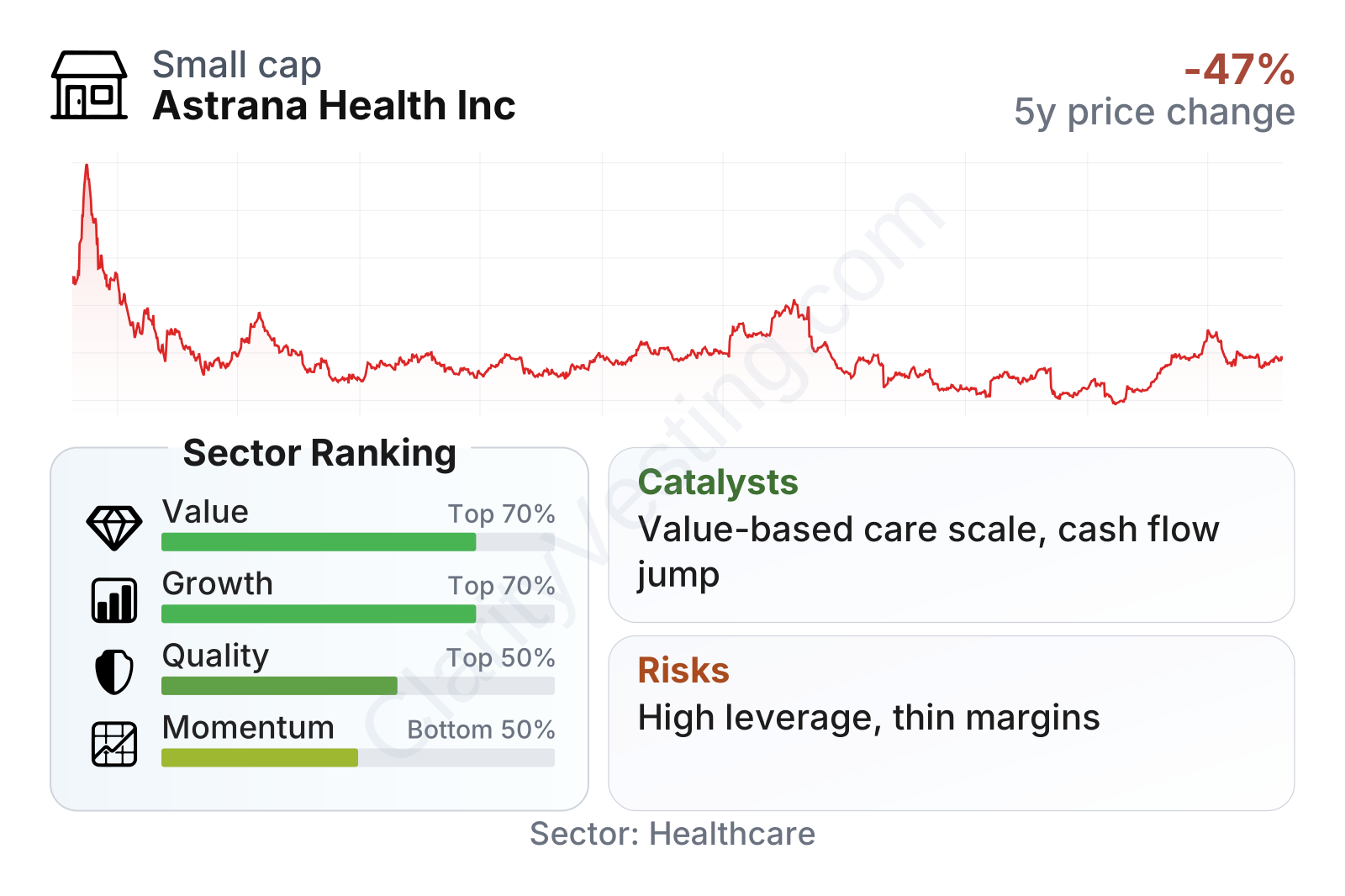
Astrana sits in the small-to-mid-cap range within healthcare and its share price has been volatile over the last several years, including a sharp decline from 2021 highs followed by a strong rebound in 2026. The latest metrics show a mixed profile. Growth and cash generation stand out positively relative to much of the sector, while leverage and profitability are less comfortable. The valuation picture is also uneven: the stock trades at a higher earnings multiple than the sector median, but other measures such as price-to-book and free-cash-flow yield look less demanding.
Growth
Astrana operates in one of the more attractive parts of healthcare: value-based care, physician enablement, and medical cost management. This area has long-term support from aging demographics, rising healthcare spending, and payer demand for more predictable costs. As Medicare Advantage and risk-based reimbursement models continue to expand, companies that can organize physician networks and manage large patient populations may have room to grow.
The company’s strategy fits that backdrop. It aims to bring independent physicians and care groups into a larger operating platform with data, care coordination, contracting capabilities, and population health management. That can make Astrana more relevant to both doctors and insurers. Scale matters in this business because larger patient panels can improve contracting power, spread administrative costs, and make care management investments more worthwhile.
Revenue growth has been far above the healthcare sector median, including recent year-over-year increases around the high double digits. Just as important, the longer-term trend in revenue per share has also been strong, which suggests the expansion is not simply a result of issuing large amounts of stock. This supports the view that Astrana has been building a larger operating footprint rather than only reshuffling its capital structure.
Free cash flow has improved sharply, with trailing twelve-month generation rising to well above prior years. That matters because healthcare businesses can report accounting profits that do not always turn into cash. Here, cash conversion has recently become a more visible strength, and the free-cash-flow yield is well above the sector median. If sustained, that gives the company more flexibility to reduce debt, fund acquisitions, or invest in network expansion.
A meaningful catalyst in the current setup is execution on recently expanded scale. Astrana has been growing through acquisitions and broader platform reach, and if management can integrate those assets well, it could unlock operating leverage over time. Another important opportunity comes from continued migration toward delegated risk and physician-led care models, where Astrana already has experience and infrastructure.
Recent company communications have also emphasized expansion in care delivery capabilities, payer relationships, and patient reach. Those developments point to a significant opportunity if the company can turn size into better margins rather than just higher revenue.
Risks
This article is for informational purposes only and does not constitute financial advice. Some content is AI-generated. See Disclaimer


