Stock Analysis · Strive Inc (ASST)
Overview
Strive Inc is a small but unusually visible asset-management company. Its core business is launching and managing exchange-traded funds and other investment products, while also promoting a distinct corporate governance approach centered on shareholder value. In practical terms, Strive earns money mainly by collecting management fees on assets it oversees, and it has also expanded through broader strategic initiatives tied to its brand, advisory capabilities, and more recently digital-asset-related ambitions.
Because Strive is still in an early and changing stage, its revenue mix is not as diversified or as stable as that of large established asset managers. Based on recent public filings, the business appears to be driven primarily by fee-based asset management activity, with additional contributions from newer initiatives that are still developing.
- Asset management and fund fees: the main source of revenue. This includes advisory and management fees collected from ETFs and related investment vehicles. This appears to account for the large majority of recurring operating revenue.
- Strategic and other operating revenue: a smaller and less consistent category that can include newer business lines, service income, and transaction-related items as the company evolves.
- Investment or non-operating items: these can materially affect reported results in a given period, but they are not the core engine of the business and may be volatile.
What stands out is that the company’s revenue base remains modest compared with its market value and public profile. At the same time, revenue has risen sharply from a very low base, which is common for a young asset manager but makes year-to-year comparisons look more dramatic than they would at a mature firm. Expenses, especially corporate and administrative costs, have remained high relative to revenue, which explains why operating losses have persisted even as top-line growth accelerated.
The long-term pattern shows a business that has increased revenue meaningfully from very small levels, but operating costs have expanded faster than the core income stream. Gross profit remains close to revenue because direct costs are low, yet overhead has absorbed that advantage so far.
Key Figures
| Metric | Value | Sector ⓘ |
|---|---|---|
| Date | Oct 17, 2026 | |
| Context | ||
| Sector | Financial Services | |
| Industry | Asset Management | |
| Market Cap ⓘ | $2.49B | |
| Beta ⓘ | 13.24 | |
Value (Cheapness) | ||
| P/E Ratio ⓘ | N/A | 12.26 |
| P/B Ratio ⓘ | 1.43 | 1.23 |
| FCF Yield ⓘ | -3.75% | 10.40% |
| Dividend Yield ⓘ | N/A | 3.02% |
| EBIT / EV ⓘ | -2.84% | 8.14% |
| PEG ⓘ | N/A | |
Growth (Business expansion) | ||
| Revenue Growth ⓘ | 94.60% | 9.35% |
| RPS Growth (5Y CAGR) ⓘ | -62.81% | 12.19% |
| EPS Growth (5Y CAGR) ⓘ | N/A | -9.53% |
| BVPS Growth (5Y CAGR) ⓘ | 65.59% | 4.99% |
| Margin Growth (5Y Trend) ⓘ | N/A | -3.86% |
| FCF Growth (5Y CAGR) ⓘ | N/A | 4.81% |
| DPS Growth (5Y CAGR) ⓘ | N/A | 8.79% |
Quality (Business durability) | ||
| ROIC (Latest) ⓘ | N/A | 9.49% |
| ROE (Latest) ⓘ | -108.08% | 13.90% |
| ROA (Latest) ⓘ | -106.00% | 1.55% |
| ROIC (5Y Median) ⓘ | -204.38% | 7.86% |
| ROE (5Y Median) ⓘ | -224.00% | 12.17% |
| ROA (5Y Median) ⓘ | -196.21% | 1.30% |
| Net Debt / EBIT (Latest) ⓘ | N/A | 0.96 |
| Net Debt / EBIT (5Y Median) ⓘ | N/A | 0.73 |
| Net Debt / EBITDA (Latest) ⓘ | N/A | 0.92 |
| Operating Margin (Latest) ⓘ | -1079.61% | 22.30% |
| Operating Margin (5Y Median) ⓘ | -763.10% | 24.63% |
| Debt to Equity (Latest) ⓘ | 0.25% | 58.56% |
| Profit Margin (Latest) ⓘ | N/A | 26.57% |
| Free Cash Flow (Latest) ⓘ | -$93.33M | |
Momentum (Price trend) | ||
| 3Y Return ⓘ | -45.44% | +88.33% |
| 12M Return (excl. last month) ⓘ | -77.84% | +19.38% |
| 6M Return ⓘ | +89.58% | +4.75% |
| Price vs. 200-Day MA ⓘ | +60.14% | +3.50% |
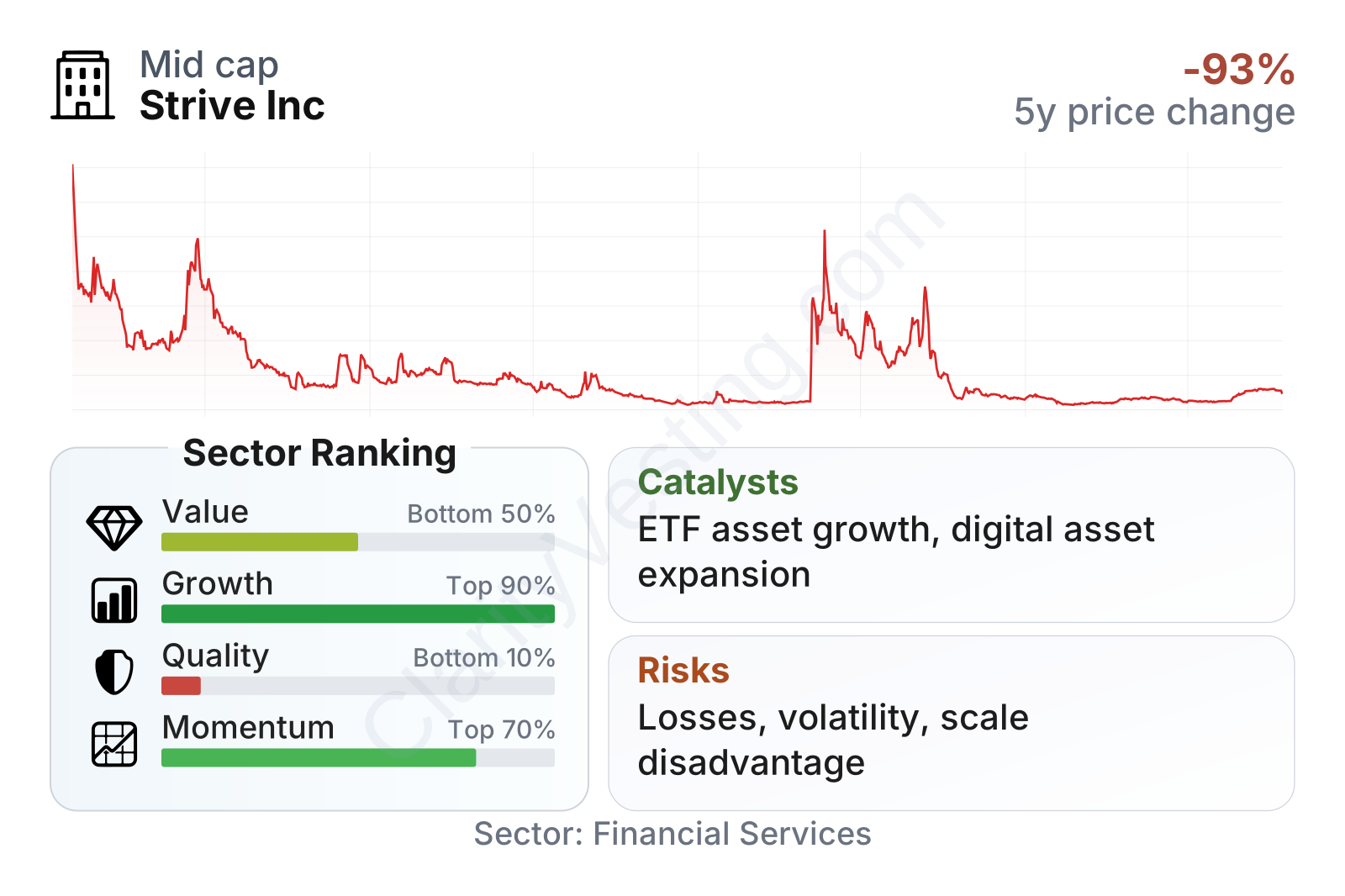
Strive screens as a mixed case. Growth metrics rank near the top of the sector because revenue has surged year over year and book value per share has risen sharply after a major reset in the capital structure. But quality metrics rank near the bottom, with negative profitability, negative free cash flow, and returns on equity and assets far below sector norms. The stock has also been extremely volatile, with a beta above 13 and large swings over short periods, which is unusual even among smaller financial stocks.
The share-price history reinforces that point. Since 2023, the stock has moved through several very steep rises and declines, including a sharp rebound in 2025 followed by another pullback into 2026. That kind of trading behavior usually signals a company where market expectations can change faster than business fundamentals.
Growth
Strive operates in a sector with real long-term potential. Asset management continues to benefit from the structural shift toward ETFs, lower-cost investment wrappers, and specialized products built around clear themes or strong brand identity. That gives emerging managers a path to growth if they can gather assets efficiently and stand out in a crowded market. Strive’s strategy makes sense in that context: build a recognizable platform, launch differentiated funds, and use publicity and corporate positioning to attract attention that would otherwise be difficult for a small manager to buy through scale alone.
A second growth angle comes from the company’s willingness to move into areas that are drawing capital and public interest, especially digital assets and politically differentiated financial products. If management can convert that attention into durable assets under management, the operating model could improve materially because fee revenue tends to scale better once distribution and product costs are covered.
Earnings still show that this scale benefit has not arrived yet. Losses have remained substantial, although the trend has improved from the worst levels. For a long-term assessment, the key question is less about near-term reported EPS and more about whether recurring fee revenue can grow fast enough to absorb the fixed cost base.
Book value per share has rebounded sharply after an earlier collapse, reflecting major balance-sheet changes rather than the kind of smooth compounding usually seen in mature financial firms. That improvement matters because it gives the company a firmer capital base, but it should not be read as proof that the underlying business model is already producing steady shareholder returns.
Recent public updates have kept Strive in the spotlight. The company has continued to announce strategic initiatives and product efforts aimed at expanding relevance beyond its original ETF lineup. For a smaller manager, that visibility can be a meaningful catalyst if it translates into faster asset gathering, partnerships, or broader distribution.
Risks
This article is for informational purposes only and does not constitute financial advice. Some content is AI-generated. See Disclaimer


