Stock Analysis · ASR Nederland N.V (ASRRF)
Overview
ASR Nederland N.V. is a Dutch financial services group focused mainly on insurance, asset management, pensions, and mortgages. Its core role is straightforward: it collects premiums and fees today, invests that money, and later pays claims, pension obligations, or other benefits. The company is primarily active in the Netherlands, which makes it easier to understand than large insurers spread across many continents, but it also means its fortunes are closely tied to Dutch households, businesses, regulation, and financial markets.
Its business mix is centered on life and non-life insurance, with additional income from pension administration, disability and income-protection products, asset management, and mortgage-related activities. After the acquisition of Aegon Nederland, the group became larger in Dutch pensions, life insurance, and distribution, strengthening its domestic scale.
Based on recent company reporting, ASR’s earnings and capital generation are broadly supported by the following activities, listed from largest to smaller strategic contributors. Exact percentages can shift meaningfully from year to year because insurers are affected by claims, investment results, and accounting valuation changes, but the operating mix is generally led by insurance and pension-related activities:
- Non-life insurance: approximately 30% to 40% of operating capital generation. This includes property and casualty insurance, disability, income protection, and health-related insurance activities.
- Life insurance: approximately 20% to 30%. This includes individual life policies, closed-book life products, and savings-related insurance.
- Pensions: approximately 20% to 25%. This covers defined contribution pensions, pension administration, and retirement solutions for employers and individuals.
- Asset management and related fees: approximately 5% to 10%. This includes managing customer and institutional assets and earning recurring management fees.
- Mortgages, banking, and distribution-related activities: approximately 5% to 10%. This includes mortgage origination, servicing, and intermediary distribution support.
The broad picture is that ASR is not a fast-moving technology business; it is a capital-intensive financial institution whose value depends on disciplined underwriting, investment management, cost control, and capital returns over long periods.
Revenue and profit have also been somewhat uneven in accounting terms, which is normal for insurers, but the longer trend points to a larger business following the Aegon Nederland integration. Revenue moved from roughly €9.8 billion in 2021 to about €17.9 billion in 2024, before declining to about €13.1 billion in 2025, while net income stayed positive in most years except for a sharp loss in 2022. That pattern suggests a business with substantial scale but also results that can swing with market conditions, finance costs, and insurance accounting effects.
The operating profile shows a larger company than it was a few years ago, but also one where reported revenue is not the best single measure of progress. For an insurer, capital generation, solvency, underwriting discipline, and book value development often matter more than top-line growth alone.
Key Figures
| Metric | Value | Sector ⓘ |
|---|---|---|
| Date | Oct 17, 2026 | |
| Context | ||
| Sector | Financial Services | |
| Industry | Insurance - Diversified | |
| Market Cap ⓘ | $16.97B | |
| Beta ⓘ | 0.51 | |
Value (Cheapness) | ||
| P/E Ratio ⓘ | 14.11 | 12.26 |
| P/B Ratio ⓘ | 1.65 | 1.23 |
| FCF Yield ⓘ | N/A | 10.40% |
| Dividend Yield ⓘ | 4.19% | 3.02% |
| EBIT / EV ⓘ | 5.85% | 8.14% |
| PEG ⓘ | N/A | |
Growth (Business expansion) | ||
| Revenue Growth ⓘ | 17.70% | 9.35% |
| RPS Growth (5Y CAGR) ⓘ | -3.00% | 12.19% |
| EPS Growth (5Y CAGR) ⓘ | -16.32% | -9.53% |
| BVPS Growth (5Y CAGR) ⓘ | -1.69% | 4.99% |
| Margin Growth (5Y Trend) ⓘ | 140.29% | -3.86% |
| FCF Growth (5Y CAGR) ⓘ | N/A | 4.81% |
| DPS Growth (5Y CAGR) ⓘ | 11.72% | 8.79% |
Quality (Business durability) | ||
| ROIC (Latest) ⓘ | N/A | 9.49% |
| ROE (Latest) ⓘ | N/A | 13.90% |
| ROA (Latest) ⓘ | N/A | 1.55% |
| ROIC (5Y Median) ⓘ | N/A | 7.86% |
| ROE (5Y Median) ⓘ | 10.06% | 12.17% |
| ROA (5Y Median) ⓘ | 0.66% | 1.30% |
| Net Debt / EBIT (Latest) ⓘ | N/A | 0.96 |
| Net Debt / EBIT (5Y Median) ⓘ | 1.29 | 0.73 |
| Net Debt / EBITDA (Latest) ⓘ | N/A | 0.92 |
| Operating Margin (Latest) ⓘ | N/A | 22.30% |
| Operating Margin (5Y Median) ⓘ | 25.29% | 24.63% |
| Debt to Equity (Latest) ⓘ | N/A | 58.56% |
| Profit Margin (Latest) ⓘ | 6.62% | 26.57% |
| Free Cash Flow (Latest) ⓘ | N/A | |
Momentum (Price trend) | ||
| 3Y Return ⓘ | +218.83% | +88.33% |
| 12M Return (excl. last month) ⓘ | +12.97% | +19.38% |
| 6M Return ⓘ | +21.11% | +4.75% |
| Price vs. 200-Day MA ⓘ | +17.19% | +3.50% |
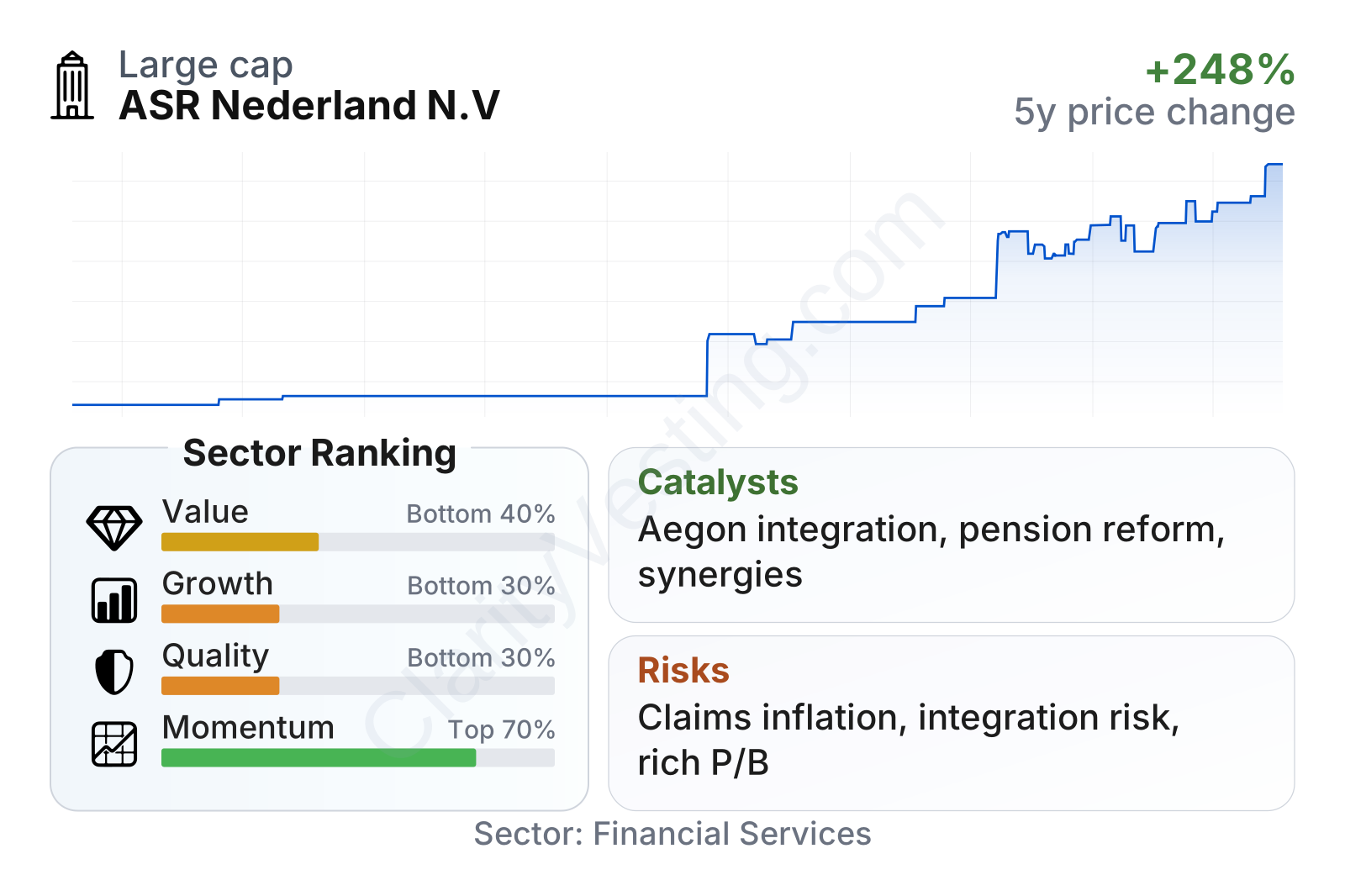
ASR stands out as a large insurer with relatively low share-price volatility, reflected in a beta well below 1. Its dividend yield is above the sector median, which fits the profile of a mature financial business returning capital to shareholders. At the same time, valuation is not especially cheap on standard measures: both earnings and book value multiples sit above the sector median, placing the stock in the weaker part of the sector on value.
The growth picture is mixed. Recent year-over-year revenue growth has been stronger than the sector median, but longer-term trends in earnings, revenue per share, and book value per share have been less impressive. That combination often points to a company that has expanded through acquisition and strategic repositioning, while still working through integration effects and accounting volatility.
Quality metrics also appear uneven. Operating margins over time have held up reasonably well and the long-term margin trend looks better than much of the sector, but profitability ratios such as return on equity and return on assets trail sector medians. Leverage is not alarming for an insurer, yet debt-related measures are not particularly conservative compared with peers. Momentum, however, has been strong: the share price has outperformed the sector clearly over three years and has stayed well above its long-term average trend.
Growth
ASR operates in a sector that is mature rather than explosive, but that does not mean growth is absent. Insurance, pensions, and retirement services benefit from durable demand: households need protection products, employers need pension solutions, and aging populations tend to increase the importance of retirement planning. In the Netherlands, stricter pension reform and the gradual shift toward defined-contribution-style arrangements create a meaningful opening for insurers and pension administrators with scale, trusted brands, and the ability to handle more complex administration.
ASR’s strategy is sensible for this environment. The company has focused on combining stable insurance earnings with fee-based activities such as pensions and asset management, while also integrating acquired businesses to broaden its customer base. The Aegon Nederland transaction is especially important because it increased scale in life insurance, pensions, mortgages, and distribution. For a domestic insurer, scale matters: it can improve pricing discipline, spread fixed costs, and strengthen bargaining power with intermediaries and service providers.
Another useful signal is book value per share. Even though the five-year growth rate is still slightly negative, the trend since 2022 has recovered steadily, indicating that balance-sheet value has been rebuilding after a difficult period for financial markets and insurance valuations.
If that rebuilding continues, it can support future capital flexibility, dividend capacity, and confidence in the group’s underlying economics. In addition, higher interest rates than the ultra-low-rate period of earlier years can be structurally helpful for many insurers, because new money can be invested at better yields, although the benefit is not immediate and can be offset by market-value swings.
Recent company updates have also pointed to ongoing synergy capture, simplification, and capital generation targets tied to the Aegon Nederland integration. For a long-term view, that is one of the clearest catalysts: if management delivers cost savings and cross-selling benefits without damaging underwriting discipline, the acquired scale could gradually translate into stronger returns rather than just bigger reported revenue.
Risks
This article is for informational purposes only and does not constitute financial advice. Some content is AI-generated. See Disclaimer


