Stock Analysis · Ascendis Pharma AS (ASND)
Overview
Ascendis Pharma is a biotechnology company focused on rare endocrine diseases. Its business is built around a drug development platform called TransCon, which is designed to release medicines in a controlled way over time. In practical terms, the company develops long-acting treatments that aim to improve convenience, dosing, and consistency compared with older therapies.
The company’s commercial base is now centered on endocrinology. Its lead product is SKYTROFA, a once-weekly growth hormone treatment for pediatric growth hormone deficiency. Ascendis is also advancing larger opportunities in hypoparathyroidism and achondroplasia, which are important because they could expand the company from a single-product commercial business into a broader rare-disease franchise.
Based on recent annual reporting, revenue is still concentrated in a small number of sources.
- Product revenue, mainly SKYTROFA: approximately 75% to 85%. This includes direct product sales and is the main driver of the company’s commercial transition.
- License, milestone, and collaboration-related revenue: approximately 15% to 25%. This can include partnership payments and other non-recurring items tied to development or commercial agreements.
That mix matters because recurring product sales are becoming more important than one-off collaboration income. Over the last several years, revenue expanded from a very small base to a much more meaningful level, while research and commercialization spending remained high as Ascendis continued building its pipeline and launch infrastructure.
The revenue base has grown sharply since 2021, and gross profit has scaled with it. The bigger issue has been operating expense: research and development remains heavy, and selling expenses have climbed as the company builds out commercialization. The broad direction is encouraging, though, because losses have narrowed as sales became large enough to absorb more of those costs.
Key Figures
| Metric | Value | Sector ⓘ |
|---|---|---|
| Date | Nov 21, 2026 | |
| Context | ||
| Sector | Healthcare | |
| Industry | Biotechnology | |
| Market Cap ⓘ | $17.37B | |
| Beta ⓘ | 0.48 | |
Value (Cheapness) | ||
| P/E Ratio ⓘ | 17.41 | 25.50 |
| P/B Ratio ⓘ | N/A | 4.14 |
| FCF Yield ⓘ | 3.27% | 2.68% |
| Dividend Yield ⓘ | N/A | 1.52% |
| EBIT / EV ⓘ | 1.55% | 2.99% |
| PEG ⓘ | N/A | |
Growth (Business expansion) | ||
| Revenue Growth ⓘ | 73.00% | 7.10% |
| RPS Growth (5Y CAGR) ⓘ | 199.41% | 8.61% |
| EPS Growth (5Y CAGR) ⓘ | N/A | -10.82% |
| BVPS Growth (5Y CAGR) ⓘ | N/A | 3.59% |
| Margin Growth (5Y Trend) ⓘ | N/A | -0.63% |
| FCF Growth (5Y CAGR) ⓘ | N/A | 1.59% |
| DPS Growth (5Y CAGR) ⓘ | N/A | 6.65% |
Quality (Business durability) | ||
| ROIC (Latest) ⓘ | 12.16% | 5.62% |
| ROA (Latest) ⓘ | 47.75% | 2.70% |
| ROIC (5Y Median) ⓘ | -41.72% | 4.51% |
| ROA (5Y Median) ⓘ | -37.71% | 1.78% |
| Net Debt / EBIT (Latest) ⓘ | -2.14 | 1.33 |
| Net Debt / EBIT (5Y Median) ⓘ | N/A | 2.00 |
| Net Debt / EBITDA (Latest) ⓘ | -1.99 | 0.99 |
| Net Debt / Assets ⓘ | -21.28% | 6.14% |
| EBITDA / Interest ⓘ | 1.66 | 9.65 |
| Operating Margin (Latest) ⓘ | 20.00% | 9.28% |
| Operating Margin (5Y Median) ⓘ | -161.25% | 7.24% |
| Debt to Equity (Latest) ⓘ | 29.84% | 28.47% |
| Profit Margin (Latest) ⓘ | 72.88% | 3.67% |
| Free Cash Flow (Latest) ⓘ | $567.36M | |
Momentum (Price trend) | ||
| 3Y Return ⓘ | +169.55% | +38.93% |
| 12M Return (excl. last month) ⓘ | +19.10% | +13.18% |
| 6M Return ⓘ | +2.11% | +10.51% |
| Price vs. 200-Day MA ⓘ | +4.91% | +3.72% |
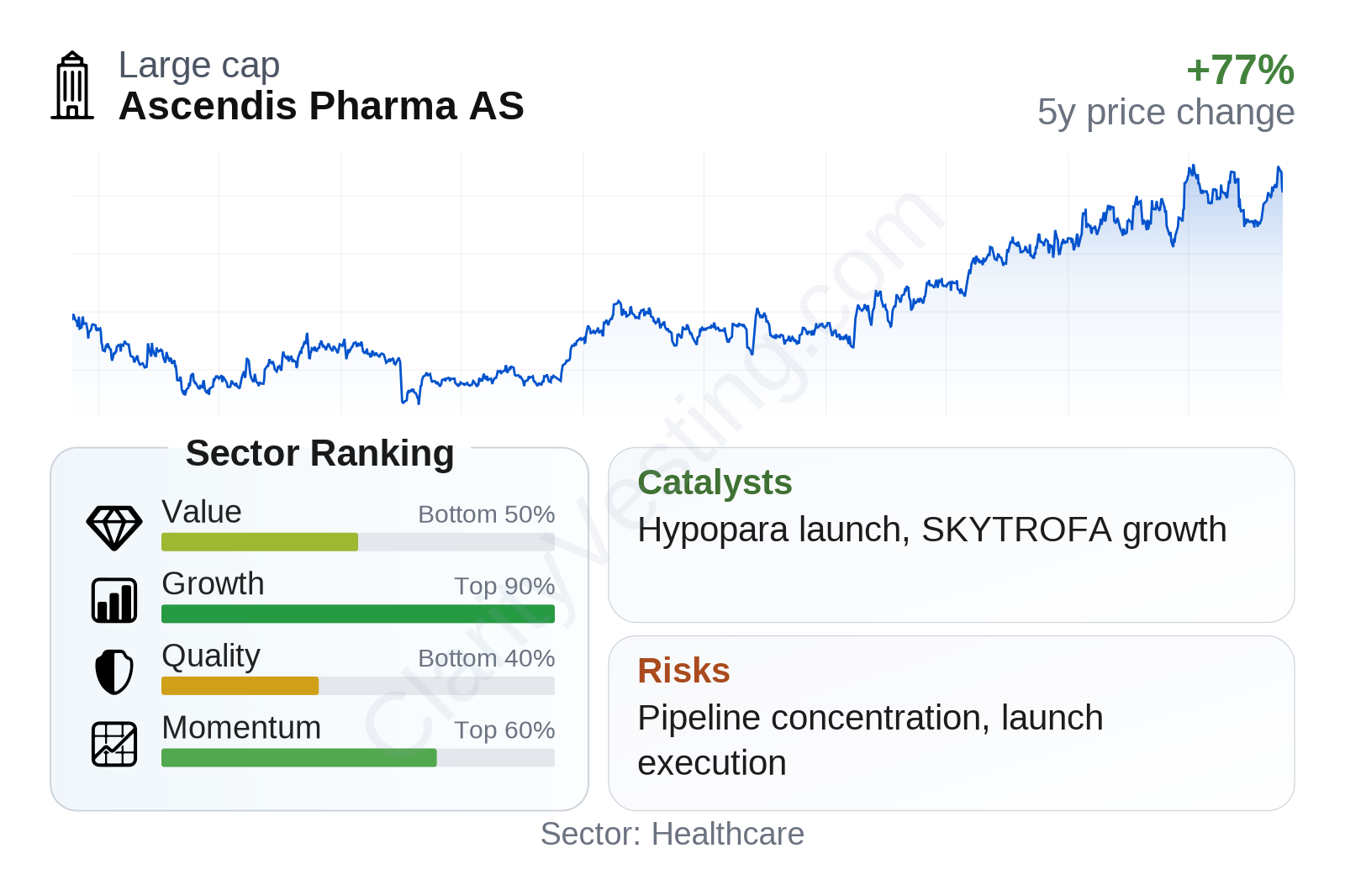
Ascendis now sits in an unusual position for a biotech company: growth ranks near the top of its sector, while profitability and balance sheet indicators are improving but still reflect a business that only recently began to scale. The valuation profile is not especially cheap on operating earnings, yet free cash flow generation has turned more favorable than the sector median. Share price performance over the last three years has been strong, but the path has been volatile, which is typical for a company whose outlook depends heavily on drug launches, clinical progress, and regulatory events.
The stock’s beta is relatively low, but that should not be confused with low business risk. Drug development companies often react more to company-specific milestones than to broad market moves. Ascendis has also grown into a large-cap biotech name, which gives it more market visibility than many smaller clinical-stage peers.
Growth
Ascendis operates in one of the more attractive parts of healthcare for long-term business growth: rare-disease biotechnology. This area tends to benefit from high unmet medical need, specialist prescribing, premium pricing, and patient populations that are small but often durable once treatment is established. Endocrine rare diseases are particularly appealing because treatment can be chronic, outcomes can be measurable, and physician education can create strong commercial positioning over time.
The company’s strategy is coherent. Rather than trying to compete across many unrelated fields, it has concentrated on applying the same delivery technology to endocrine disorders where longer-acting treatment can offer a clear practical benefit. That gives Ascendis a platform approach rather than a one-asset model, which is important because it may allow multiple products to share scientific know-how, manufacturing capabilities, and specialist commercial infrastructure.
Revenue growth has been exceptional over the last several years, although the path has not been smooth quarter to quarter. The latest year-over-year growth rate remains far above the healthcare sector median, even after the company moved beyond the earliest launch phase. That suggests growth is no longer only a tiny-base effect; it is increasingly tied to commercial traction.
Cash generation is another major shift. Free cash flow was deeply negative for years, which is common for a biotech moving from development into launch. More recently, the trend improved sharply and turned positive on a trailing basis. That does not eliminate funding risk, but it changes the discussion: Ascendis is no longer purely a cash-burning pipeline company and is starting to show signs of self-funding capacity.
The main growth catalysts are tied to execution in key endocrine franchises. SKYTROFA still has room to expand through greater physician adoption and geographic reach. Beyond that, the company’s largest opportunity appears to be in hypoparathyroidism, where a successful launch could materially increase revenue scale and diversify the business beyond growth hormone deficiency. Additional development progress in achondroplasia also matters because it could open another meaningful market and reinforce the value of the TransCon platform.
Recent company communications have also pointed to continued regulatory and commercial progress across these programs. For a business like Ascendis, major inflection points often come from approvals, label expansion, reimbursement wins, and evidence that a treatment can move from specialist enthusiasm to broader routine use.
Risks
This article is for informational purposes only and does not constitute financial advice. Some content is AI-generated. See Disclaimer