Stock Analysis · Ategrity Specialty Insurance Company Holdings (ASIC)
Overview
Ategrity Specialty Insurance Company Holdings is a U.S. specialty property and casualty insurer. In simple terms, it focuses on harder-to-insure commercial risks where pricing is usually more customized than in mass-market insurance. The company operates through a network of wholesale brokers and selected distribution partners, writing policies for small and mid-sized businesses in niche areas where underwriting discipline matters more than scale alone.
The business model is centered on earning underwriting profit from premiums and generating investment income from the insurance float, which is the pool of premiums held before claims are paid. Like many insurers, results depend on pricing discipline, claims experience, reserve accuracy, and the return generated on invested assets.
Based on recent company filings, Ategrity’s revenue mix is heavily concentrated in insurance operations, with a smaller contribution from invested assets.
- Net premiums earned: approximately 90% to 95% of total revenue. This is the core business and reflects premium revenue recognized over the life of policies written across its specialty commercial lines.
- Net investment income: approximately 5% to 10% of total revenue. This mainly comes from the company’s bond-heavy investment portfolio funded by insurance float.
- Other insurance-related income: a small residual share when present, typically linked to commission-related items, fee-related activity, or accounting adjustments depending on the reporting period.
The most notable business trend is that Ategrity has been scaling quickly while also improving profitability. Revenue rose strongly from 2023 through 2025, and earnings expanded even faster, which suggests that growth has not come only from writing more business, but also from better margins.
The income flow shows a meaningful shift over the last three years: revenue increased sharply, underwriting costs became a smaller share of revenue, and operating profit widened substantially. That combination is important for an insurer because it signals that growth has recently come with improving economics rather than with obvious margin sacrifice.
Key Figures
| Metric | Value | Sector ⓘ |
|---|---|---|
| Date | Oct 17, 2026 | |
| Context | ||
| Sector | Financial Services | |
| Industry | Insurance - Property & Casualty | |
| Market Cap ⓘ | $1.25B | |
| Beta ⓘ | N/A | |
Value (Cheapness) | ||
| P/E Ratio ⓘ | 12.18 | 12.26 |
| P/B Ratio ⓘ | 2.03 | 1.23 |
| FCF Yield ⓘ | 13.55% | 10.40% |
| Dividend Yield ⓘ | N/A | 3.02% |
| EBIT / EV ⓘ | 11.64% | 8.14% |
| PEG ⓘ | N/A | |
Growth (Business expansion) | ||
| Revenue Growth ⓘ | 45.90% | 9.35% |
| RPS Growth (5Y CAGR) ⓘ | 35.73% | 12.19% |
| EPS Growth (5Y CAGR) ⓘ | N/A | -9.53% |
| BVPS Growth (5Y CAGR) ⓘ | 41.49% | 4.99% |
| Margin Growth (5Y Trend) ⓘ | 16.77% | -3.86% |
| FCF Growth (5Y CAGR) ⓘ | 17.97% | 4.81% |
| DPS Growth (5Y CAGR) ⓘ | 316.29% | 8.79% |
Quality (Business durability) | ||
| ROIC (Latest) ⓘ | 18.38% | 9.49% |
| ROE (Latest) ⓘ | 17.16% | 13.90% |
| ROA (Latest) ⓘ | 7.51% | 1.55% |
| ROIC (5Y Median) ⓘ | N/A | 7.86% |
| ROE (5Y Median) ⓘ | N/A | 12.17% |
| ROA (5Y Median) ⓘ | N/A | 1.30% |
| Net Debt / EBIT (Latest) ⓘ | -0.22 | 0.96 |
| Net Debt / EBIT (5Y Median) ⓘ | -0.39 | 0.73 |
| Net Debt / EBITDA (Latest) ⓘ | -0.22 | 0.92 |
| Operating Margin (Latest) ⓘ | 27.87% | 22.30% |
| Operating Margin (5Y Median) ⓘ | 19.87% | 24.63% |
| Debt to Equity (Latest) ⓘ | 0.27% | 58.56% |
| Profit Margin (Latest) ⓘ | 20.67% | 26.57% |
| Free Cash Flow (Latest) ⓘ | $169.97M | |
Momentum (Price trend) | ||
| 3Y Return ⓘ | N/A | +88.33% |
| 12M Return (excl. last month) ⓘ | +39.87% | +19.38% |
| 6M Return ⓘ | +31.14% | +4.75% |
| Price vs. 200-Day MA ⓘ | +21.82% | +3.50% |
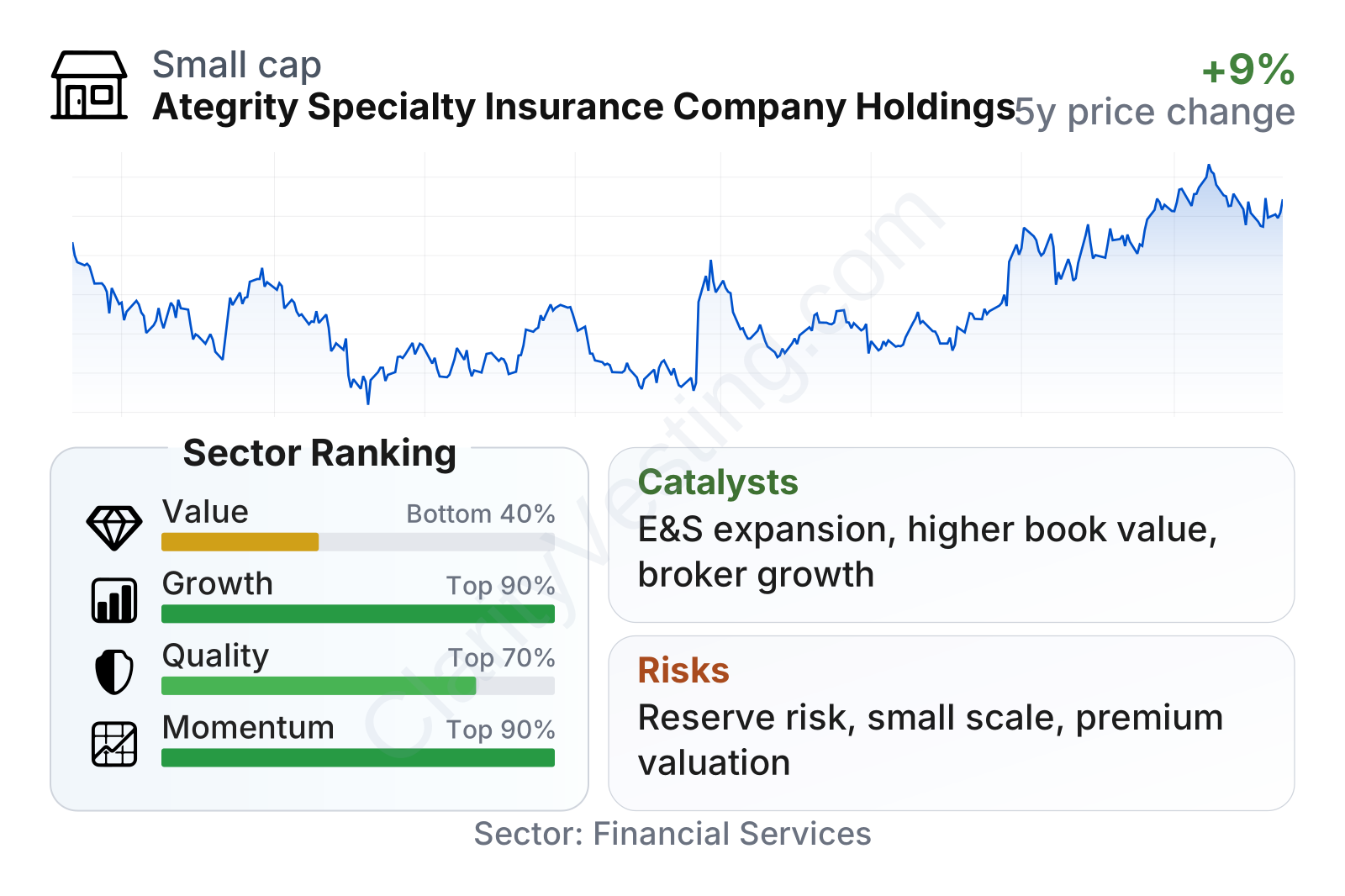
Ategrity sits in the upper tier of the sector on growth and above average on quality and momentum, while its value profile is more mixed. Revenue growth, book value growth, and cash generation stand out versus most property and casualty peers. Profitability metrics are also solid, with returns on equity and assets above sector medians. The main trade-off is valuation: the earnings multiple is not stretched, but the stock trades at a noticeable premium to sector book value, which means the market is already recognizing part of the recent improvement.
Growth
Specialty property and casualty insurance remains an attractive area for growth because it serves fragmented markets that often require underwriting expertise rather than broad consumer brand recognition. In these niches, insurers can benefit when market pricing stays firm and when competitors pull back from lines with volatile claims. That backdrop tends to favor focused operators like Ategrity, especially when they can expand through broker relationships without building a large retail distribution footprint.
Ategrity’s strategy appears coherent for future growth. The company has been increasing written business, deepening specialty distribution, and converting that expansion into higher profitability. Over the last several years, revenue per share and book value per share have risen far faster than the sector median, indicating that growth has not been driven only by issuing more shares or relying on leverage.
The earnings trend shows that profitability stepped up materially into 2025 and has remained at a higher level through 2026. Even with some normalization after the year-end peak, the earnings base is still well above where the company stood earlier in its development, which supports the view that Ategrity has moved into a stronger operating phase.
Book value per share has compounded rapidly, rising from roughly the mid-$6 range in 2023 to above $13 by 2025. For an insurer, this is a key sign of value creation because book value captures retained earnings and capital growth over time. Fast expansion in book value usually matters most when it comes from profitable underwriting rather than financial engineering, and Ategrity’s margin improvement points in that direction.
A meaningful catalyst is the combination of rising scale and still-modest company size. With a market value around the small-cap range, Ategrity has more room to grow than large incumbents if it continues adding business while preserving underwriting standards. Another support is higher interest income relative to the near-zero-rate years, since insurers generally benefit when new cash can be invested at better yields.
Recent public company communications have also pointed to continued operating momentum in 2026, with profitability and returns remaining strong. For a specialty insurer, that matters because sustained underwriting performance is often a stronger growth signal than premium growth alone.
Risks
This article is for informational purposes only and does not constitute financial advice. Some content is AI-generated. See Disclaimer


