Stock Analysis · Ascletis Pharma Inc (ASCLF)
Overview
Ascletis Pharma Inc is a biotechnology company focused on discovering and developing new medicines, with current attention centered on metabolic disease, especially obesity, and certain antiviral programs. The company was originally known for commercializing hepatitis C therapies in China, but its business profile has changed sharply in recent years. It now looks much more like a clinical-stage drug developer than a traditional revenue-generating pharmaceutical company.
That shift matters for long-term analysis. Ascletis is no longer mainly judged by current product sales. Instead, its value increasingly depends on whether its research pipeline can produce successful clinical results, partnerships, and eventually approved products in large markets.
Based on recent annual reporting, revenue has become very small and uneven. The main sources are limited product-related sales and other operating income, while the company’s spending is dominated by research and development rather than commercial activity. In practical terms, the business mix appears to be:
- Product sales and related pharmaceutical revenue: historically the core source of income, including antiviral products and commercialization-related receipts; this source has fallen dramatically and remains the main operating revenue category only because total revenue is now very low.
- Other income and non-core items: items such as grants, interest, and accounting-related contributions can materially affect reported results in some periods, but they are not a stable business engine.
- Pipeline value not yet reflected in revenue: obesity and metabolic candidates are strategically the most important assets, but they are still development-stage programs rather than current revenue contributors.
The financial flow over the last several years shows a company moving away from a shrinking commercial base and toward a research-heavy model. Revenue has collapsed from tens of millions a few years ago to a very low level, while research spending has expanded substantially. That creates a high-risk, high-dependence setup around clinical execution.
The operating picture is defined by very limited sales and very large research expenses. Research and development has consistently been the largest use of cash, and in the latest period it outweighed revenue by a very wide margin, which is typical of an early-stage biotech but also explains the company’s persistent losses.
Key Figures
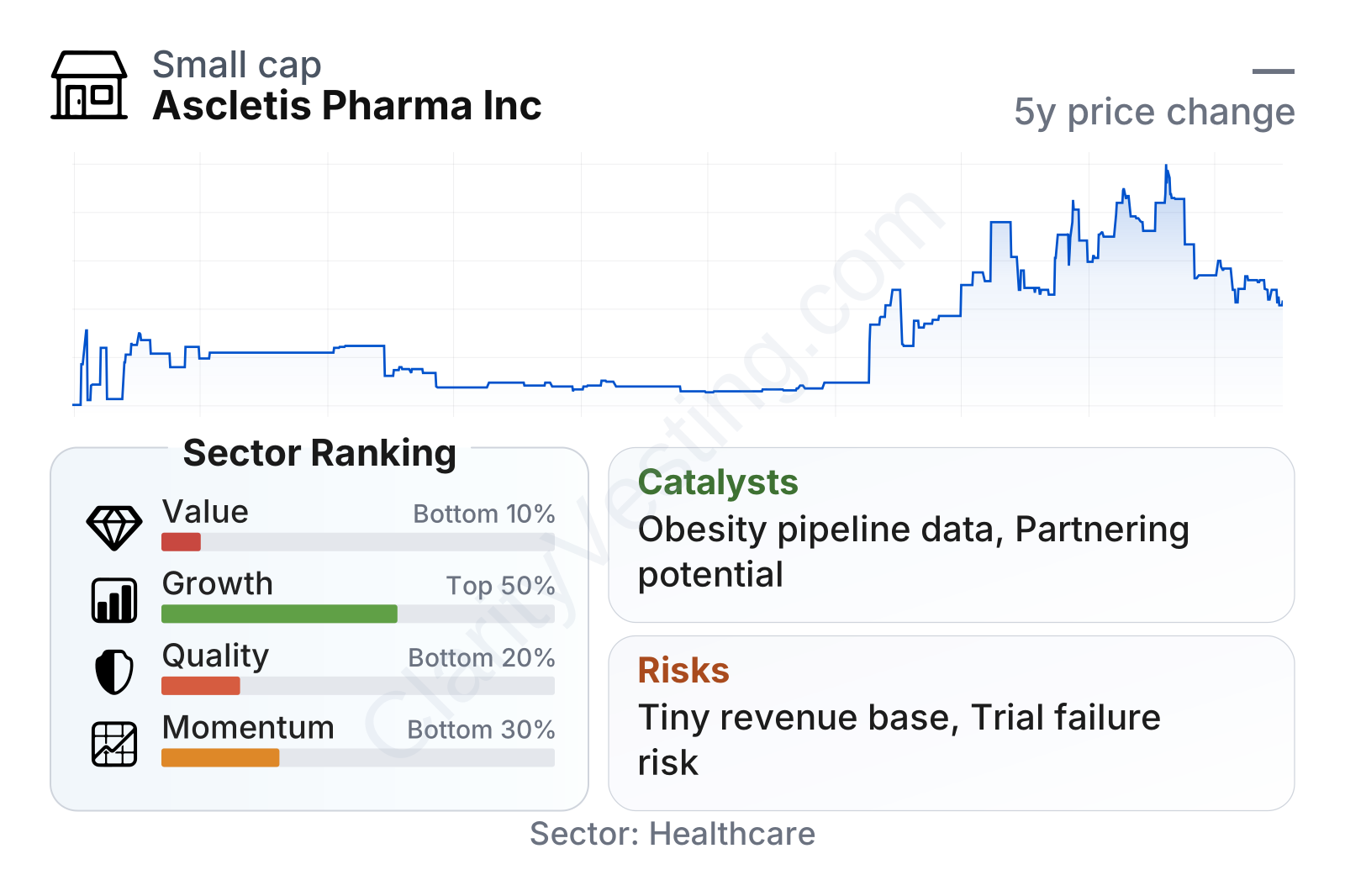
The share price history reflects a very volatile biotechnology profile. After trading at very low levels in earlier periods, the stock rebounded strongly through 2025 and into early 2026 before pulling back. Even after that retreat, the longer three-year move remains exceptionally strong relative to much of the healthcare sector, but shorter-term momentum has weakened noticeably.
| Metric | Value | Sector ⓘ |
|---|---|---|
| Date | Oct 17, 2026 | |
| Context | ||
| Sector | Healthcare | |
| Industry | Biotechnology | |
| Market Cap ⓘ | $1.09B | |
| Beta ⓘ | 0.43 | |
Value (Cheapness) | ||
| P/E Ratio ⓘ | N/A | 24.79 |
| P/B Ratio ⓘ | 0.50 | 3.08 |
| FCF Yield ⓘ | -72.79% | 3.15% |
| Dividend Yield ⓘ | N/A | 1.94% |
| EBIT / EV ⓘ | N/A | 0.57% |
| PEG ⓘ | N/A | |
Growth (Business expansion) | ||
| Revenue Growth ⓘ | -26.20% | 7.45% |
| RPS Growth (5Y CAGR) ⓘ | -58.73% | 8.61% |
| EPS Growth (5Y CAGR) ⓘ | -15.54% | -17.81% |
| BVPS Growth (5Y CAGR) ⓘ | -5.42% | 3.72% |
| Margin Growth (5Y Trend) ⓘ | N/A | -0.62% |
| FCF Growth (5Y CAGR) ⓘ | N/A | 1.04% |
| DPS Growth (5Y CAGR) ⓘ | 7.54% | 6.77% |
Quality (Business durability) | ||
| ROIC (Latest) ⓘ | N/A | 3.24% |
| ROA (Latest) ⓘ | -32.33% | 3.01% |
| ROIC (5Y Median) ⓘ | -7.38% | 4.60% |
| ROA (5Y Median) ⓘ | -11.48% | 1.89% |
| Net Debt / EBIT (Latest) ⓘ | N/A | 1.34 |
| Net Debt / EBIT (5Y Median) ⓘ | N/A | 1.84 |
| Net Debt / EBITDA (Latest) ⓘ | N/A | 1.00 |
| Net Debt / Assets ⓘ | -24.05% | 5.45% |
| EBITDA / Interest ⓘ | N/A | 9.64 |
| Operating Margin (Latest) ⓘ | N/A | 9.27% |
| Operating Margin (5Y Median) ⓘ | -581.78% | 7.38% |
| Debt to Equity (Latest) ⓘ | 0.16% | 28.58% |
| Profit Margin (Latest) ⓘ | N/A | 3.59% |
| Free Cash Flow (Latest) ⓘ | -$794.79M | |
Momentum (Price trend) | ||
| 3Y Return ⓘ | +358.18% | +42.80% |
| 12M Return (excl. last month) ⓘ | -31.58% | +18.50% |
| 6M Return ⓘ | -48.10% | +7.57% |
| Price vs. 200-Day MA ⓘ | -33.03% | +5.12% |
Ascletis currently sits in an unusual position. On traditional valuation measures, the stock looks optically cheap on book value, trading at roughly 0.5 times book versus a sector median above 3 times. But that low multiple comes with major caveats: the company is loss-making, free cash flow is deeply negative, and revenue has been contracting rather than expanding. In other words, the discount reflects weak current fundamentals, not proven earnings power.
Quality measures are also weak. Returns on assets are sharply negative, operating margins have been deeply below sector norms, and free cash flow remains heavily negative. One bright spot is the balance sheet structure: debt is almost negligible, and net cash appears meaningful relative to assets. That gives the company more flexibility than many small biotech peers that rely heavily on borrowing.
Growth indicators are mixed. Recent revenue trends are poor, including a year-over-year decline and a deeply negative five-year revenue-per-share trend. However, this can be misleading for a pipeline biotech because reported sales no longer capture the main economic objective. The market is effectively looking past shrinking legacy revenue and focusing on whether the pipeline can create future value.
Growth
Ascletis operates in one of the most active parts of biotechnology. Obesity and related metabolic disease have become major industry targets because they affect very large patient populations and have already produced blockbuster drugs for leading companies. That means the sector itself is attractive, with substantial medical demand, commercial potential, and ongoing partnership interest across the industry.
The company’s strategy broadly makes sense in that context. Rather than trying to rebuild a declining antiviral sales base, Ascletis has redirected resources toward proprietary candidates in obesity and metabolic disease, including oral small-molecule approaches. If successful, that could be strategically important because the current obesity market is dominated by injectable drugs, and the industry remains highly interested in oral alternatives, combinations, and next-generation mechanisms.
A key catalyst is clinical progress. For a company like Ascletis, value creation usually comes from trial data, regulatory milestones, and licensing partnerships rather than quarterly sales growth. Public company communications in 2026 have highlighted continued advancement of obesity-focused assets, including candidate development and study-related updates. Any convincing human data showing competitive efficacy, safety, or convenience could have outsized importance because the addressable market is so large.
Another supportive factor is financial structure. Although profitability is weak, the company’s very low leverage reduces one common biotech risk. It gives Ascletis more room to keep funding trials, seek partnerships, or adjust priorities without the same debt pressure that can affect more leveraged peers.
The recent rise in the stock over the multi-year period suggests the market has already started assigning value to this strategic pivot. That does not confirm success, but it does show that Ascletis is no longer being evaluated mainly as a shrinking legacy commercial company. It is increasingly being priced as a pipeline-driven biotechnology name with exposure to one of the hottest therapeutic markets.
Risks
This article is for informational purposes only and does not constitute financial advice. Some content is AI-generated. See Disclaimer


