Stock Analysis · Associated British Foods plc (ASBFF)
Overview
Associated British Foods plc is a diversified consumer staples group with activities that stretch well beyond packaged food. The company owns grocery brands, produces sugar, supplies ingredients to food manufacturers, runs an agriculture business, and controls Primark, a large value-fashion retailer. This mix makes ABF unusual: part of the business looks like a traditional defensive food company, while a large part is tied to apparel retail and consumer spending trends.
In the latest annual reporting period, Primark remained the biggest contributor to group sales, while the food and agriculture operations provided diversification across products and geographies. Based on the company’s segment reporting, revenue is roughly split as follows:
- Retail (Primark): about 39% — value clothing, accessories, beauty, and homeware sold through physical stores across Europe and the U.S.
- Grocery: about 20% — branded and private-label foods, including tea, oils, cereals, bakery, ethnic foods, and other pantry staples.
- Sugar: about 14% — sugar production and related operations in Europe, Africa, and other markets.
- Ingredients: about 13% — yeast, enzymes, bakery ingredients, and specialty ingredients supplied to food and industrial customers.
- Agriculture: about 13% — animal feed and related products, mainly serving farming customers.
This structure gives ABF more than one earnings engine. It also means the company is not driven by a single product cycle, although Primark’s performance has an outsized influence on sentiment because it is the largest business and one of the clearest long-term growth platforms inside the group.
Over the last several years, revenue has expanded strongly, and gross profit has grown even faster than sales, showing better pricing and mix. Operating income also improved materially from 2021 through 2024, though 2025 shows some moderation in profitability despite another step up in revenue, suggesting that margin pressure has not disappeared.
Key Figures
| Metric | Value | Sector ⓘ |
|---|---|---|
| Date | Oct 24, 2026 | |
| Context | ||
| Sector | Consumer Defensive | |
| Industry | Packaged Foods | |
| Market Cap ⓘ | $20.28B | |
| Beta ⓘ | 0.81 | |
Value (Cheapness) | ||
| P/E Ratio ⓘ | 16.31 | 18.68 |
| P/B Ratio ⓘ | 1.47 | 1.24 |
| FCF Yield ⓘ | 12.54% | 12.11% |
| Dividend Yield ⓘ | 2.22% | 2.67% |
| EBIT / EV ⓘ | N/A | 6.40% |
| PEG ⓘ | 2.54 | |
Growth (Business expansion) | ||
| Revenue Growth ⓘ | -0.40% | 4.10% |
| RPS Growth (5Y CAGR) ⓘ | 19.73% | 6.22% |
| EPS Growth (5Y CAGR) ⓘ | -25.53% | -13.59% |
| BVPS Growth (5Y CAGR) ⓘ | 4.71% | 3.27% |
| Margin Growth (5Y Trend) ⓘ | 0.90% | -0.13% |
| FCF Growth (5Y CAGR) ⓘ | 18.32% | 4.10% |
| DPS Growth (5Y CAGR) ⓘ | 110.51% | 6.83% |
Quality (Business durability) | ||
| ROIC (Latest) ⓘ | N/A | 12.34% |
| ROA (Latest) ⓘ | N/A | 6.30% |
| ROIC (5Y Median) ⓘ | 10.68% | 10.53% |
| ROA (5Y Median) ⓘ | 5.41% | 5.44% |
| Net Debt / EBIT (Latest) ⓘ | 0.96 | 1.98 |
| Net Debt / EBIT (5Y Median) ⓘ | 1.40 | 2.35 |
| Net Debt / EBITDA (Latest) ⓘ | 0.59 | 1.38 |
| Net Debt / Assets ⓘ | 15.42% | 21.70% |
| EBITDA / Interest ⓘ | 16.44 | 9.49 |
| Operating Margin (Latest) ⓘ | 8.07% | 8.88% |
| Operating Margin (5Y Median) ⓘ | 7.41% | 9.57% |
| Debt to Equity (Latest) ⓘ | 32.63% | 72.35% |
| Profit Margin (Latest) ⓘ | 4.89% | 5.40% |
| Free Cash Flow (Latest) ⓘ | $2.54B | |
Momentum (Price trend) | ||
| 3Y Return ⓘ | +9.67% | +24.53% |
| 12M Return (excl. last month) ⓘ | -6.57% | +1.93% |
| 6M Return ⓘ | +1.29% | +1.61% |
| Price vs. 200-Day MA ⓘ | -6.01% | +2.99% |
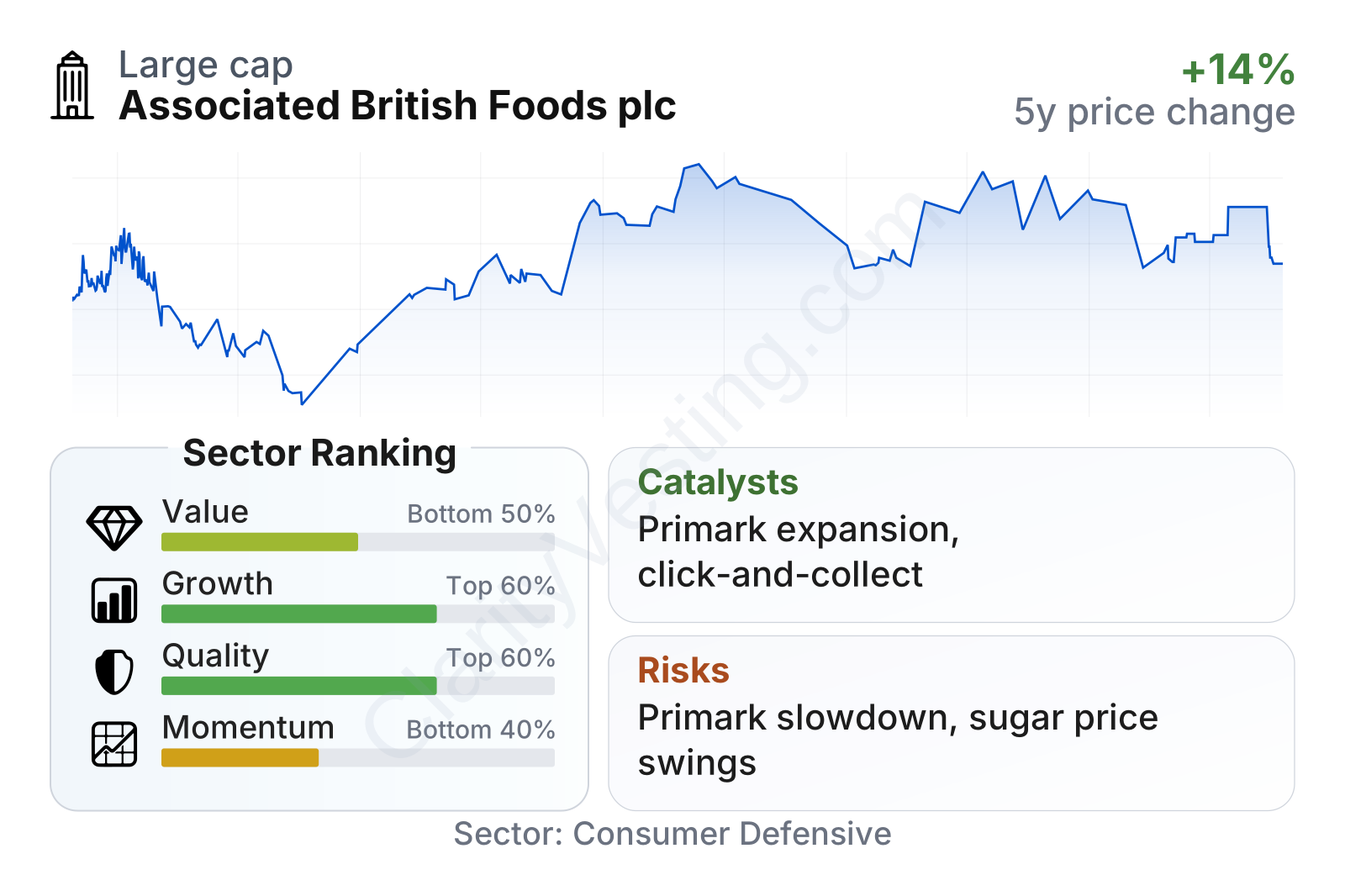
ABF is a large-cap business with relatively low share-price volatility, which fits its mix of consumer staples and everyday retail. On valuation, the earnings multiple sits a bit below the sector median, but the price-to-book ratio is above the median, so the picture is mixed rather than obviously cheap. Cash generation stands out more clearly: free cash flow yield is around the sector norm, yet absolute free cash flow is strong for a company of this size.
Growth metrics are uneven in the short term but stronger over a longer horizon. Recent year-over-year revenue was slightly negative, while five-year revenue per share and free cash flow growth have been much stronger than the sector median. Profitability quality looks solid overall, especially on leverage and interest coverage, even if margins remain somewhat below the better operators in the sector. Market performance has also been mixed: the last year has been softer, but the six-month and three-year picture is better.
Growth
ABF operates in a combination of mature and still-expandable markets. Its food, ingredients, sugar, and agriculture divisions are mostly tied to essential consumption, which usually means slower but steadier long-term demand. The more visible growth engine is Primark, where the company is still adding stores, entering new locations, and broadening categories such as beauty, kids, home, and digital customer engagement.
That strategy makes industrial sense. Primark has a value positioning that can be resilient when consumers are under pressure, and it still has room to scale in the U.S. and continental Europe. Unlike many apparel chains, Primark has historically relied heavily on physical stores, so newer work on click-and-collect and digital traffic could help support sales productivity without fully changing the low-cost model that defines the brand.
Outside retail, the ingredients business also offers a more attractive growth profile than commodity food lines because specialty ingredients tend to benefit from food innovation, formulation changes, and demand for efficiency in food manufacturing. This is not as visible as store openings, but it can support margin quality over time.
One important point for long-term analysis is that ABF is not dependent on one single growth theme. Expansion at Primark, recovery or normalization in sugar, and steady demand in grocery and ingredients can each contribute at different times. That reduces reliance on any one cycle, although it can also make the investment case look less straightforward than a pure-play retailer or pure-play branded food company.
Recent corporate updates have continued to emphasize Primark expansion and investment in customer convenience tools. If execution remains disciplined, that is one of the clearest opportunities in the group because additional store density can drive scale benefits in sourcing and overhead absorption.
Risks
This article is for informational purposes only and does not constitute financial advice. Some content is AI-generated. See Disclaimer


