Stock Analysis · Aryzta AG PK (ARZTY)
Overview
Aryzta AG is a specialty bakery group that supplies baked goods to foodservice operators, quick-service restaurants, convenience channels, retail customers, and industrial partners. In simple terms, it is a large business-to-business bakery platform: it makes bread, buns, pizza products, pastries, and other baked items, often sold frozen or partially baked so customers can finish them fresh in store or on site. The company has a strong footprint in Europe, with additional exposure to Asia, Australia, and New Zealand through its international activities.
The business has become more focused in recent years after a long restructuring period. Today, the core idea is scale in specialty bakery production, close relationships with major chain customers, and operational efficiency across manufacturing and distribution. That matters because bakery is a high-volume, low-margin category where cost control, plant utilization, and reliable delivery can strongly affect profitability.
Public company materials indicate that revenue is mainly generated from geographic operating segments rather than a long list of separately disclosed product lines. Based on recent annual reporting, the largest sources of revenue are approximately:
- Europe – about 80% to 85%: the company’s largest activity, covering bakery products sold to foodservice, retail, and convenience customers across several European markets.
- Rest of World – about 15% to 20%: primarily operations in Asia-Pacific and selected international markets, including products for foodservice and retail channels.
Within those segments, the revenue mix is supported by everyday staple bakery categories such as artisan breads, buns, rolls, croissants, sweet baked goods, pizza bases, and other convenience-led products. The broad takeaway is that Aryzta is not built around a single niche item; it is built around supplying recurring bakery demand at scale.
The profit flow has improved substantially since 2022. Revenue expanded from roughly $1.8 billion in fiscal 2022 to above $2.1 billion in fiscal 2025, while gross profit grew much faster than sales, showing better pricing and mix. Operating income also rose materially from a modest level in 2022 to much healthier levels afterward, although net income remains more exposed to financing costs and other below-operating-line items.
The broad financial pattern is encouraging: sales have been relatively stable to growing over the last few years, while gross profit improved much faster, suggesting that restructuring and pricing discipline have had a real effect. At the same time, interest expense still absorbs a noticeable portion of operating profit, which means balance-sheet discipline remains important.
Key Figures
| Metric | Value | Sector ⓘ |
|---|---|---|
| Date | Oct 17, 2026 | |
| Context | ||
| Sector | Consumer Defensive | |
| Industry | Packaged Foods | |
| Market Cap ⓘ | $1.24B | |
| Beta ⓘ | 0.38 | |
Value (Cheapness) | ||
| P/E Ratio ⓘ | 9.63 | 17.88 |
| P/B Ratio ⓘ | 2.62 | 1.29 |
| FCF Yield ⓘ | 28.24% | 12.39% |
| Dividend Yield ⓘ | N/A | 2.85% |
| EBIT / EV ⓘ | N/A | 6.43% |
| PEG ⓘ | N/A | |
Growth (Business expansion) | ||
| Revenue Growth ⓘ | -2.10% | 4.10% |
| RPS Growth (5Y CAGR) ⓘ | 173.45% | 6.18% |
| EPS Growth (5Y CAGR) ⓘ | N/A | -13.59% |
| BVPS Growth (5Y CAGR) ⓘ | 111.57% | 3.20% |
| Margin Growth (5Y Trend) ⓘ | 7.82% | -0.15% |
| FCF Growth (5Y CAGR) ⓘ | 384.50% | 4.10% |
| DPS Growth (5Y CAGR) ⓘ | 5.72% | 6.79% |
Quality (Business durability) | ||
| ROIC (Latest) ⓘ | N/A | 12.34% |
| ROA (Latest) ⓘ | N/A | 6.30% |
| ROIC (5Y Median) ⓘ | 11.14% | 10.49% |
| ROA (5Y Median) ⓘ | 5.53% | 5.44% |
| Net Debt / EBIT (Latest) ⓘ | 1.94 | 1.96 |
| Net Debt / EBIT (5Y Median) ⓘ | 3.37 | 2.35 |
| Net Debt / EBITDA (Latest) ⓘ | 1.13 | 1.38 |
| Net Debt / Assets ⓘ | 41.16% | 21.51% |
| EBITDA / Interest ⓘ | 6.95 | 9.46 |
| Operating Margin (Latest) ⓘ | 7.78% | 8.87% |
| Operating Margin (5Y Median) ⓘ | 7.20% | 9.53% |
| Debt to Equity (Latest) ⓘ | 193.16% | 72.35% |
| Profit Margin (Latest) ⓘ | 5.02% | 5.40% |
| Free Cash Flow (Latest) ⓘ | $350.19M | |
Momentum (Price trend) | ||
| 3Y Return ⓘ | -35.39% | +20.92% |
| 12M Return (excl. last month) ⓘ | -40.95% | +2.13% |
| 6M Return ⓘ | -36.94% | +1.26% |
| Price vs. 200-Day MA ⓘ | -32.26% | +1.39% |
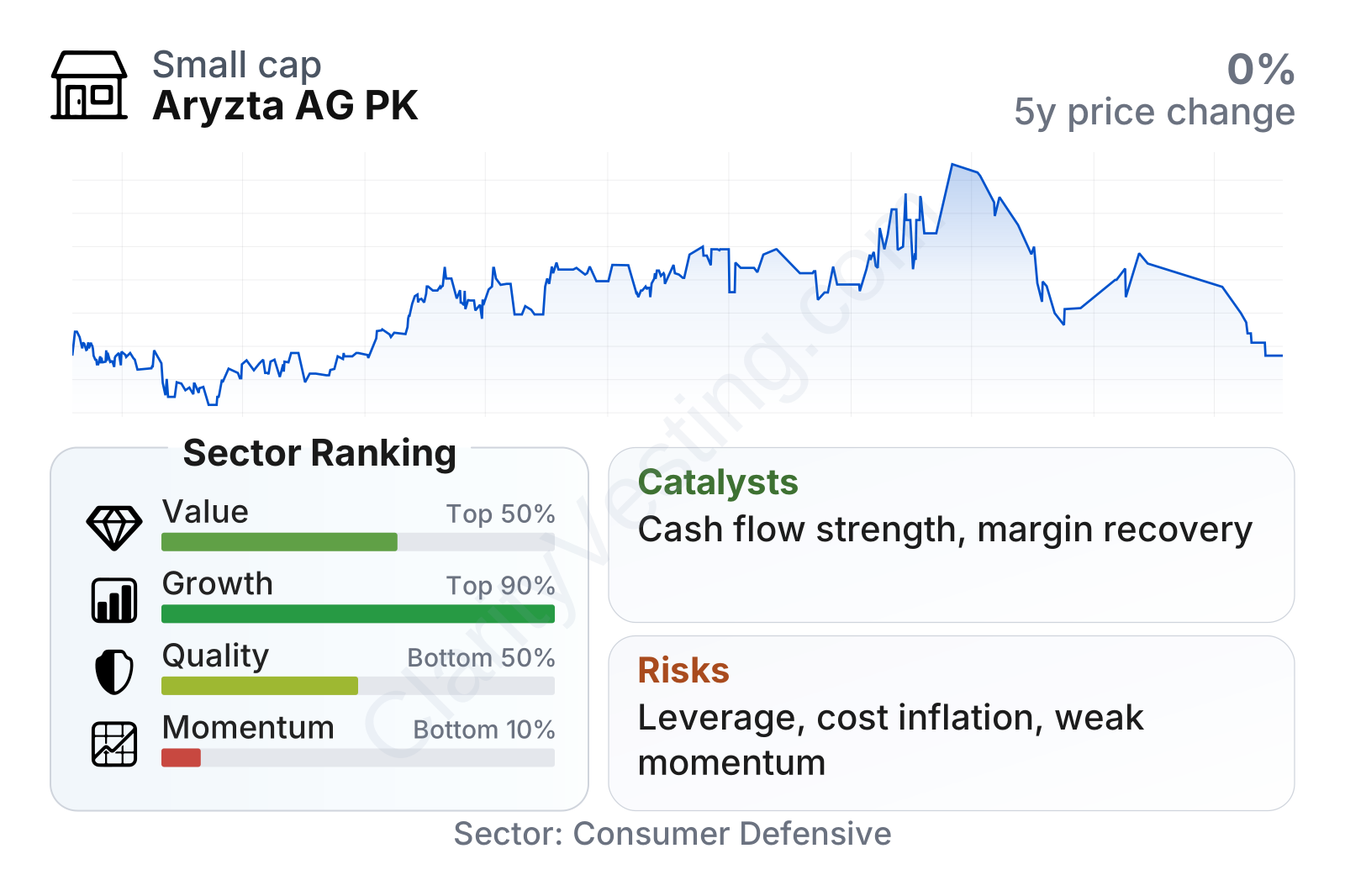
Aryzta’s profile is unusual at first glance. On valuation, the earnings multiple is below the sector median, while free-cash-flow yield is clearly stronger than many peers. That points to a company generating meaningful cash relative to its market value. On the other hand, the price-to-book ratio is above the sector median, so the stock does not look uniformly cheap on every measure.
Growth indicators are one of the stronger areas. Five-year trends in revenue per share, book value per share, free cash flow, and operating margin progression all compare well with much of the sector. The weak point is that the latest year-over-year revenue change was slightly negative, so the long-term improvement has recently lost some momentum.
Quality is more mixed. Profitability is acceptable but not outstanding versus packaged-food peers, and leverage remains elevated in some balance-sheet measures. Net debt to EBITDA is manageable, but debt to equity and net debt relative to assets are still high for a defensive food business. Interest coverage is positive, yet below the sector median, which limits flexibility if financing conditions worsen.
Market performance has been weak. The stock is far below its recent peak and sits well under its longer-term trend line. That poor momentum does not say much about the bakery business itself, but it does show that the market has become more cautious despite the company’s operational recovery. The low beta suggests the shares have not moved as violently as many stocks overall, but the longer decline shows that company-specific concerns remain present.
Growth
Aryzta operates in a sector that is mature but still attractive for long-term demand. Bakery is not a fast-changing technology market, yet it benefits from repeat consumption, convenience trends, foodservice recovery, premiumization in fresh-style products, and the outsourcing of bakery production by retailers and restaurant chains. That creates a useful backdrop for a scaled supplier with established industrial capacity.
The company’s strategy is credible because it is centered on businesses it already understands well: specialty bakery, operational efficiency, category expertise, and large customer relationships. For a company like Aryzta, future progress is less about launching a disruptive new product and more about improving plant productivity, product mix, pricing, and contract quality. In that sense, the recent history matters: margins and cash generation have improved much faster than revenue, which suggests the turnaround has been more than cosmetic.
A meaningful catalyst is the combination of scale and cash generation. Aryzta is producing strong free cash flow for its size, and if that continues, it can support debt reduction, reinvestment, or a stronger capital allocation profile over time. Another positive factor is that bakery demand tends to be recurring; large foodservice and retail customers need reliable supply, and once a supplier is integrated into menus, logistics, and store operations, switching can be disruptive.
There is also a potential strategic angle in the market’s current view of the stock. The share price has fallen sharply from its 2025 high even though the business remains profitable and cash generative. When that gap appears, it often reflects concerns about sustainability rather than the absence of progress. If Aryzta shows that margins and cash flow can remain durable while leverage keeps improving, that could reshape how the market values the company.
Recent company reporting has continued to emphasize simplification, focus on core bakery categories, and disciplined execution. For a business emerging from restructuring, that is more important than aggressive expansion headlines. The key opportunity is not rapid empire-building; it is demonstrating that a leaner bakery platform can translate stable demand into consistently higher returns.
Risks
This article is for informational purposes only and does not constitute financial advice. Some content is AI-generated. See Disclaimer


