Stock Analysis · Arxis Inc (ARXS)
Overview
Arxis Inc operates in aerospace and defense, with a business centered on advanced propulsion and hypersonic systems. Public company materials describe it as a developer and producer of air-breathing engines, tactical propulsion products, and related defense technologies used in missiles, high-speed aircraft, and other national security programs. In simple terms, the company sells highly specialized hardware and engineering capabilities to government and defense customers that need speed, range, and survivability.
The business mix appears to be driven primarily by propulsion products and defense programs rather than by a broad portfolio of commercial end markets. Based on company disclosures and the profile of its contracts, revenue is mainly tied to program execution, production contracts, engineering services, and development work for U.S. government and prime defense contractors. A precise revenue split is not consistently detailed in the material available, but the main sources can be summarized as follows:
- Propulsion systems and products: engines, integrated propulsion solutions, and related hardware for missiles and high-speed flight programs.
- Engineering and development contracts: design, testing, prototyping, and technical services tied to defense and aerospace programs.
- Program support and other defense-related work: follow-on manufacturing, integration, and contract modifications linked to existing platforms.
What stands out is the pace of expansion. Revenue rose from about $424 million in 2023 to about $743 million in 2024, then to roughly $1.6 billion in 2025. Gross profit also expanded rapidly over the same period. That suggests Arxis is moving from a smaller development-oriented base toward larger-scale production and program execution. At the same time, bottom-line profitability has remained negative, which means the company is still in a transition phase where growth is strong but not yet fully converting into earnings.
The financial flow highlights a business scaling quickly: revenue and gross profit increased sharply over the last three years, but selling, general, and administrative costs also climbed materially, and interest expense remained heavy. The result is a company with improving operating scale but limited net income conversion so far.
Key Figures
Metric Value Sector ⓘ Date Oct 03, 2026 Context Sector Industrials Industry Aerospace & Defense Market Cap ⓘ $21.22B Beta ⓘ N/A P/E Ratio ⓘ N/A 22.45 P/B Ratio ⓘ 4.44 1.98 FCF Yield ⓘ 0.94% 6.31% Dividend Yield ⓘ N/A 1.96% EBIT / EV ⓘ 1.28% 4.81% PEG ⓘ N/A Revenue Growth ⓘ 25.00% 9.10% RPS Growth (5Y CAGR) ⓘ N/A 7.75% EPS Growth (5Y CAGR) ⓘ N/A -13.59% BVPS Growth (5Y CAGR) ⓘ N/A 6.22% Margin Growth (5Y Trend) ⓘ -5.88% 0.72% FCF Growth (5Y CAGR) ⓘ N/A 10.98% DPS Growth (5Y CAGR) ⓘ N/A 9.48% ROIC (Latest) ⓘ N/A 10.92% ROA (Latest) ⓘ N/A 5.41% ROIC (5Y Median) ⓘ N/A 9.21% ROA (5Y Median) ⓘ N/A 4.94% Net Debt / EBIT (Latest) ⓘ 4.31 2.07 Net Debt / EBIT (5Y Median) ⓘ N/A 2.28 Net Debt / EBITDA (Latest) ⓘ 2.57 1.43 Net Debt / Assets ⓘ 18.39% 19.27% EBITDA / Interest ⓘ 2.39 9.53 Operating Margin (Latest) ⓘ 17.17% 10.50% Operating Margin (5Y Median) ⓘ 13.00% 10.27% Debt to Equity (Latest) ⓘ 39.92% 65.48% Profit Margin (Latest) ⓘ 7.23% 6.62% Free Cash Flow (Latest) ⓘ $199.27M 3Y Return ⓘ N/A +58.56% 12M Return (excl. last month) ⓘ N/A +15.63% 6M Return ⓘ N/A +4.19% Price vs. 200-Day MA ⓘ N/A +0.93%
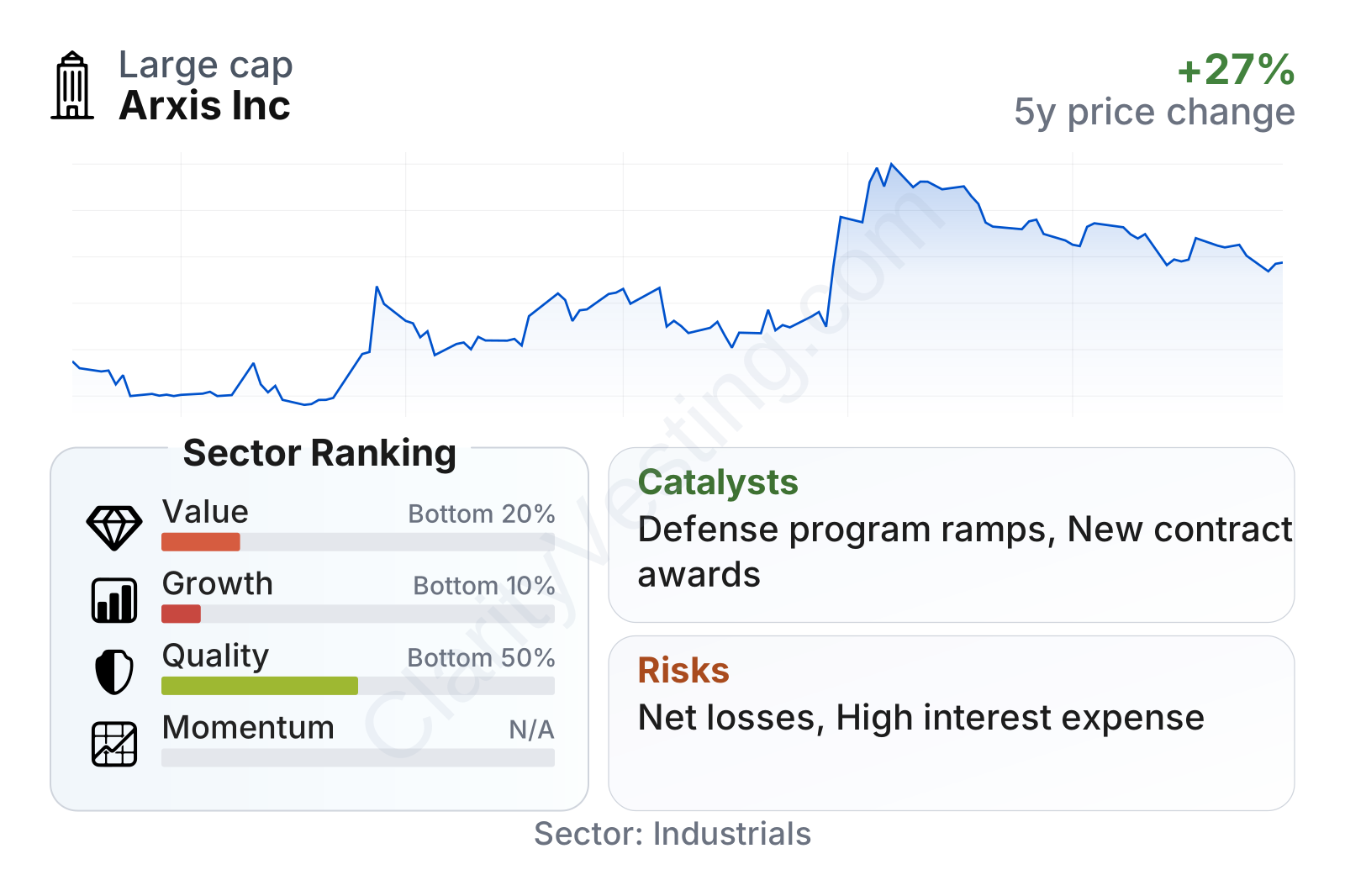
Recent market action shows a positive move over the latest visible period, with the stock rising from the high $30s in April to the low $40s by mid-July. That is not enough on its own to establish a long-term trend, but it does indicate improving sentiment over the short term.
The broader financial profile is mixed. Growth is clearly stronger than the typical company in the Industrials sector, with year-over-year revenue growth around 25% compared with a sector median near 9%. Profit margin is modestly above the sector median at about 7%, and leverage looks manageable by some balance-sheet measures, including debt to equity near 40%, better than the sector median of about 66%.
Valuation is where the picture becomes more demanding. The company sits in the bottom 20% of its sector on value metrics. Its price-to-book ratio is more than double the sector median, while free cash flow yield is around 1%, far below the sector median above 6%. In practical terms, the market is already assigning a premium to future growth and strategic relevance, even though free cash generation remains relatively light for a company of this size.
Growth
Arxis operates in a part of aerospace and defense that has attracted increasing attention: high-speed weapons, propulsion modernization, and next-generation national security systems. This is a favorable backdrop because defense budgets in the United States and allied countries continue to emphasize deterrence, missile systems, and technologies that can counter more advanced threats. Those are areas where propulsion performance and specialized engineering matter a great deal.
The company’s strategy appears logically aligned with that trend. If Arxis is indeed moving from development and prototyping into higher-volume production programs, the revenue trajectory makes sense. Defense suppliers often experience a step-up pattern: years of technical work are followed by much larger sales once programs are selected and move into procurement. The jump in revenue over the past three years suggests Arxis may be entering that more scalable phase.
Another constructive point is that its products are not generic industrial components. In aerospace and defense, technical qualification, testing, and mission-critical reliability can create long program lives and meaningful switching costs. Once a supplier is embedded in a defense platform or weapons system, replacement is usually difficult, slow, and heavily regulated. That can support recurring revenue over the life of a program if execution remains solid.
A major catalyst would be additional production awards, larger order volumes on existing programs, and deeper integration with prime contractors and U.S. defense agencies. Any confirmation that more of the backlog is shifting toward repeat production rather than one-off development work would strengthen the case that recent growth is structural rather than temporary.
Risks
This article is for informational purposes only and does not constitute financial advice. Some content is AI-generated. See Disclaimer