Stock Analysis · Arrowhead Pharmaceuticals Inc (ARWR)
Overview
Arrowhead Pharmaceuticals is a biotechnology company focused on RNA interference, often shortened to RNAi. In simple terms, it designs medicines that aim to switch off disease-causing genes before harmful proteins are made. The company is not a traditional large drug maker with a broad portfolio of approved products sold directly to hospitals and pharmacies. Its business is still centered on research, clinical development, and partnership deals with larger pharmaceutical companies.
Arrowhead’s revenue has been uneven because it mainly comes from collaboration agreements rather than a stable base of product sales. That is common for development-stage biotechnology companies: revenue can jump when a partner signs a deal, pays an upfront fee, reaches a development milestone, or funds part of the research work. Based on recent annual results, the main sources of revenue are approximately:
- License and collaboration revenue: around 95% to 100% — upfront payments, milestone payments, and research support from partners such as large pharmaceutical companies.
- Other revenue: around 0% to 5% — smaller items that are not the core of the business.
That concentration matters. Arrowhead’s economics are tied far more to pipeline progress and deal-making than to recurring product demand. The income profile can therefore look very strong in one year and very weak in the next, depending on when partnership payments are recognized. Over the last several years, spending has remained heavily focused on research and development, which fits the company’s model: it is trying to build value by advancing multiple drug candidates across liver, cardiometabolic, pulmonary, and rare disease programs.
The biggest positive in the business model is that Arrowhead has created a broad platform rather than relying on just one program. The biggest limitation is that commercial self-sufficiency is still not firmly established. For long-term analysis, this makes Arrowhead less like a mature pharmaceutical company and more like a platform biotech whose value depends on whether its technology keeps producing clinically useful medicines and attractive licensing deals.
The revenue pattern has been highly volatile, but one useful feature stands out: operating expenses are dominated by research and development, not by a large commercial cost base. That usually means management is still prioritizing pipeline expansion over near-term earnings stability.
Key Figures
| Metric | Value | Sector ⓘ |
|---|---|---|
| Date | Oct 24, 2026 | |
| Context | ||
| Sector | Healthcare | |
| Industry | Biotechnology | |
| Market Cap ⓘ | $8.31B | |
| Beta ⓘ | 1.30 | |
Value (Cheapness) | ||
| P/E Ratio ⓘ | N/A | 25.42 |
| P/B Ratio ⓘ | 17.99 | 3.08 |
| FCF Yield ⓘ | -0.90% | 3.12% |
| Dividend Yield ⓘ | N/A | 1.85% |
| EBIT / EV ⓘ | -1.80% | 0.56% |
| PEG ⓘ | -1.32 | |
Growth (Business expansion) | ||
| Revenue Growth ⓘ | 171.00% | 7.50% |
| RPS Growth (5Y CAGR) ⓘ | 46.86% | 8.60% |
| EPS Growth (5Y CAGR) ⓘ | N/A | -17.73% |
| BVPS Growth (5Y CAGR) ⓘ | -5.03% | 3.72% |
| Margin Growth (5Y Trend) ⓘ | N/A | -0.57% |
| FCF Growth (5Y CAGR) ⓘ | N/A | 0.96% |
| DPS Growth (5Y CAGR) ⓘ | N/A | 6.69% |
Quality (Business durability) | ||
| ROIC (Latest) ⓘ | -12.28% | 3.17% |
| ROA (Latest) ⓘ | -18.30% | 2.98% |
| ROIC (5Y Median) ⓘ | -54.09% | 4.56% |
| ROA (5Y Median) ⓘ | -25.18% | 1.87% |
| Net Debt / EBIT (Latest) ⓘ | N/A | 1.34 |
| Net Debt / EBIT (5Y Median) ⓘ | N/A | 1.86 |
| Net Debt / EBITDA (Latest) ⓘ | N/A | 1.00 |
| Net Debt / Assets ⓘ | 38.32% | 5.06% |
| EBITDA / Interest ⓘ | N/A | 9.55 |
| Operating Margin (Latest) ⓘ | -23.82% | 9.25% |
| Operating Margin (5Y Median) ⓘ | -78.16% | 7.33% |
| Debt to Equity (Latest) ⓘ | 185.61% | 26.68% |
| Profit Margin (Latest) ⓘ | -47.79% | 3.34% |
| Free Cash Flow (Latest) ⓘ | -$75.11M | |
Momentum (Price trend) | ||
| 3Y Return ⓘ | +136.37% | +51.61% |
| 12M Return (excl. last month) ⓘ | +124.21% | +19.90% |
| 6M Return ⓘ | -21.05% | +10.10% |
| Price vs. 200-Day MA ⓘ | -18.84% | +6.44% |
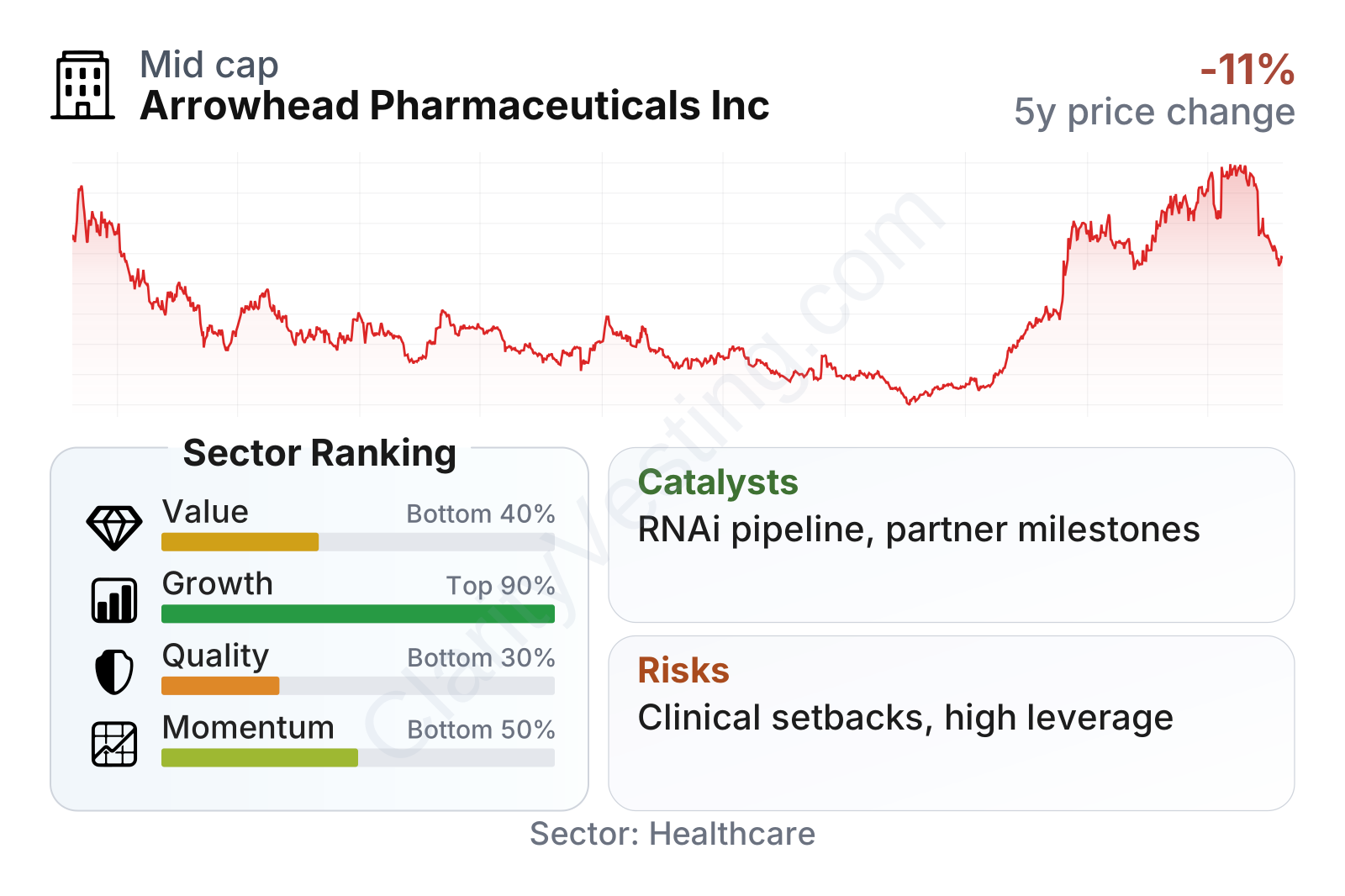
Arrowhead is a mid-to-large biotechnology company by sector standards, and the stock has shown very strong long-term price momentum despite extreme swings along the way. The latest factor snapshot is mixed. Growth ranks near the top of the healthcare sector, while profitability and balance-sheet quality rank much lower. Value measures also look weak, which is common for a company where current earnings do not yet fully reflect the expectations built into the share price.
In practical terms, the company looks like a classic high-potential biotech setup: fast revenue expansion on paper, but with negative margins, negative recent free cash flow, and leverage that is high for the sector. The market appears to be placing more weight on future drug economics than on current profitability.
Growth
Arrowhead operates in a part of healthcare that has clear long-term tailwinds. RNA-based medicines have attracted major industry interest because they offer a targeted way to reduce the production of harmful proteins. This field has already produced important commercial examples elsewhere in biotech, which helps validate the broader approach. For Arrowhead, that sector backdrop matters because it suggests that successful clinical results can translate into licensing interest, partnerships, or future commercial products.
The company’s strategy also makes sense from a portfolio perspective. Instead of betting everything on one disease, Arrowhead has built a pipeline across several therapeutic areas. That diversification can improve the odds that at least some programs create meaningful value, even if others fail. Its platform approach may also allow it to generate new candidates more efficiently than companies that build each program from scratch.
Revenue growth has been exceptionally strong in the latest period, but the pattern is irregular. That does not necessarily mean the core business is unstable in the usual sense; it mainly reflects the timing of partner payments and accounting recognition. For a company like Arrowhead, investors looking at long-term prospects usually need to focus less on smooth quarterly revenue and more on whether the pipeline is advancing, whether partners remain committed, and whether the company continues to attract large drug developers.
Cash generation has improved from the deepest outflows seen in earlier periods, but it remains inconsistent. That is typical of a business that funds large clinical programs while receiving milestone-based cash inflows. If more programs move forward and trigger additional payments, free cash flow could remain volatile but become less structurally negative over time.
A major recent opportunity is Arrowhead’s ability to convert scientific progress into large partnership economics. The company has previously attracted collaborations with established pharmaceutical groups, which is an important outside validation signal. In biotechnology, that can be almost as important as short-term revenue because larger partners usually perform extensive technical and commercial due diligence before committing capital. If upcoming trial readouts, regulatory milestones, or additional licensing deals are positive, the company’s platform value could expand faster than what near-term earnings alone suggest.
Risks
This article is for informational purposes only and does not constitute financial advice. Some content is AI-generated. See Disclaimer


