Stock Analysis · Fagron NV (ARSUF)
Overview
Fagron NV is a healthcare company focused on pharmaceutical compounding. In simple terms, it supplies products and services that help pharmacists, hospitals, and specialized facilities prepare customized medicines for patients. These tailored medicines are used when a standard mass-produced drug is not the right fit, for example because a patient needs a different dosage, a different form such as a cream instead of a pill, or a formulation that is temporarily unavailable in the regular market.
The company operates internationally, with a strong presence in Europe, North America, and Latin America. Its business is built around supporting the compounding ecosystem rather than competing directly with the largest branded drug makers. That gives it a more specialized position inside healthcare: it serves professionals who prepare personalized treatments and, in some cases, offers sterile and non-sterile compounded medicines through regulated outsourcing and compounding facilities.
Based on the company’s reporting structure, revenue mainly comes from three business lines:
- Brands — approximately 55% to 60% of revenue. This includes pharmaceutical raw materials, vehicles, creams, gels, capsules, equipment, and other essentials used by compounding pharmacies and hospitals.
- Compounding Services — approximately 20% to 25% of revenue. This covers sterile and non-sterile preparations produced by Fagron facilities for healthcare providers and pharmacies, especially in markets where outsourcing demand is growing.
- Essentials — approximately 15% to 20% of revenue. This includes lower-margin bulk ingredients and basic supplies used in compounding activities.
Geographically, Fagron is diversified across EMEA, North America, and Latin America, which reduces dependence on a single country’s healthcare system. That said, the U.S. sterile compounding platform and the company’s Brazil operations are especially important to its growth profile.
Over the last several years, the business has shown a clear pattern: revenue has expanded steadily, gross profit has also climbed, and operating profit has improved faster than sales. That points to a business mix gradually shifting toward more value-added activities rather than simple distribution alone.
The long-term trend shows a company getting larger while preserving healthy gross margins. Revenue has moved from roughly the mid-$500 million range to near $1 billion in a few years, while operating income and net income have also advanced. That suggests growth has not come purely from volume, but also from better mix and operating discipline.
Key Figures
| Metric | Value | Sector ⓘ |
|---|---|---|
| Date | Oct 24, 2026 | |
| Context | ||
| Sector | Healthcare | |
| Industry | Drug Manufacturers - Specialty & Generic | |
| Market Cap ⓘ | $1.89B | |
| Beta ⓘ | 0.35 | |
Value (Cheapness) | ||
| P/E Ratio ⓘ | 17.67 | 25.42 |
| P/B Ratio ⓘ | 3.21 | 3.08 |
| FCF Yield ⓘ | N/A | 3.12% |
| Dividend Yield ⓘ | 1.55% | 1.85% |
| EBIT / EV ⓘ | 4.09% | 0.56% |
| PEG ⓘ | N/A | |
Growth (Business expansion) | ||
| Revenue Growth ⓘ | 16.00% | 7.50% |
| RPS Growth (5Y CAGR) ⓘ | 13.35% | 8.60% |
| EPS Growth (5Y CAGR) ⓘ | -31.64% | -17.73% |
| BVPS Growth (5Y CAGR) ⓘ | 13.95% | 3.72% |
| Margin Growth (5Y Trend) ⓘ | -0.74% | -0.57% |
| FCF Growth (5Y CAGR) ⓘ | 21.24% | 0.96% |
| DPS Growth (5Y CAGR) ⓘ | 18.70% | 6.69% |
Quality (Business durability) | ||
| ROIC (Latest) ⓘ | N/A | 3.17% |
| ROA (Latest) ⓘ | N/A | 2.98% |
| ROIC (5Y Median) ⓘ | 11.64% | 4.56% |
| ROA (5Y Median) ⓘ | 7.82% | 1.87% |
| Net Debt / EBIT (Latest) ⓘ | N/A | 1.34 |
| Net Debt / EBIT (5Y Median) ⓘ | 1.86 | 1.86 |
| Net Debt / EBITDA (Latest) ⓘ | N/A | 1.00 |
| Net Debt / Assets ⓘ | 28.95% | 5.06% |
| EBITDA / Interest ⓘ | N/A | 9.55 |
| Operating Margin (Latest) ⓘ | N/A | 9.25% |
| Operating Margin (5Y Median) ⓘ | 13.96% | 7.33% |
| Debt to Equity (Latest) ⓘ | N/A | 26.68% |
| Profit Margin (Latest) ⓘ | 8.92% | 3.34% |
| Free Cash Flow (Latest) ⓘ | N/A | |
Momentum (Price trend) | ||
| 3Y Return ⓘ | +49.03% | +51.61% |
| 12M Return (excl. last month) ⓘ | +16.23% | +19.90% |
| 6M Return ⓘ | -2.75% | +10.10% |
| Price vs. 200-Day MA ⓘ | +5.39% | +6.44% |
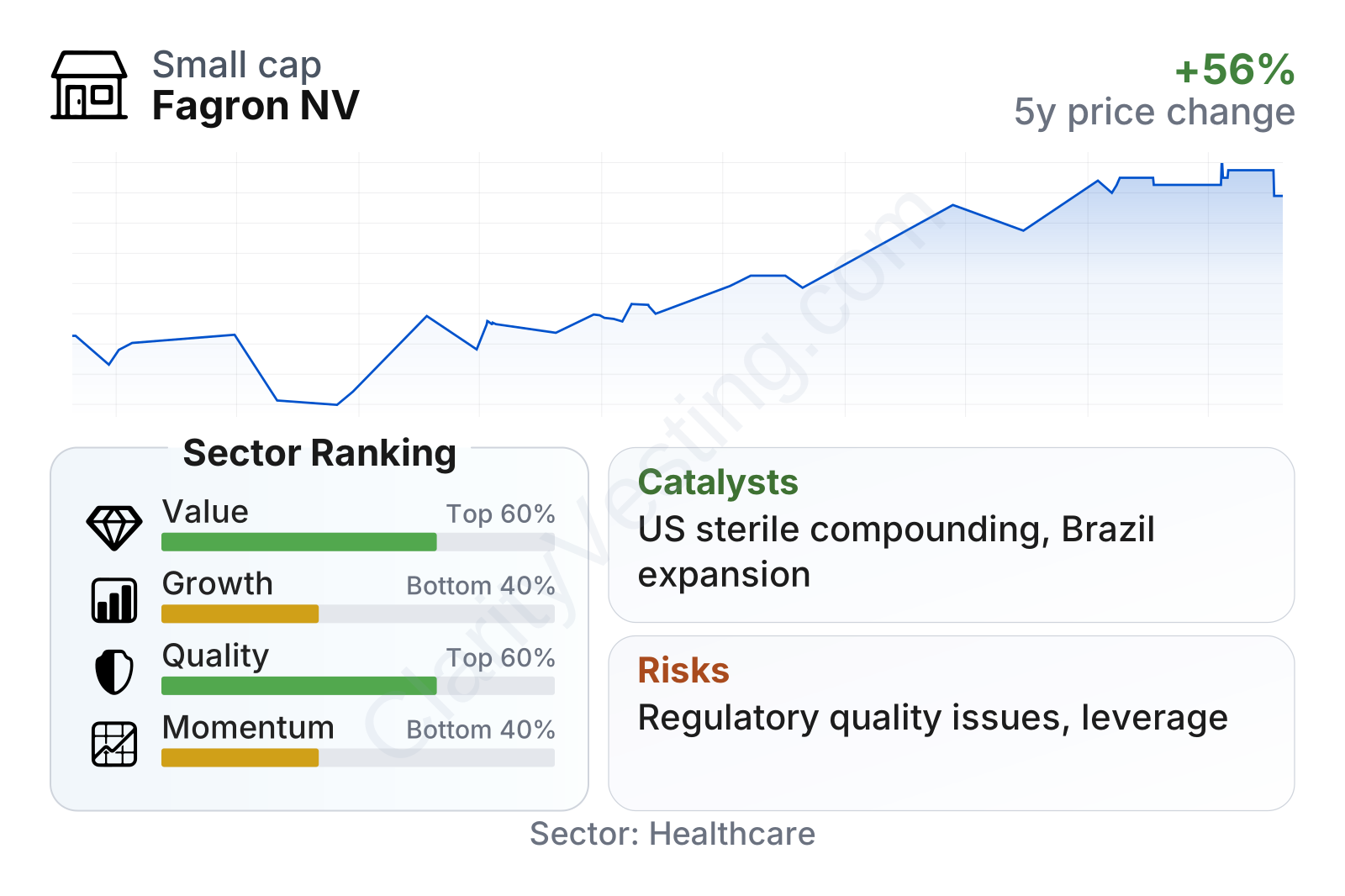
Fagron is a mid-sized healthcare company with relatively low share-price volatility, as reflected by a beta well below 1. On valuation, its earnings multiple sits below the sector median, while its price-to-book ratio is slightly above the median. That combination usually points to a market that recognizes the quality of the business but is not assigning an extreme premium.
Profitability looks solid compared with much of the healthcare peer group. Profit margin is meaningfully above the sector median, and the company’s multi-year returns on invested capital and assets have been stronger than typical sector levels. Free cash flow generation has also improved notably over time, which matters because it supports acquisitions, debt service, and dividends.
The mixed area is growth quality. Revenue growth has been strong, including over five years, but earnings-per-share growth over that same period has been weaker and even negative on a compounded basis. That gap suggests dilution, acquisition-related costs, financing costs, or temporary margin pressures have limited how much of the top-line growth reached per-share earnings. Momentum is also uneven: the longer-term share performance is favorable, but the shorter-term trend has lagged much of the sector.
Growth
Fagron operates in a part of healthcare with attractive structural support. Personalized medicine, rising complexity in therapies, hospital demand for outsourced preparation, and periodic drug shortages all create room for compounding specialists. These are not short-lived themes. Healthcare systems increasingly need flexible production and patient-specific formats, especially in dermatology, hormone therapy, pain management, pediatrics, and sterile preparations.
The company’s strategy is coherent with that backdrop. Instead of relying on one blockbuster medicine, Fagron builds a broad platform: ingredients and formulations for pharmacists, outsourced compounding capacity, and regional distribution networks. This reduces dependence on any single product and makes the business more tied to the recurring daily needs of pharmacies and care providers.
A particularly important catalyst is sterile compounding in the United States. This area typically requires regulatory expertise, specialized facilities, and strong quality systems, which raises the barrier to entry. If utilization rises in line with management’s expansion plans, that business can contribute both growth and better margins than basic supply sales.
Another growth driver is Brazil and broader Latin America, where Fagron has built a meaningful presence in compounding and related products. These markets can grow faster than mature European markets, although they also bring more currency and macroeconomic swings.
The company has also used acquisitions as a regular tool to deepen local scale, widen product offerings, and add specialized capabilities. In a fragmented niche like compounding, that approach can make strategic sense as long as integration remains disciplined and debt stays controlled.
Recent company communication has continued to emphasize expansion of compounding capacity, cross-selling of higher-value formulations, and demand resilience across regions. Those elements point to a business still benefiting from favorable industry conditions rather than one relying on a one-time turnaround.
Risks
This article is for informational purposes only and does not constitute financial advice. Some content is AI-generated. See Disclaimer


