Stock Analysis · Aeroports de Paris SA (ARRPY)
Overview
Aeroports de Paris SA, usually known as Groupe ADP, is a large airport operator based in France. Its core role is to own, operate, and develop airport infrastructure, with Paris-Charles de Gaulle, Paris-Orly, and Paris-Le Bourget as its most important assets. Beyond running terminals and airside infrastructure, the group also earns money from retail, real estate, engineering, and international airport activities.
For a long-term stock analysis, the company is best understood as a mix of transport infrastructure and commercial real estate tied to air traffic. Passenger volumes matter because more travelers typically support aeronautical fees, store sales, parking, lounge activity, and demand for airport-linked property. This makes ADP less like a pure airline business and more like a regulated platform with several revenue streams built around major hubs.
Based on the group’s recent annual reporting, revenue is mainly generated from the following areas:
- Aviation and airport fees: roughly 30% to 35% of revenue. This includes charges paid by airlines and airport users for landing, passengers, security-related services, and use of infrastructure.
- Retail and services: roughly 20% to 25%. This includes duty free and travel retail income, food and beverage, advertising, car parking, lounges, and other passenger services.
- International and airport developments: roughly 20% to 25%. This covers stakes and operations in airports outside Paris, as well as development and engineering activities.
- Real estate: roughly 10% to 15%. This includes leasing of airport-area land and buildings, offices, logistics, and related property assets.
- Other activities: the remainder, including various support and diversification activities.
That mix matters because it gives ADP more than one way to monetize traffic. A passenger does not only generate a regulated airport fee; that same traveler can support shopping, dining, parking, and commercial rents. Over time, this layered model can be attractive when traffic is healthy and airport capacity remains strategically valuable.
The company’s recent financial progression also shows how much the business has recovered since the pandemic period. Revenue moved from roughly €2.8 billion in 2021 to about €6.7 billion in 2025, while operating income rebounded strongly from a very weak 2021 base. However, net income has been less stable than revenue because financing costs and other expenses have weighed on the bottom line.
The broad trend is positive at the revenue and operating level: activity has expanded sharply since 2021 and operating profitability has recovered. At the same time, interest expense remains an important pressure point, which helps explain why higher revenue has not translated into equally strong net profit growth.
Key Figures
| Metric | Value | Sector ⓘ |
|---|---|---|
| Date | Oct 17, 2026 | |
| Context | ||
| Sector | Industrials | |
| Industry | Airports & Air Services | |
| Market Cap ⓘ | $11.92B | |
| Beta ⓘ | 0.92 | |
Value (Cheapness) | ||
| P/E Ratio ⓘ | 17.21 | 22.10 |
| P/B Ratio ⓘ | 3.48 | 1.97 |
| FCF Yield ⓘ | 4.88% | 6.38% |
| Dividend Yield ⓘ | 3.65% | 1.94% |
| EBIT / EV ⓘ | N/A | 4.79% |
| PEG ⓘ | 0.78 | |
Growth (Business expansion) | ||
| Revenue Growth ⓘ | 1.60% | 9.30% |
| RPS Growth (5Y CAGR) ⓘ | 24.72% | 7.81% |
| EPS Growth (5Y CAGR) ⓘ | N/A | -13.06% |
| BVPS Growth (5Y CAGR) ⓘ | -1.63% | 6.14% |
| Margin Growth (5Y Trend) ⓘ | 15.96% | 0.88% |
| FCF Growth (5Y CAGR) ⓘ | 9.14% | 11.01% |
| DPS Growth (5Y CAGR) ⓘ | 120.76% | 9.48% |
Quality (Business durability) | ||
| ROIC (Latest) ⓘ | 6.03% | 10.84% |
| ROA (Latest) ⓘ | 3.34% | 5.41% |
| ROIC (5Y Median) ⓘ | 4.10% | 9.38% |
| ROA (5Y Median) ⓘ | 1.89% | 4.95% |
| Net Debt / EBIT (Latest) ⓘ | 5.15 | 2.08 |
| Net Debt / EBIT (5Y Median) ⓘ | 7.69 | 2.27 |
| Net Debt / EBITDA (Latest) ⓘ | 2.48 | 1.39 |
| Net Debt / Assets ⓘ | 42.00% | 19.28% |
| EBITDA / Interest ⓘ | 3.23 | 9.58 |
| Operating Margin (Latest) ⓘ | 13.09% | 10.50% |
| Operating Margin (5Y Median) ⓘ | 18.32% | 10.29% |
| Debt to Equity (Latest) ⓘ | 265.99% | 65.48% |
| Profit Margin (Latest) ⓘ | 8.84% | 6.67% |
| Free Cash Flow (Latest) ⓘ | $581.98M | |
Momentum (Price trend) | ||
| 3Y Return ⓘ | +7.13% | +61.68% |
| 12M Return (excl. last month) ⓘ | +0.19% | +12.58% |
| 6M Return ⓘ | -2.41% | 0.00% |
| Price vs. 200-Day MA ⓘ | -7.62% | +0.02% |
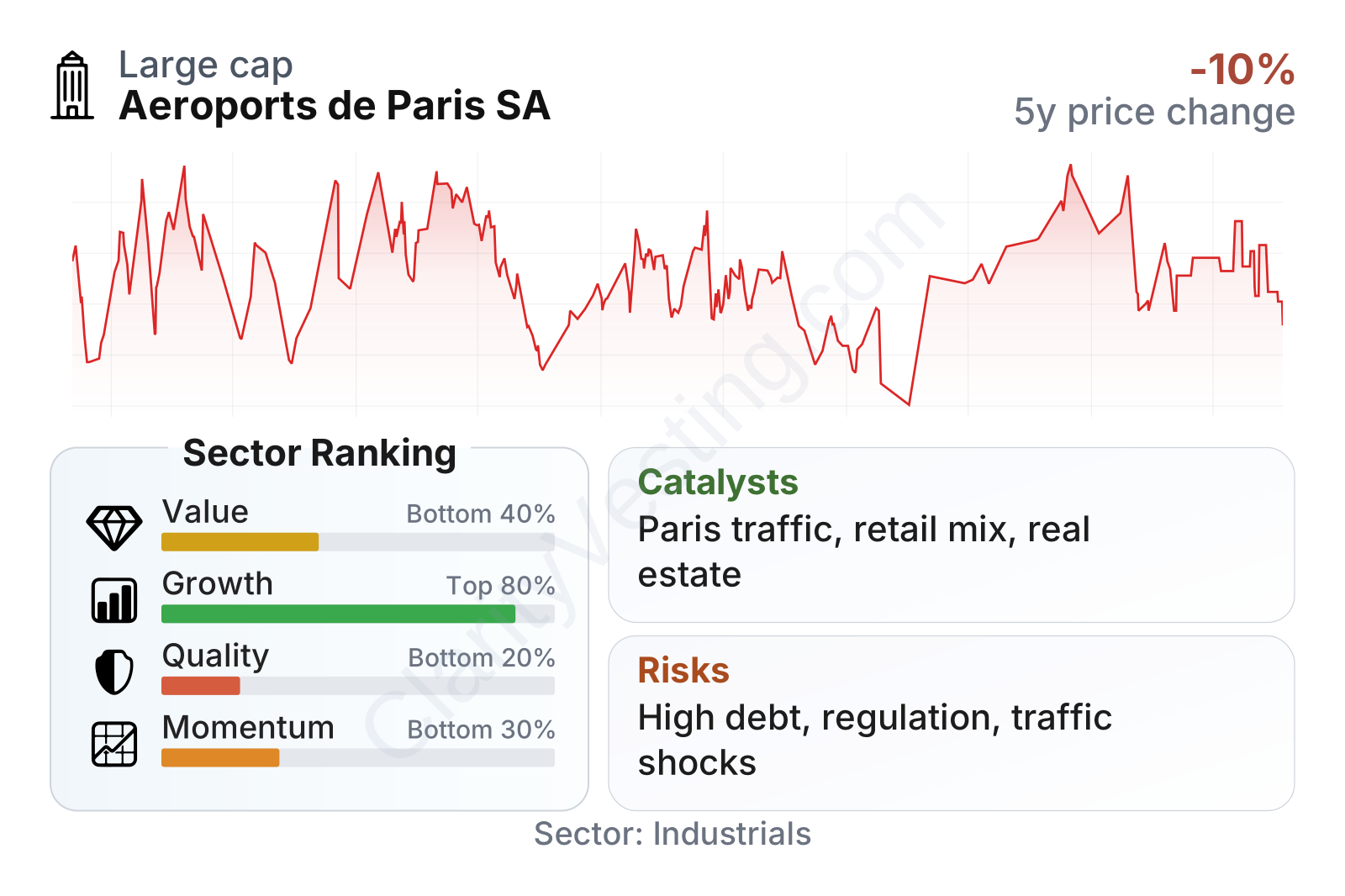
ADP stands out as a large infrastructure operator with relatively low share-price volatility, but its financial profile is mixed. Growth indicators look solid over a multiyear period, especially revenue per share, free cash flow expansion, and margin improvement after the air traffic recovery. Profitability margins are better than many sector peers, yet balance-sheet quality is weaker: debt is high compared with equity, assets, and operating earnings, and interest coverage is clearly below the sector median. On valuation, the earnings multiple is below the sector median, but the price-to-book ratio is higher, which suggests the market still gives value to the scarcity and strategic nature of its airport assets. Recent stock performance has trailed much of the sector, showing that operational recovery has not fully translated into stronger market momentum.
Growth
The airport sector remains structurally linked to long-term growth in air travel, tourism, and international mobility. While the industry is cyclical and sensitive to economic slowdowns, major hub airports usually benefit from durable demand because they sit at the center of airline networks and face high barriers to entry. In that context, ADP has exposure to one of Europe’s most important metropolitan areas and to airports that are difficult to replicate.
The company’s strategy broadly makes sense for future growth because it is not relying on a single lever. First, it can benefit from passenger traffic and aircraft movements at Paris airports. Second, it can raise commercial spending per passenger through retail, hospitality, parking, and premium services. Third, it can expand value from its land base through real estate projects around airport zones. Fourth, it keeps an international presence that can diversify earnings beyond France.
A major catalyst over the next several years is capacity and traffic normalization at Paris airports combined with the ability to extract more non-aeronautical revenue from each traveler. This is often where airport operators can create additional profit because retail and property activities can be less constrained than regulated airport charges. Another important support is the scarcity value of large European airport platforms: when air travel grows but infrastructure is limited, incumbent operators are in a strong position.
There is also a visible event-driven opportunity related to Paris’s role as a global gateway for tourism, business travel, and major events. Even when one-off event effects fade, they can leave behind better commercial relationships, improved infrastructure, and stronger airport visibility. More broadly, Europe’s continued travel recovery and long-haul normalization remain favorable background trends for ADP.
One point worth noting is that recent year-over-year revenue growth has become modest compared with the sharp rebound period. That is normal after a strong post-pandemic recovery. For ADP, the next phase of growth is likely to depend less on rebound effects and more on pricing, commercial execution, route mix, and disciplined development of property and international assets.
Risks
This article is for informational purposes only and does not constitute financial advice. Some content is AI-generated. See Disclaimer


