Stock Analysis · ARMOUR Residential REIT Inc (ARR)
Overview
ARMOUR Residential REIT Inc is a mortgage real estate investment trust, or mortgage REIT. Unlike a traditional property REIT that owns apartments, offices, or warehouses, ARMOUR mainly invests in mortgage-backed securities. Its portfolio is centered on residential mortgage assets that are issued or guaranteed by U.S. government-related agencies such as Fannie Mae, Freddie Mac, and Ginnie Mae. In simple terms, the company earns money from the spread between the yield it receives on those mortgage assets and the cost of the borrowing it uses to finance them.
This structure makes ARMOUR more like a leveraged income vehicle tied to interest rates, mortgage markets, and financing conditions than a landlord collecting rent. The company actively manages portfolio mix, hedging, and financing in order to protect book value and maintain dividend-paying capacity.
Based on recent company filings, ARMOUR’s economic exposure is heavily concentrated in agency residential mortgage-backed securities, with a smaller role for cash, related hedges, and operational items. Revenue in accounting terms can be volatile because fair-value changes, gains or losses on derivatives, and market movements can swing reported results sharply from one period to another. Economically, the main earnings drivers can be summarized as follows:
- Net interest income from agency residential mortgage-backed securities: the dominant source of recurring earnings, generated by the difference between asset yields and funding costs.
- Gains or losses on investment securities and derivatives: a highly variable source tied to changes in interest rates, prepayment expectations, and market prices.
- Other investment and operating income: a small contribution relative to the mortgage portfolio and hedging activities.
Because ARMOUR is a mortgage REIT, exact revenue percentages are less informative than for an operating company selling products. The recurring economic engine is overwhelmingly the agency mortgage portfolio, while reported accounting revenue can move significantly from year to year depending on unrealized and realized marks.
The recent financial flow also shows how unstable reported earnings can be in this business. After a deeply negative year in 2022, results improved in 2023, remained mixed in 2024, and turned much stronger in 2025, largely reflecting market valuation changes and spread conditions rather than a simple steady sales trend.
Key Figures
| Metric | Value | Sector ⓘ |
|---|---|---|
| Date | Nov 03, 2026 | |
| Context | ||
| Sector | Real Estate | |
| Industry | REIT - Mortgage | |
| Market Cap ⓘ | $1.76B | |
| Beta ⓘ | 1.45 | |
Value (Cheapness) | ||
| P/E Ratio ⓘ | 248.20 | 18.10 |
| P/B Ratio ⓘ | 0.76 | 0.87 |
| FCF Yield ⓘ | 25.97% | 7.16% |
| Dividend Yield ⓘ | 23.13% | 4.84% |
| EBIT / EV ⓘ | N/A | 3.72% |
| PEG ⓘ | 2.97 | |
Growth (Business expansion) | ||
| Revenue Growth ⓘ | 126.10% | 5.60% |
| RPS Growth (5Y CAGR) ⓘ | 84.56% | 6.02% |
| EPS Growth (5Y CAGR) ⓘ | -34.98% | -7.39% |
| BVPS Growth (5Y CAGR) ⓘ | -48.01% | 0.46% |
| Margin Growth (5Y Trend) ⓘ | -6.23% | -0.87% |
| FCF Growth (5Y CAGR) ⓘ | 80.36% | 5.40% |
| DPS Growth (5Y CAGR) ⓘ | -18.24% | 5.11% |
Quality (Business durability) | ||
| ROIC (Latest) ⓘ | N/A | 5.20% |
| ROE (Latest) ⓘ | -2.39% | 7.59% |
| ROA (Latest) ⓘ | -0.24% | 3.10% |
| ROIC (5Y Median) ⓘ | N/A | 4.22% |
| ROE (5Y Median) ⓘ | -2.00% | 6.04% |
| ROA (5Y Median) ⓘ | -0.11% | 2.45% |
| Net Debt / EBIT (Latest) ⓘ | N/A | 7.57 |
| Net Debt / EBIT (5Y Median) ⓘ | 9.20 | 8.34 |
| Net Debt / EBITDA (Latest) ⓘ | 36.38 | 5.35 |
| Net Debt / Assets ⓘ | 85.81% | 37.80% |
| EBITDA / Interest ⓘ | 0.71 | 4.21 |
| Operating Margin (Latest) ⓘ | N/A | 34.59% |
| Operating Margin (5Y Median) ⓘ | 80.14% | 37.79% |
| Debt to Equity (Latest) ⓘ | 824.41% | 88.37% |
| Profit Margin (Latest) ⓘ | N/A | 20.06% |
| Free Cash Flow (Latest) ⓘ | $456.23M | |
Momentum (Price trend) | ||
| 3Y Return ⓘ | +28.33% | +37.73% |
| 12M Return (excl. last month) ⓘ | +4.01% | +2.27% |
| 6M Return ⓘ | -23.41% | -2.01% |
| Price vs. 200-Day MA ⓘ | -19.04% | -0.65% |
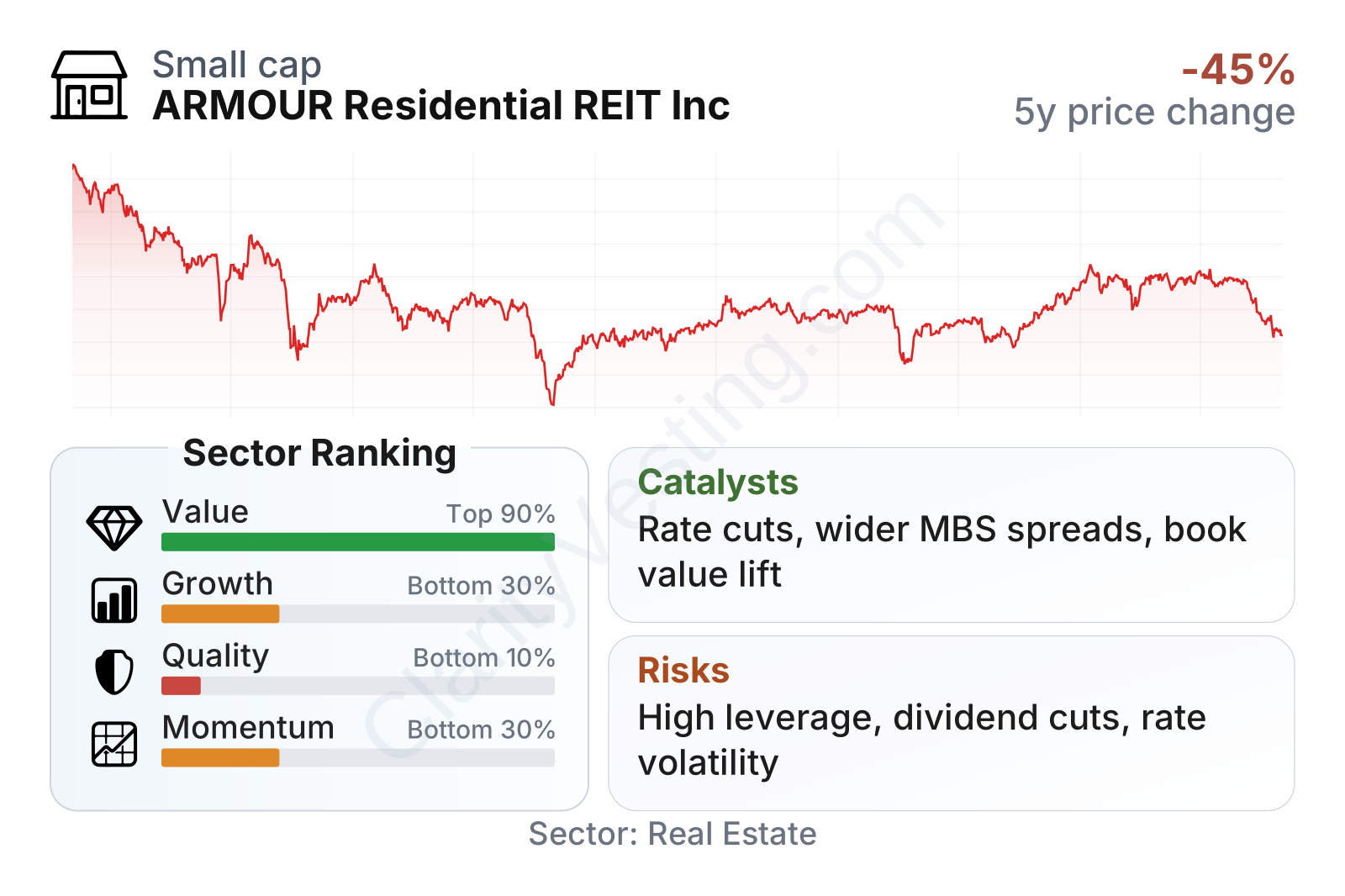
ARMOUR is a mid-sized mortgage REIT with a stock that has shown meaningful volatility over the last several years. The share price remains well below its 2021 level, even though it recovered from the lows seen during the most difficult rate period. In the factor breakdown, value metrics look strong on the surface, helped by a low price-to-book ratio and a very high trailing dividend yield. However, quality and growth rank poorly versus the broader real estate sector, which is important because mortgage REITs can look inexpensive for long periods when the market is discounting pressure on book value, earnings stability, or dividend durability.
The table also suggests a split picture. On one side, free cash flow yield and dividend yield stand out. On the other, profitability, returns on equity and assets, leverage, and recent market momentum compare unfavorably with sector norms. That combination usually points to a company that offers high income potential but carries elevated balance-sheet and earnings sensitivity.
Growth
ARMOUR operates in a sector that is not a classic long-term growth industry in the way technology or healthcare can be. Mortgage REITs generally do not expand by winning customers or launching new products at scale. Their growth depends more on interest-rate cycles, mortgage spreads, funding conditions, capital raises, and portfolio management. In that sense, the opportunity set can improve materially when borrowing costs stabilize, yield curves normalize, and mortgage-backed securities offer attractive spreads relative to financing.
That backdrop matters today because agency mortgage securities remain a large and liquid market, and ARMOUR’s focus on government-backed residential mortgage assets reduces credit risk compared with mortgage REITs that take larger exposure to non-agency or credit-sensitive assets. If funding costs ease or asset spreads remain favorable, earnings power can improve without the company needing a dramatic change in business model.
The company’s strategy is understandable for long-term readers: stay concentrated in agency-backed residential mortgage assets, use repurchase funding, and hedge interest-rate exposure. The logic is not about rapid expansion; it is about surviving rate cycles, preserving book value better than peers, and producing distributable income over time. Recent company communications have also emphasized active portfolio repositioning, financing discipline, and hedging adjustments as market conditions evolve.
Revenue per share has been extremely uneven, which is normal for this industry but still important. The large swings from negative to strongly positive results show how much accounting outcomes depend on market marks and interest-rate movements. That means long-term assessment should focus less on smooth top-line growth and more on whether the company can maintain earning capacity through different rate environments.
The dividend profile is one of ARMOUR’s main attractions, but the longer trend shows pressure rather than expansion. The annual dividend per share has moved down materially over the last five years, even though the trailing yield remains very high because of the stock’s price level. For long-term analysis, that distinction is important: a high yield can coexist with lower actual cash distributions over time.
A meaningful catalyst would be a more favorable interest-rate environment. If short-term funding costs decline while agency mortgage yields stay attractive, net interest spread could widen. Another potential support is any improvement in demand for agency mortgage-backed securities, which could help asset pricing and book value. Recent operating momentum also looks better than the worst part of the 2022 rate shock, suggesting ARMOUR is functioning in a less hostile environment than it faced during that period.
Risks
This article is for informational purposes only and does not constitute financial advice. Some content is AI-generated. See Disclaimer