Stock Analysis · Arcutis Biotherapeutics Inc (ARQT)
Overview
Arcutis Biotherapeutics is a biotechnology company focused on medical dermatology, meaning treatments for skin diseases that are chronic, visible, uncomfortable, and often under-treated. Its commercial focus is now centered on approved prescription products for inflammatory skin conditions, while it also continues to develop additional uses and new candidates in dermatology.
The company’s best-known product is ZORYVE (roflumilast), a non-steroidal treatment franchise that has expanded across several forms and skin conditions. Arcutis also markets YNFITY (previously branded as Klisyri), a treatment for actinic keratosis, although this is much smaller in economic importance than ZORYVE. In practical terms, Arcutis is becoming less of a pre-revenue biotech and more of a specialty dermatology company built around one main platform.
Based on recent annual results and company disclosures, Arcutis’ revenue is overwhelmingly product-based, with ZORYVE as the dominant contributor.
- ZORYVE net product revenue: approximately 95% to 98% of total revenue in 2025. This includes prescriptions across approved indications such as plaque psoriasis, seborrheic dermatitis, and atopic dermatitis, supported by different topical formulations.
- YNFITY net product revenue: approximately 1% to 3%. This incorporates sales of the actinic keratosis treatment acquired with the prior licensing arrangement.
- Other revenue: approximately 1% to 3%. This may include small amounts tied to collaboration, royalty, or other non-core items, depending on period-to-period accounting.
The business mix has become much cleaner over time: revenue has scaled rapidly, gross profit has improved sharply, and operating losses have narrowed as commercial sales have grown faster than research spending. The main issue is concentration, since the company still depends heavily on one brand family.
The financial flow shows a clear transition from heavy development spending with little revenue to a commercial model generating substantial gross profit. Research and development spending has moderated from earlier peak levels, while selling and administrative costs remain high because Arcutis is still building and supporting its commercial footprint.
Key Figures
| Metric | Value | Sector ⓘ |
|---|---|---|
| Date | Oct 24, 2026 | |
| Context | ||
| Sector | Healthcare | |
| Industry | Biotechnology | |
| Market Cap ⓘ | $4.01B | |
| Beta ⓘ | 1.58 | |
Value (Cheapness) | ||
| P/E Ratio ⓘ | 151.76 | 25.42 |
| P/B Ratio ⓘ | 19.84 | 3.08 |
| FCF Yield ⓘ | 0.98% | 3.12% |
| Dividend Yield ⓘ | N/A | 1.85% |
| EBIT / EV ⓘ | 1.29% | 0.56% |
| PEG ⓘ | N/A | |
Growth (Business expansion) | ||
| Revenue Growth ⓘ | 59.30% | 7.50% |
| RPS Growth (5Y CAGR) ⓘ | N/A | 8.60% |
| EPS Growth (5Y CAGR) ⓘ | N/A | -17.73% |
| BVPS Growth (5Y CAGR) ⓘ | -29.49% | 3.72% |
| Margin Growth (5Y Trend) ⓘ | N/A | -0.57% |
| FCF Growth (5Y CAGR) ⓘ | -56.46% | 0.96% |
| DPS Growth (5Y CAGR) ⓘ | N/A | 6.69% |
Quality (Business durability) | ||
| ROIC (Latest) ⓘ | 14.03% | 3.17% |
| ROA (Latest) ⓘ | 6.64% | 2.98% |
| ROIC (5Y Median) ⓘ | -50.29% | 4.56% |
| ROA (5Y Median) ⓘ | -58.29% | 1.87% |
| Net Debt / EBIT (Latest) ⓘ | 1.94 | 1.34 |
| Net Debt / EBIT (5Y Median) ⓘ | N/A | 1.86 |
| Net Debt / EBITDA (Latest) ⓘ | 1.84 | 1.00 |
| Net Debt / Assets ⓘ | 16.38% | 5.06% |
| EBITDA / Interest ⓘ | 3.14 | 9.55 |
| Operating Margin (Latest) ⓘ | 8.88% | 9.25% |
| Operating Margin (5Y Median) ⓘ | -220.91% | 7.33% |
| Debt to Equity (Latest) ⓘ | 51.74% | 26.68% |
| Profit Margin (Latest) ⓘ | 6.15% | 3.34% |
| Free Cash Flow (Latest) ⓘ | $39.15M | |
Momentum (Price trend) | ||
| 3Y Return ⓘ | +1233.33% | +51.61% |
| 12M Return (excl. last month) ⓘ | +59.88% | +19.90% |
| 6M Return ⓘ | +35.58% | +10.10% |
| Price vs. 200-Day MA ⓘ | +28.12% | +6.44% |
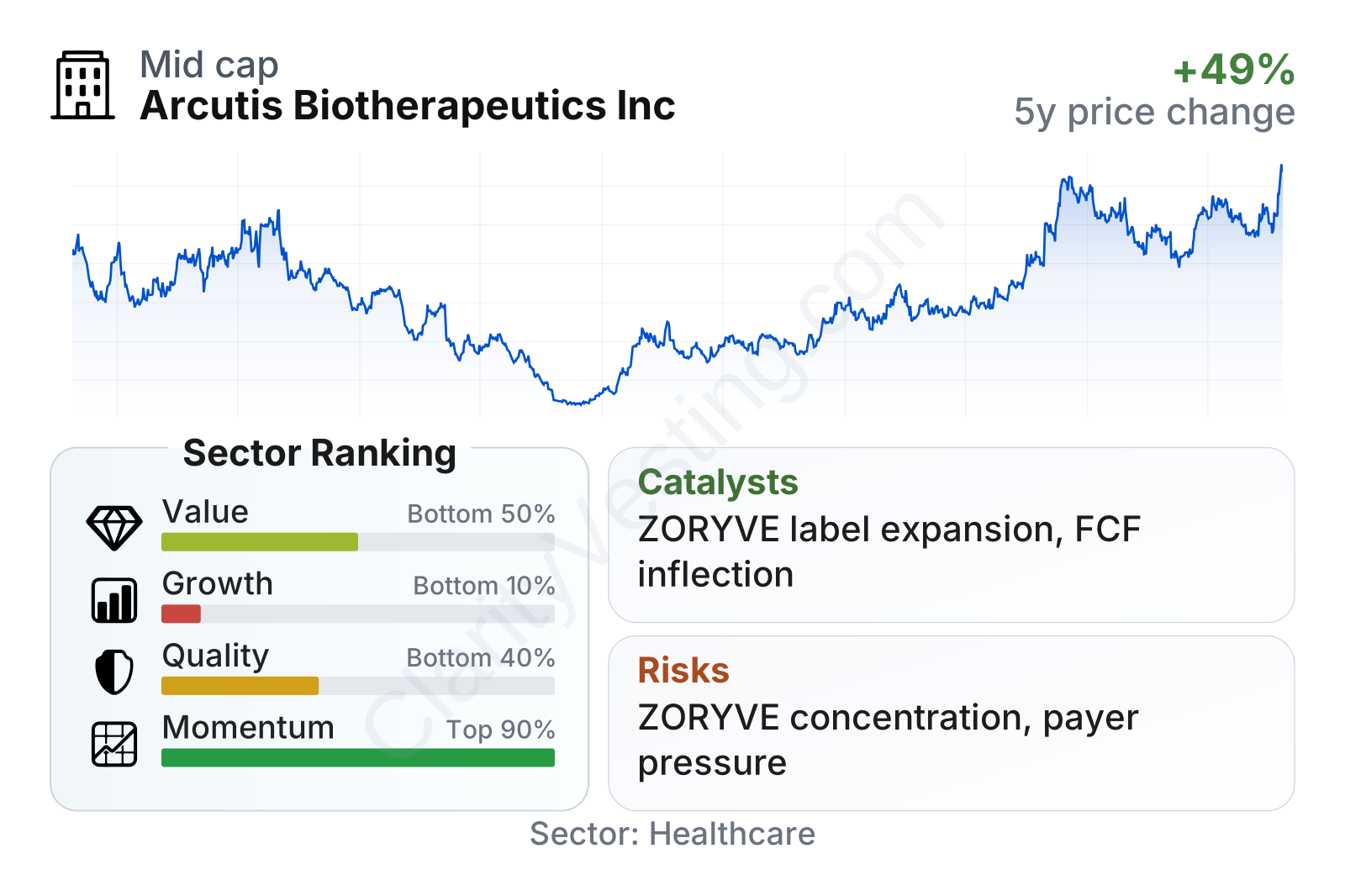
Arcutis is now a mid-sized healthcare company by market value, but its profile still looks more like an emerging commercial biotech than a mature pharmaceutical business. Growth and share-price momentum have been strong, while value metrics look expensive relative to the healthcare sector. Quality is mixed: recent returns on capital and assets have improved, yet the longer multi-year history still reflects the company’s loss-making development phase.
Growth
Arcutis operates in a favorable part of healthcare. Dermatology is a large and durable market because many skin diseases are chronic, recurring, and require long-term management rather than one-time treatment. There is also room for differentiated products because many patients and physicians want alternatives to steroids, especially for sensitive skin areas or repeated use. That backdrop supports continued demand if a treatment is effective, convenient, and well tolerated.
The company’s strategy is coherent. Rather than building a broad drug portfolio across many unrelated diseases, Arcutis is concentrating on dermatology and extending one active molecule across multiple formulations and indications. That approach can be efficient because it allows the company to reuse commercial infrastructure, physician relationships, and brand recognition. It also reduces some development complexity compared with starting from scratch in new therapeutic areas.
Revenue growth has been exceptional, although it is naturally slowing from the earliest launch phase. The latest year-over-year growth rate remains very high by sector standards, close to 60%, even after prior periods of rapid expansion. That suggests ZORYVE is still in a meaningful adoption curve rather than nearing saturation.
Cash generation has improved materially. Free cash flow moved from deeply negative levels to positive territory over the last year, a major milestone for a company that had long been consuming cash to fund launch activities and clinical development. That shift matters because it reduces dependence on new financing and gives management more flexibility to support pipeline work, commercialization, and lifecycle expansion.
One of the strongest growth catalysts is continued expansion of the ZORYVE franchise. Arcutis has been adding approved uses over time, and each additional indication expands the addressable patient base while leveraging the same commercial engine. In dermatology, doctors often prefer familiar brands, so broader label coverage can create a reinforcing effect: more prescribers, more patient awareness, and more payer engagement.
Another important catalyst is execution in atopic dermatitis and other larger markets where non-steroidal options are in demand. If uptake remains solid in these categories, Arcutis could continue growing even if earlier indications begin to mature. The company has also emphasized direct commercial execution, reimbursement progress, and physician adoption as key operational levers, which are the right areas for a company at this stage.
Recent company updates have generally reinforced the view that Arcutis is moving from launch mode toward operating leverage. The most meaningful opportunity remains straightforward: turning strong prescription growth into durable profitability across a wider set of dermatology indications.
Risks
This article is for informational purposes only and does not constitute financial advice. Some content is AI-generated. See Disclaimer


