Stock Analysis · Archrock Inc (AROC)
Overview
Archrock is a U.S. energy infrastructure company focused on natural gas compression. In simple terms, it provides the equipment and services that help move natural gas from the wellhead through gathering systems, processing facilities, pipelines, and storage. Compression is a necessary step in the gas value chain because pressure naturally falls as gas travels, so producers and midstream operators need compressors to keep volumes flowing efficiently.
The business is more specialized and steadier than many oilfield service companies because a large share of its work is tied to operating existing gas infrastructure rather than only drilling new wells. Archrock owns a large fleet of compression equipment and either rents it to customers with service support or sells equipment packages and aftermarket services. Its customer base is spread across major U.S. producing regions, with meaningful exposure to gas-weighted basins such as the Permian, Eagle Ford, Appalachia, and other active areas.
Based on the company’s recent filings, revenue is mainly generated from the following activities:
- Contract operations / rental compression: about 75% to 85% of revenue. This is the core business. Archrock places compression units with customers under service contracts and also provides operations, maintenance, and field support.
- Aftermarket services: about 10% to 20% of revenue. This includes parts, repairs, overhauls, and other support work for compression equipment.
- Equipment sales: about 5% to 10% of revenue. This is the most cyclical part of the mix and covers the sale of new or modified compressor packages and related systems.
That revenue mix matters because contract operations usually brings more recurring cash flow and better visibility than pure equipment sales. It also helps explain why Archrock has been able to lift margins as utilization improved and larger-horsepower units stayed in demand.
The financial flow over the last several years shows a clear pattern: revenue has climbed sharply since 2021, but operating income and net income have expanded even faster. That suggests the company has been improving pricing, utilization, and cost absorption, not just adding volume.
Key Figures
| Metric | Value | Sector ⓘ |
|---|---|---|
| Date | Oct 17, 2026 | |
| Context | ||
| Sector | Energy | |
| Industry | Oil & Gas Equipment & Services | |
| Market Cap ⓘ | $5.38B | |
| Beta ⓘ | 0.91 | |
Value (Cheapness) | ||
| P/E Ratio ⓘ | 16.49 | 15.44 |
| P/B Ratio ⓘ | 3.35 | 1.73 |
| FCF Yield ⓘ | 5.42% | 8.20% |
| Dividend Yield ⓘ | 2.90% | 3.59% |
| EBIT / EV ⓘ | 6.75% | 7.46% |
| PEG ⓘ | 1.19 | |
Growth (Business expansion) | ||
| Revenue Growth ⓘ | -3.10% | 26.90% |
| RPS Growth (5Y CAGR) ⓘ | 13.45% | 6.90% |
| EPS Growth (5Y CAGR) ⓘ | 29.91% | -15.73% |
| BVPS Growth (5Y CAGR) ⓘ | 9.80% | 6.07% |
| Margin Growth (5Y Trend) ⓘ | 22.08% | 0.58% |
| FCF Growth (5Y CAGR) ⓘ | -3.77% | 1.86% |
| DPS Growth (5Y CAGR) ⓘ | 8.33% | 16.79% |
Quality (Business durability) | ||
| ROIC (Latest) ⓘ | 11.95% | 11.40% |
| ROA (Latest) ⓘ | 7.42% | 6.06% |
| ROIC (5Y Median) ⓘ | 7.84% | 10.30% |
| ROA (5Y Median) ⓘ | 4.00% | 5.42% |
| Net Debt / EBIT (Latest) ⓘ | 4.49 | 1.64 |
| Net Debt / EBIT (5Y Median) ⓘ | 6.17 | 1.83 |
| Net Debt / EBITDA (Latest) ⓘ | 2.92 | 1.08 |
| Net Debt / Assets ⓘ | 53.01% | 17.29% |
| EBITDA / Interest ⓘ | 4.96 | 9.64 |
| Operating Margin (Latest) ⓘ | 34.83% | 16.27% |
| Operating Margin (5Y Median) ⓘ | 26.10% | 20.39% |
| Debt to Equity (Latest) ⓘ | 151.87% | 54.76% |
| Profit Margin (Latest) ⓘ | 21.84% | 8.82% |
| Free Cash Flow (Latest) ⓘ | $291.33M | |
Momentum (Price trend) | ||
| 3Y Return ⓘ | +153.93% | +67.38% |
| 12M Return (excl. last month) ⓘ | +28.46% | +49.19% |
| 6M Return ⓘ | -16.99% | +7.07% |
| Price vs. 200-Day MA ⓘ | -11.40% | +9.56% |
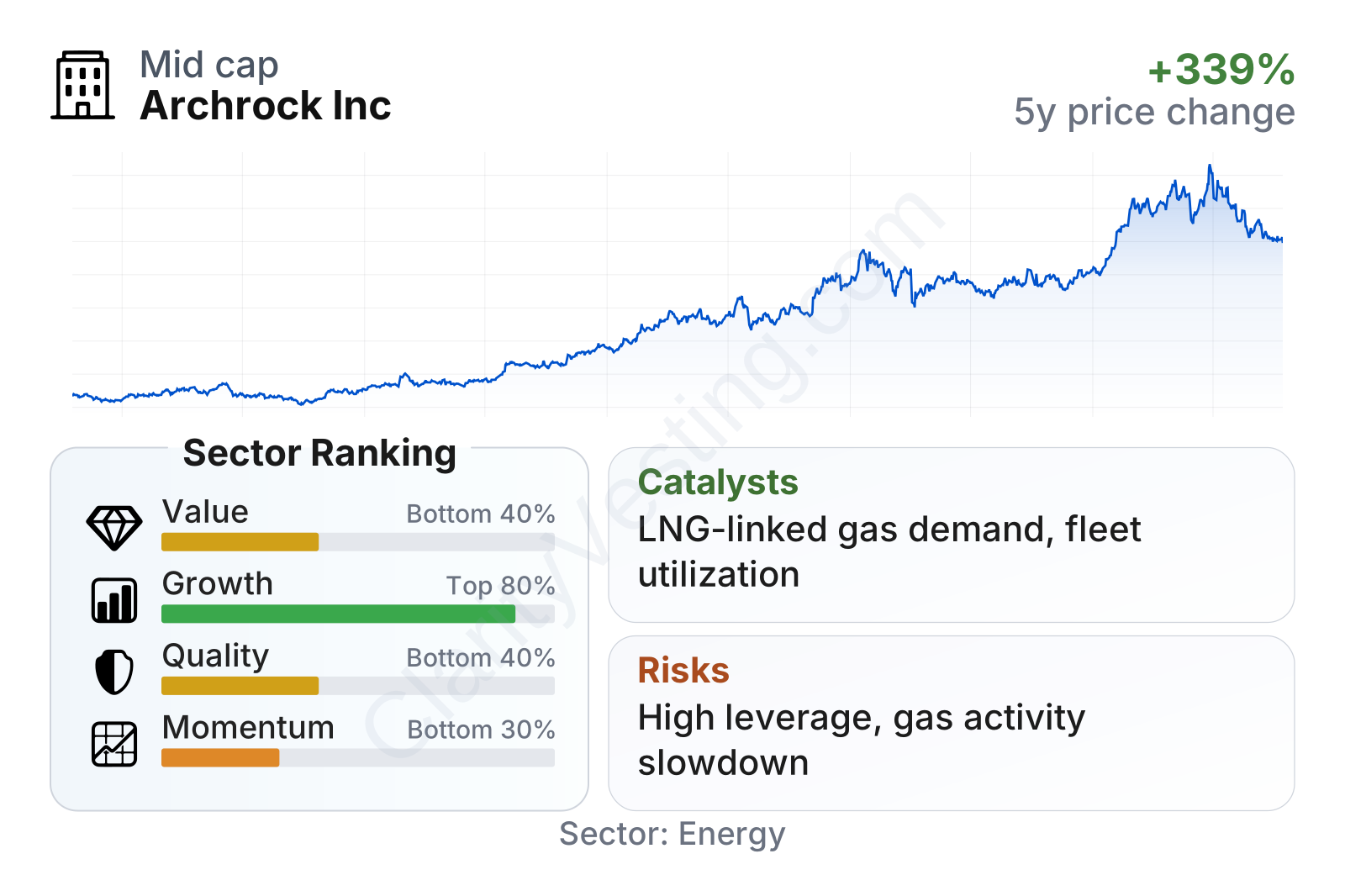
Archrock is now a mid-sized energy services company with a relatively low beta for the sector, which suggests its shares have not been as volatile as many energy names. The table points to a mixed profile: growth has been stronger than much of the sector over a multiyear period, profitability is solid, but balance-sheet leverage keeps overall quality scores from looking stronger. On valuation factors, the stock does not stand out as especially cheap versus the broader energy group.
The stock’s long-term share price trend has been very strong, especially since 2023, reflecting a combination of rising earnings, better margins, and improving sentiment around natural gas infrastructure. More recently, however, momentum has cooled, which usually means the market is asking whether the next phase of growth can keep pace with the gains already delivered.
Growth
Archrock operates in a part of the energy market that still has structural relevance. Natural gas remains a major fuel for U.S. power generation, industrial use, LNG exports, and petrochemicals. Even in a changing energy mix, gas infrastructure is expected to remain important for reliability and export growth. Compression demand tends to rise with higher gas production, greater pipeline and gathering needs, and stricter requirements for efficient operations in the field.
The company’s strategy is straightforward and sensible for long-term expansion: prioritize high-horsepower compression, keep fleet utilization high, invest in new units where demand is strongest, and deepen relationships with large producers and midstream customers. This approach benefits from scale because a broad installed base supports service revenue, field logistics, maintenance capability, and replacement demand over time.
Revenue growth was strong for most of the last several years, with many periods in the low-teens to above 40% range, before turning slightly negative in the latest comparison. That slowdown does not erase the bigger trend, but it does suggest growth is normalizing after a very strong stretch and may become more dependent on pricing discipline, new fleet additions, and acquisition integration rather than easy cyclical recovery.
One notable catalyst has been industry demand for large horsepower compression tied to gas production, associated gas handling, and infrastructure bottlenecks. Another has been consolidation. Archrock’s combination with Natural Gas Compression Systems strengthened its scale, customer reach, and equipment base. In this niche, size can matter because larger fleets are better positioned to meet customer needs quickly and keep equipment working at high utilization levels.
Free cash flow has been uneven over time, which is common in equipment-heavy businesses, but the recent trend has improved sharply. That matters because stronger cash generation gives the company more flexibility to fund growth capital, service debt, and continue returning capital through dividends without relying as heavily on external financing.
Recent company updates have also pointed to continued demand for compression services, especially in applications linked to U.S. natural gas volumes and export-related infrastructure. If LNG and gas takeaway capacity continue expanding, Archrock is positioned in an enabling layer of the value chain rather than depending on a single commodity price move alone.
Risks
This article is for informational purposes only and does not constitute financial advice. Some content is AI-generated. See Disclaimer


