Stock Analysis · Aramark Holdings (ARMK)
Overview
Aramark is a large food services and facilities services company that operates mainly in the United States and also in other countries. In simple terms, it runs dining programs, manages concessions, and provides support services for places such as schools, universities, hospitals, sports arenas, offices, factories, and correctional facilities. The business is built around long-term service contracts, recurring client relationships, and very large daily volumes of meals, refreshments, and site support work.
Its revenue mainly comes from food and support services delivered across a broad set of client sites. Based on the company’s recent annual reporting structure, the largest contributors are approximately:
- Food and support services in the United States, about 75% to 80%: campus dining, healthcare foodservice, workplace dining, corrections, and facility-related support work.
- Food and support services outside the United States, about 20% to 25%: similar activities in international markets, including education, business, healthcare, and leisure accounts.
- Product mix within total sales: food service revenue is the clear majority, while facilities and support services represent a smaller but meaningful share. The company does not always break these pieces out in a single simple percentage split across all operations.
Aramark’s model is straightforward: it manages high-volume, labor-intensive service operations for institutions that prefer to outsource these functions rather than run them in-house. That can create dependable demand, but it also means margins tend to be relatively thin because labor, food, and logistics costs absorb most of the revenue.
The financial flow shows a business that has expanded revenue materially over the last several years, while profitability has been much less steady. Sales moved from roughly $12 billion in fiscal 2021 to more than $18 billion in fiscal 2025, yet net income and gross profit have been more volatile, highlighting both the scale of the platform and the sensitivity of earnings to contract mix, inflation, and operating execution.
Key Figures
| Metric | Value | Sector ⓘ |
|---|---|---|
| Date | Oct 03, 2026 | |
| Context | ||
| Sector | Industrials | |
| Industry | Specialty Business Services | |
| Market Cap ⓘ | $14.35B | |
| Beta ⓘ | 1.19 | |
Value (Cheapness) | ||
| P/E Ratio ⓘ | 37.81 | 22.45 |
| P/B Ratio ⓘ | 4.33 | 1.98 |
| FCF Yield ⓘ | 3.26% | 6.31% |
| Dividend Yield ⓘ | 0.88% | 1.96% |
| EBIT / EV ⓘ | 4.15% | 4.81% |
| PEG ⓘ | 0.87 | |
Growth (Business expansion) | ||
| Revenue Growth ⓘ | 9.30% | 9.10% |
| RPS Growth (5Y CAGR) ⓘ | 9.88% | 7.75% |
| EPS Growth (5Y CAGR) ⓘ | 6.76% | -13.59% |
| BVPS Growth (5Y CAGR) ⓘ | 2.33% | 6.22% |
| Margin Growth (5Y Trend) ⓘ | 1.85% | 0.72% |
| FCF Growth (5Y CAGR) ⓘ | 12.70% | 10.98% |
| DPS Growth (5Y CAGR) ⓘ | -1.46% | 9.48% |
Quality (Business durability) | ||
| ROIC (Latest) ⓘ | 6.92% | 10.92% |
| ROA (Latest) ⓘ | 2.81% | 5.41% |
| ROIC (5Y Median) ⓘ | 5.34% | 9.21% |
| ROA (5Y Median) ⓘ | 1.78% | 4.94% |
| Net Debt / EBIT (Latest) ⓘ | 6.95 | 2.07 |
| Net Debt / EBIT (5Y Median) ⓘ | 6.58 | 2.28 |
| Net Debt / EBITDA (Latest) ⓘ | 4.34 | 1.43 |
| Net Debt / Assets ⓘ | 42.71% | 19.27% |
| EBITDA / Interest ⓘ | 4.04 | 9.53 |
| Operating Margin (Latest) ⓘ | 4.32% | 10.50% |
| Operating Margin (5Y Median) ⓘ | 4.17% | 10.27% |
| Debt to Equity (Latest) ⓘ | 190.56% | 65.48% |
| Profit Margin (Latest) ⓘ | 1.93% | 6.62% |
| Free Cash Flow (Latest) ⓘ | $467.89M | |
Momentum (Price trend) | ||
| 3Y Return ⓘ | +120.98% | +58.56% |
| 12M Return (excl. last month) ⓘ | +45.51% | +15.63% |
| 6M Return ⓘ | +32.66% | +4.19% |
| Price vs. 200-Day MA ⓘ | +11.43% | +0.93% |
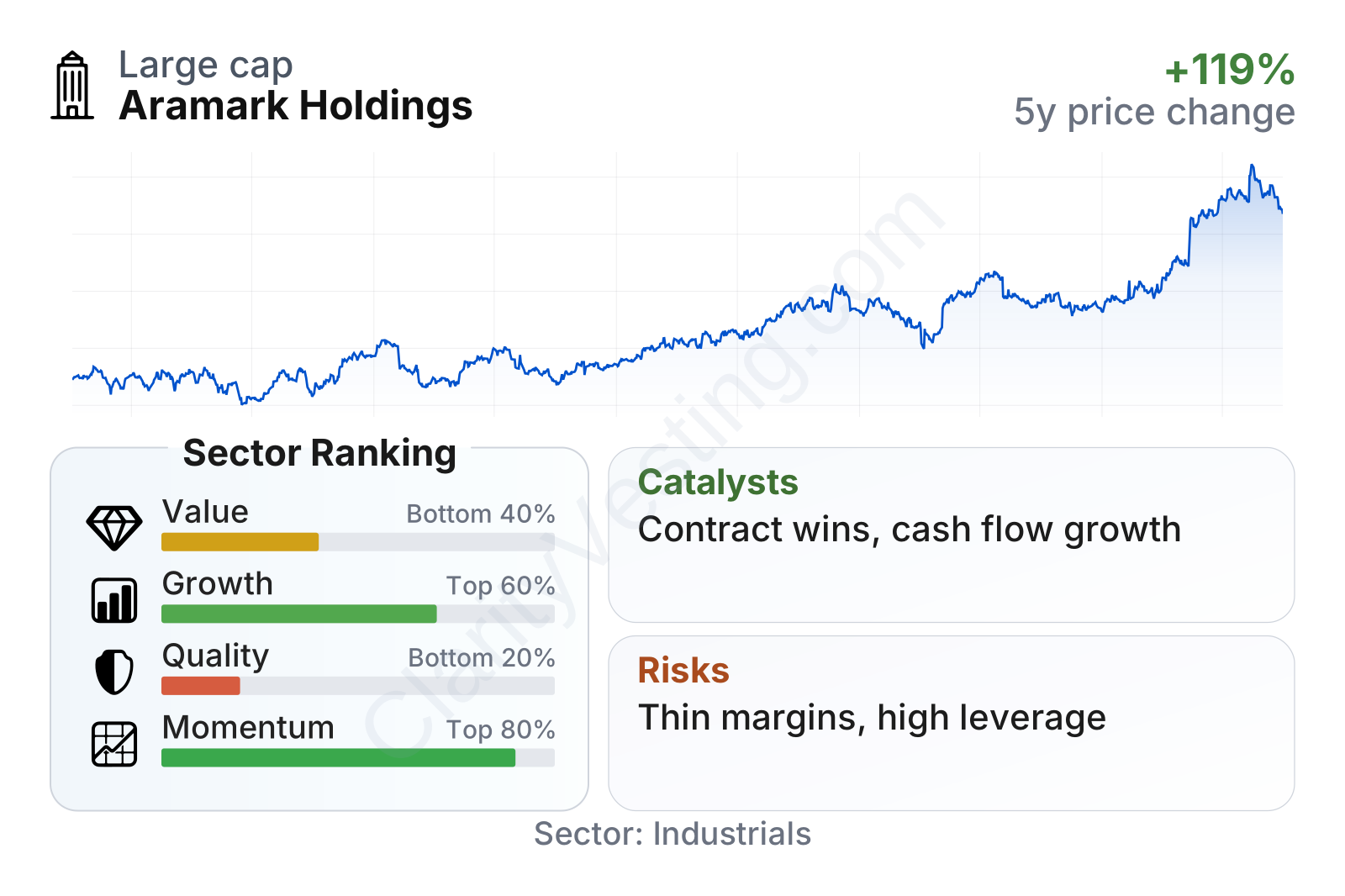
Aramark is a mid-to-large-sized company with above-market share price volatility, as shown by a beta modestly above 1. The broader picture from the latest metrics is mixed. Growth and market momentum look solid relative to much of the sector, but value and quality measures are weaker. In practice, that means the market has been rewarding the company’s recent progress, while the underlying business still carries lower margins, heavier leverage, and lower returns on capital than many peers.
Growth
Aramark operates in outsourced foodservice and facilities management, a sector supported by durable long-term trends. Many institutions want to reduce fixed overhead, improve labor flexibility, and rely on specialized operators for dining and support services. That makes the sector structurally attractive, especially for companies with national scale, purchasing power, and established client relationships.
The company’s strategy also fits that environment. Aramark has focused on contract retention, pricing actions, operational efficiency, and selective new business wins. Its customer base is diversified across education, healthcare, sports, leisure, and workplaces, which helps reduce dependence on any single end market. Some areas, especially higher education, healthcare, and sports venues, can provide steady demand even when the economy slows.
Recent revenue trends point to continued expansion, although not in a perfectly smooth line. After the post-pandemic rebound years, growth moderated and then reaccelerated, with the most recent year-over-year pace near 9%, roughly in line with the sector median. Over a five-year view, revenue per share growth has been stronger than the sector median, which suggests the business has been expanding at a respectable rate even if profitability has not always kept up at the same pace.
Cash generation is one of the more encouraging parts of the recent picture. Free cash flow moved from negative territory in 2022 to clearly positive and rising levels in the following years, reaching well above $400 million on a trailing basis. That matters because a contract services business needs cash to manage working capital, maintain service quality, and gradually reduce debt. A stronger cash profile can support flexibility even when margins remain narrow.
A notable catalyst for future growth is Aramark’s ability to win and retain large institutional contracts where scale matters. The company’s purchasing reach, national footprint, and embedded presence in schools, hospitals, and stadiums can create opportunities to deepen existing relationships and add more services per client site. Public company communications in 2026 have also emphasized business wins, retention, and ongoing productivity actions, which suggests management is still pushing both volume growth and efficiency at the same time.
Risks
This article is for informational purposes only and does not constitute financial advice. Some content is AI-generated. See Disclaimer