Stock Analysis · Alliance Resource Partners LP (ARLP)
Overview
Alliance Resource Partners LP is a U.S. energy partnership best known as a coal producer. Its core business is mining and selling thermal coal, which is mainly used by utilities and industrial customers to generate electricity and heat. The partnership operates mining complexes in the Illinois Basin and Appalachia and also owns interests in related energy and mineral assets.
For long-term analysis, the central point is that ARLP is still primarily a coal business, even though management has been trying to broaden the company through royalties, oil and gas mineral interests, and investments tied to energy infrastructure and data-center related power opportunities. That diversification matters, but coal remains the economic engine.
Based on recent company reporting, revenue is heavily concentrated in coal sales, with smaller contributions from other activities.
- Coal operations: approximately 90% to 95% of revenue. This includes coal produced and sold from ARLP’s mining operations to domestic utilities, industrial users, and export customers.
- Oil & gas royalties and mineral interests: approximately 3% to 7% of revenue. This comes from royalty income and lease-related payments tied to mineral ownership.
- Other and corporate-related activities: generally below 5% of revenue. This can include transportation, terminal, and miscellaneous energy-related activities.
What stands out is not a broad, balanced revenue mix, but a company using cash flow from coal to support distributions, maintain a relatively conservative balance sheet, and invest selectively outside its legacy business.
The business expanded sharply during the coal price upswing in 2022 and 2023, then cooled as pricing normalized. Even with lower revenue and earnings after that peak, ARLP has remained solidly profitable, which suggests the company did not rely only on unusually favorable market conditions to stay in the black.
Key Figures
| Metric | Value | Sector ⓘ |
|---|---|---|
| Date | Oct 17, 2026 | |
| Context | ||
| Sector | Energy | |
| Industry | Thermal Coal | |
| Market Cap ⓘ | $3.24B | |
| Beta ⓘ | 0.30 | |
Value (Cheapness) | ||
| P/E Ratio ⓘ | 12.28 | 15.44 |
| P/B Ratio ⓘ | 1.83 | 1.73 |
| FCF Yield ⓘ | 10.81% | 8.20% |
| Dividend Yield ⓘ | 9.64% | 3.59% |
| EBIT / EV ⓘ | 2393.90% | 7.46% |
| PEG ⓘ | 0.55 | |
Growth (Business expansion) | ||
| Revenue Growth ⓘ | 0.70% | 26.90% |
| RPS Growth (5Y CAGR) ⓘ | 8.48% | 6.90% |
| EPS Growth (5Y CAGR) ⓘ | -32.08% | -15.73% |
| BVPS Growth (5Y CAGR) ⓘ | 10.19% | 6.07% |
| Margin Growth (5Y Trend) ⓘ | 3.25% | 0.58% |
| FCF Growth (5Y CAGR) ⓘ | 6.44% | 1.86% |
| DPS Growth (5Y CAGR) ⓘ | 59.07% | 16.79% |
Quality (Business durability) | ||
| ROIC (Latest) ⓘ | 3707.31% | 11.40% |
| ROA (Latest) ⓘ | 9.11% | 6.06% |
| ROIC (5Y Median) ⓘ | 17.84% | 10.30% |
| ROA (5Y Median) ⓘ | 12.65% | 5.42% |
| Net Debt / EBIT (Latest) ⓘ | 0.01 | 1.64 |
| Net Debt / EBIT (5Y Median) ⓘ | 0.84 | 1.83 |
| Net Debt / EBITDA (Latest) ⓘ | 0.76 | 1.08 |
| Net Debt / Assets ⓘ | 16.31% | 17.29% |
| EBITDA / Interest ⓘ | 13.53 | 9.64 |
| Operating Margin (Latest) ⓘ | 4147.06% | 16.27% |
| Operating Margin (5Y Median) ⓘ | 17.02% | 20.39% |
| Debt to Equity (Latest) ⓘ | 33.40% | 54.76% |
| Profit Margin (Latest) ⓘ | 12.25% | 8.82% |
| Free Cash Flow (Latest) ⓘ | $350.26M | |
Momentum (Price trend) | ||
| 3Y Return ⓘ | +48.37% | +67.38% |
| 12M Return (excl. last month) ⓘ | +26.52% | +49.19% |
| 6M Return ⓘ | +1.70% | +7.07% |
| Price vs. 200-Day MA ⓘ | +0.70% | +9.56% |
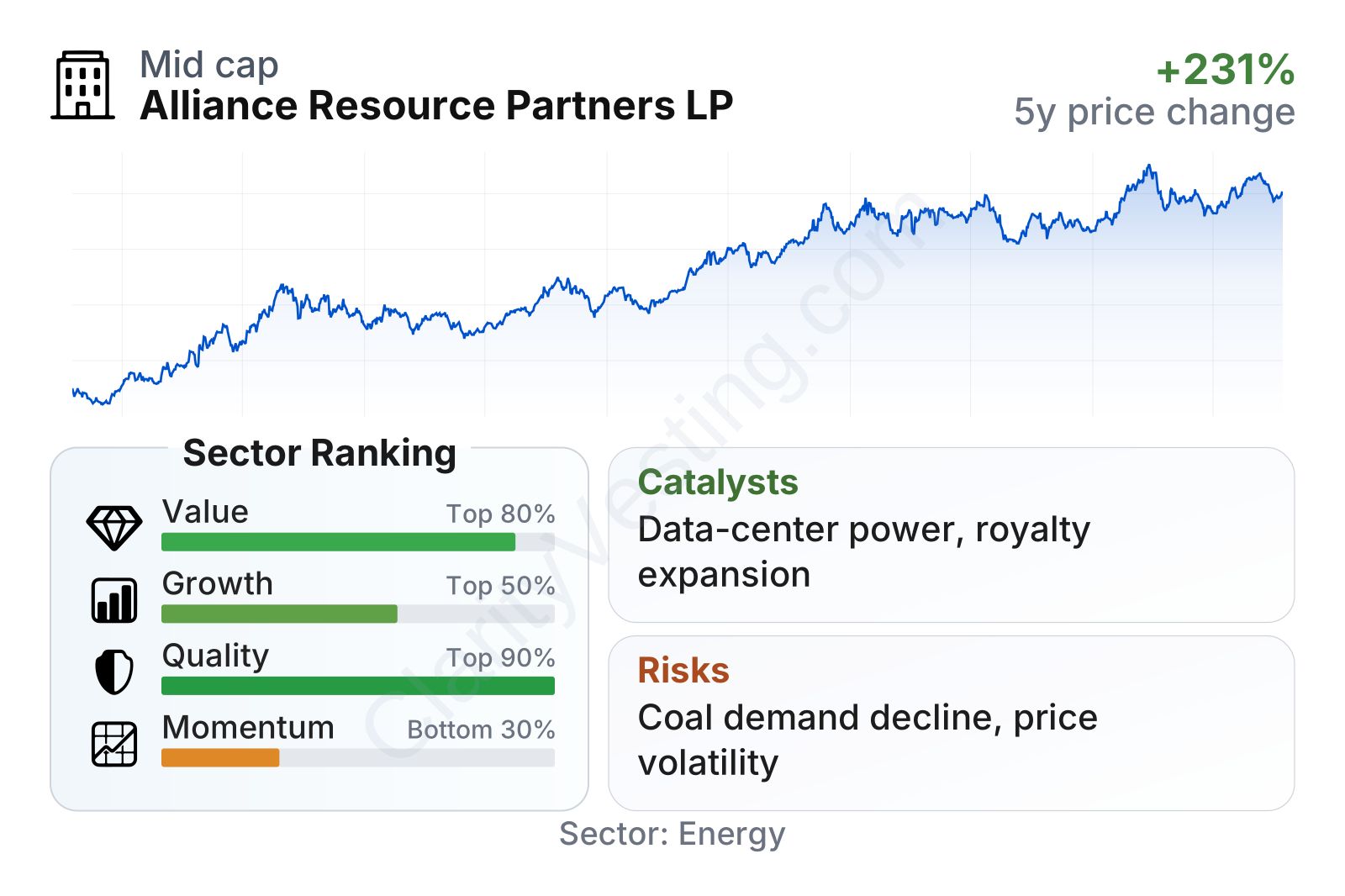
ARLP appears strongest on quality and cash generation. Profitability measures remain well above many energy peers, leverage is relatively modest, and free cash flow remains meaningful for a company of its size. Growth metrics are more mixed: the long-term record is respectable in revenue per share and book value growth, but recent year-over-year sales growth has been close to flat after a period of decline. Market performance has also been weaker than much of the sector recently, showing that strong cash generation has not translated into the same level of price momentum.
The share price history shows a major rerating since 2021, rising from single digits to the low-to-mid twenties range. That move reflects stronger coal fundamentals, higher cash returns to unitholders, and improved balance-sheet strength. At the same time, the slower momentum over the last several quarters suggests the market is already treating the coal windfall period as mature rather than early-stage.
Growth
ARLP operates in a sector with limited structural growth. Thermal coal is not a growing industry in the way data infrastructure, software, or semiconductors are. In the U.S., long-term electricity trends still favor natural gas, renewables, and in some regions nuclear power. Environmental regulation and utility decarbonization plans continue to pressure domestic coal demand over time.
That said, “limited structural growth” does not mean “no opportunity.” Coal demand can remain durable for longer than many expect when power grids need reliability, when natural gas prices rise, or when export demand supports pricing. ARLP’s strategy makes sense within that reality: harvest cash from a mature coal business, maintain contract coverage, keep leverage under control, and reinvest part of the cash flow into mineral royalties and power-related opportunities that could outlast coal’s domestic decline.
Revenue growth illustrates this pattern well. The company enjoyed exceptional expansion in 2022, then moved through a long normalization phase with several quarters of decline before returning to roughly flat-to-slightly-positive growth recently. This is consistent with a cyclical commodity business rather than a steady compounding growth company.
Free cash flow remains one of the more important positives. Even after stepping down from prior highs, ARLP has continued to generate several hundred million dollars in trailing cash flow. That financial flexibility supports distributions, debt management, and selective investments in newer areas such as oil and gas mineral interests and power-focused infrastructure initiatives.
A notable potential catalyst is the growing U.S. power demand tied to data centers and artificial intelligence infrastructure. ARLP has discussed opportunities around supplying or enabling reliable power for these large-load customers. This does not turn ARLP into a technology company, but it could create a practical bridge between its traditional fuel base and rising demand for around-the-clock electricity. If these efforts become commercially meaningful, they could improve the market’s view of ARLP as more than a pure coal partnership.
Risks
This article is for informational purposes only and does not constitute financial advice. Some content is AI-generated. See Disclaimer


