Stock Analysis · Arlo Technologies (ARLO)
Overview
Arlo Technologies is a connected security company focused on smart home and small-business monitoring. Its products include wireless cameras, video doorbells, floodlight cameras, security systems, and related accessories. The company also sells cloud-based subscriptions that add features such as video storage, AI-powered alerts, emergency response tools, and broader monitoring services. In simple terms, Arlo combines hardware sold upfront with recurring software and service revenue collected over time.
That mix matters because the business has been shifting away from being mainly a device seller toward a model with a larger subscription component. Hardware still brings in a meaningful share of sales, but subscriptions tend to carry higher margins and can make revenue more predictable if the customer base keeps expanding.
Based on recent company disclosures, Arlo’s revenue is mainly split between product revenue and service revenue.
- Product revenue: about 52% to 56% of total revenue in recent periods. This includes smart security cameras, doorbells, security systems, and accessories sold through retail, e-commerce, and channel partners.
- Service revenue: about 44% to 48% of total revenue in recent periods. This includes paid subscriptions such as Arlo Secure plans, cloud video storage, AI features, professional monitoring, and related service offerings.
The broad financial flow also shows an important improvement: revenue has grown moderately over the last few years, while gross profit has increased faster, helped by a richer service mix and better cost structure. The company was loss-making for several years, but it moved into positive net income in 2025, which is a notable turning point.
One of the clearest business changes is that gross profit has improved much faster than sales. That suggests Arlo is getting more value from each dollar of revenue, largely because recurring services are becoming more important and product costs have become more manageable.
Key Figures
| Metric | Value | Sector ⓘ |
|---|---|---|
| Date | Oct 03, 2026 | |
| Context | ||
| Sector | Industrials | |
| Industry | Building Products & Equipment | |
| Market Cap ⓘ | $1.34B | |
| Beta ⓘ | 1.54 | |
Value (Cheapness) | ||
| P/E Ratio ⓘ | 44.39 | 22.45 |
| P/B Ratio ⓘ | 8.67 | 1.98 |
| FCF Yield ⓘ | 5.00% | 6.31% |
| Dividend Yield ⓘ | N/A | 1.96% |
| EBIT / EV ⓘ | 2.39% | 4.81% |
| PEG ⓘ | 0.55 | |
Growth (Business expansion) | ||
| Revenue Growth ⓘ | 20.50% | 9.10% |
| RPS Growth (5Y CAGR) ⓘ | -2.25% | 7.75% |
| EPS Growth (5Y CAGR) ⓘ | N/A | -13.59% |
| BVPS Growth (5Y CAGR) ⓘ | -3.93% | 6.22% |
| Margin Growth (5Y Trend) ⓘ | N/A | 0.72% |
| FCF Growth (5Y CAGR) ⓘ | N/A | 10.98% |
| DPS Growth (5Y CAGR) ⓘ | N/A | 9.48% |
Quality (Business durability) | ||
| ROIC (Latest) ⓘ | 21.25% | 10.92% |
| ROA (Latest) ⓘ | 8.42% | 5.41% |
| ROIC (5Y Median) ⓘ | -22.47% | 9.21% |
| ROA (5Y Median) ⓘ | -10.45% | 4.94% |
| Net Debt / EBIT (Latest) ⓘ | -3.00 | 2.07 |
| Net Debt / EBIT (5Y Median) ⓘ | N/A | 2.28 |
| Net Debt / EBITDA (Latest) ⓘ | -2.44 | 1.43 |
| Net Debt / Assets ⓘ | -25.54% | 19.27% |
| EBITDA / Interest ⓘ | N/A | 9.53 |
| Operating Margin (Latest) ⓘ | 5.43% | 10.50% |
| Operating Margin (5Y Median) ⓘ | -5.76% | 10.27% |
| Debt to Equity (Latest) ⓘ | 3.61% | 65.48% |
| Profit Margin (Latest) ⓘ | 5.20% | 6.62% |
| Free Cash Flow (Latest) ⓘ | $66.87M | |
Momentum (Price trend) | ||
| 3Y Return ⓘ | +20.39% | +58.56% |
| 12M Return (excl. last month) ⓘ | -24.47% | +15.63% |
| 6M Return ⓘ | -12.86% | +4.19% |
| Price vs. 200-Day MA ⓘ | -8.21% | +0.93% |
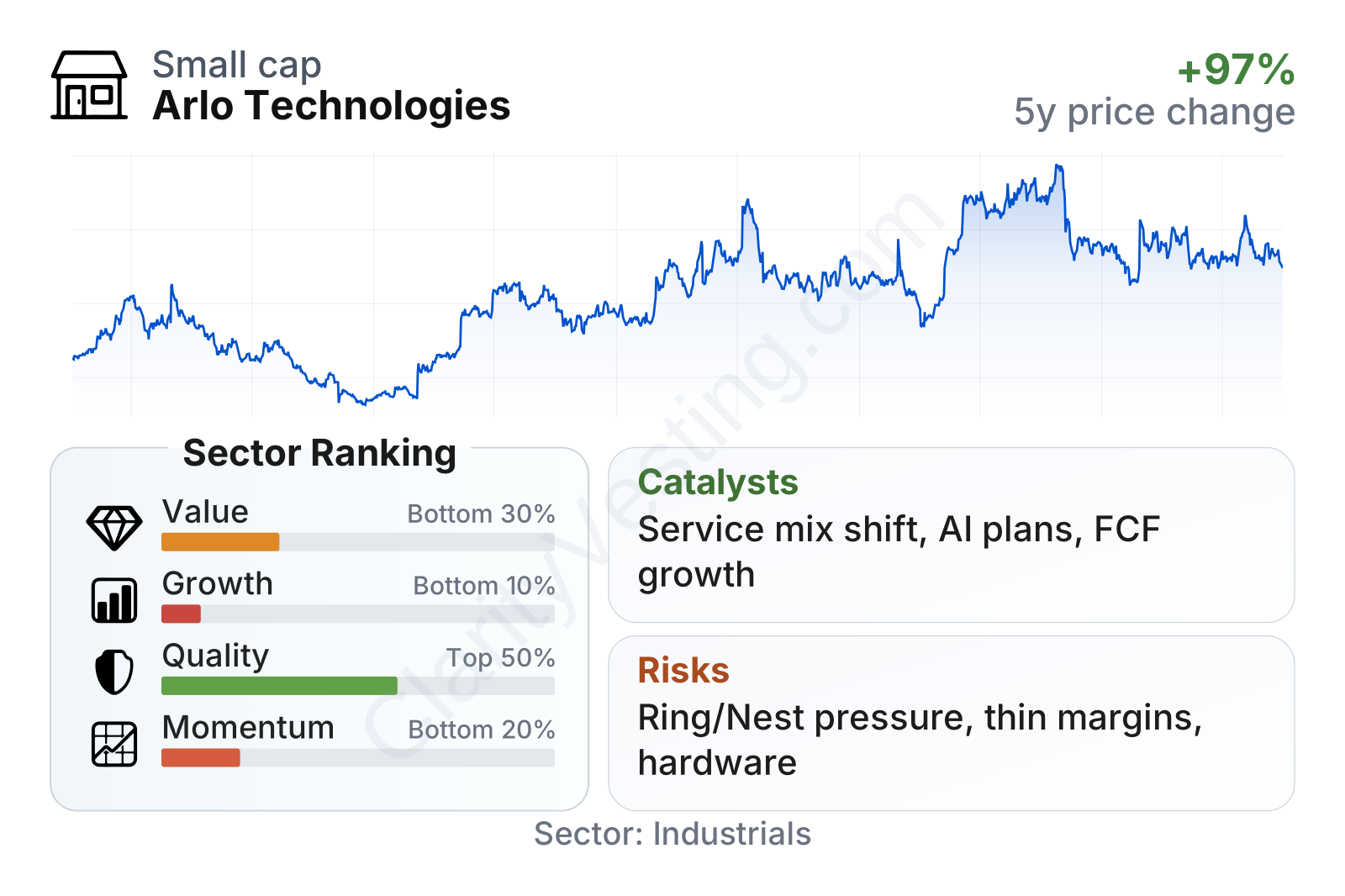
Arlo sits in the smaller-cap range, which can bring both upside from execution and higher share-price swings. The stock’s overall profile is mixed: balance-sheet quality looks strong, current profitability has improved, but valuation appears richer than much of the sector and recent share-price momentum has been weaker. The growth section of the table is also a bit deceptive at first glance: recent year-over-year growth has been solid, yet the longer five-year trend still reflects a business that spent several years restructuring and rebuilding.
The stock-price history also highlights that Arlo has been volatile. After a deep drop in 2022 and early 2023, the shares recovered strongly, then pulled back again. That pattern usually reflects a company that is transitioning from a low-profit hardware profile to a more stable recurring-revenue model, but where the market is still debating how durable that progress will be.
Growth
Arlo operates in a market with long-term growth drivers. Home and small-business security remain attractive categories because consumers increasingly want remote monitoring, smartphone control, AI-based detection, and subscription services layered on top of connected devices. This is not a brand-new market anymore, but it is still evolving as customers upgrade older products and adopt smarter monitoring tools.
Arlo’s strategy makes sense for that environment. Instead of relying only on one-time device sales, the company has spent years building a subscription base around its installed hardware footprint. That creates a more resilient model if customers stay engaged after the initial purchase. It also helps explain why free cash flow has improved and why profitability has recently turned positive.
Recent revenue growth has reaccelerated after a choppy period. Growth had several weak or negative quarters during the company’s transition, but the latest readings show a return to double-digit expansion, clearly ahead of the broader sector median. That does not erase the uneven longer-term record, yet it supports the view that Arlo’s current business mix is stronger than it was a few years ago.
Free cash flow has improved meaningfully, moving from negative territory to a solid positive level over the last two years. That is one of the more encouraging signals in Arlo’s profile because cash generation often says more about business durability than accounting earnings alone. If the company can keep growing subscriptions while controlling product and operating costs, this trend could remain an important support for the business.
A key catalyst is the continued expansion of paid subscribers and premium service adoption. Another is the company’s use of AI-powered security features, which can justify higher-priced plans and improve retention. Arlo has also been emphasizing partnerships, broader monitoring capabilities, and international reach, all of which can widen its addressable market without requiring a complete reinvention of the product lineup.
Recent company updates have pointed to ongoing service momentum, improving margins, and a larger recurring-revenue contribution. For a company of Arlo’s size, that combination can be significant because even moderate top-line growth can have an outsized effect if more of each new sales dollar falls to profit and cash flow.
Risks
This article is for informational purposes only and does not constitute financial advice. Some content is AI-generated. See Disclaimer