Stock Analysis · Aris Mining Corporation (ARIS)
Overview
Aris Mining is a gold mining company focused mainly on Colombia, with additional development exposure in Guyana and a growing interest in copper through its Soto Norte project. In simple terms, it finds, develops, and operates mines that produce gold, then sells that gold into the market. The company’s current production base is built around two operating assets in Colombia: Segovia and Marmato. Segovia has historically been the larger and more established operation, while Marmato is important both as a producer today and as a longer-term expansion platform.
For long-term readers, the business is relatively straightforward: revenue depends mostly on how much gold Aris produces, how efficiently it mines and processes ore, and the gold price it receives. The company has been moving from being a smaller producer with uneven profitability toward a larger platform with more operating scale and more development options. That transition matters because mining businesses often become stronger when fixed costs are spread across higher production.
Based on company disclosures, Aris Mining’s revenue is overwhelmingly tied to gold sales, with only limited contribution from silver and other by-products. A practical breakdown is:
- Gold sales: approximately 95% to 99% of revenue. This is the core business and includes production from Segovia and Marmato in Colombia.
- Silver and other by-products: approximately 1% to 5% of revenue. These are minor compared with gold and mainly arise alongside the main mining process.
- Development-stage optionality: currently negligible in revenue terms. Projects such as Soto Norte and the Toroparu project in Guyana are more relevant for future growth than current sales.
Geographically, Colombia accounts for the great majority of current operating revenue because that is where the producing mines are located. Guyana is presently more of a future value driver than a current revenue contributor.
One notable operating trend is that revenue expanded sharply from about $511 million in 2024 to about $928 million in 2025, while operating income improved even faster. That suggests the company did not just benefit from higher sales volume or gold prices; it also captured stronger operating leverage as the business scaled.
Key Figures
| Metric | Value | Sector ⓘ |
|---|---|---|
| Date | Oct 24, 2026 | |
| Context | ||
| Sector | Basic Materials | |
| Industry | Gold | |
| Market Cap ⓘ | $3.52B | |
| Beta ⓘ | 2.08 | |
Value (Cheapness) | ||
| P/E Ratio ⓘ | 12.27 | 16.92 |
| P/B Ratio ⓘ | 2.02 | 1.66 |
| FCF Yield ⓘ | 3.36% | 5.83% |
| Dividend Yield ⓘ | N/A | 2.07% |
| EBIT / EV ⓘ | 12.81% | 6.38% |
| PEG ⓘ | N/A | |
Growth (Business expansion) | ||
| Revenue Growth ⓘ | 62.30% | 11.25% |
| RPS Growth (5Y CAGR) ⓘ | 4.72% | 4.49% |
| EPS Growth (5Y CAGR) ⓘ | 16.99% | -15.24% |
| BVPS Growth (5Y CAGR) ⓘ | 10.60% | 5.49% |
| Margin Growth (5Y Trend) ⓘ | -37.40% | -1.54% |
| FCF Growth (5Y CAGR) ⓘ | N/A | 0.37% |
| DPS Growth (5Y CAGR) ⓘ | N/A | 5.91% |
Quality (Business durability) | ||
| ROIC (Latest) ⓘ | 15.25% | 9.59% |
| ROA (Latest) ⓘ | 10.91% | 4.92% |
| ROIC (5Y Median) ⓘ | N/A | 7.91% |
| ROA (5Y Median) ⓘ | 1.47% | 3.92% |
| Net Debt / EBIT (Latest) ⓘ | 0.16 | 1.36 |
| Net Debt / EBIT (5Y Median) ⓘ | 1.59 | 1.69 |
| Net Debt / EBITDA (Latest) ⓘ | 0.14 | 0.93 |
| Net Debt / Assets ⓘ | 2.84% | 13.69% |
| EBITDA / Interest ⓘ | 17.26 | 12.38 |
| Operating Margin (Latest) ⓘ | 40.19% | 13.24% |
| Operating Margin (5Y Median) ⓘ | 21.51% | 11.82% |
| Debt to Equity (Latest) ⓘ | 28.65% | 40.30% |
| Profit Margin (Latest) ⓘ | 22.43% | 6.38% |
| Free Cash Flow (Latest) ⓘ | $118.35M | |
Momentum (Price trend) | ||
| 3Y Return ⓘ | +732.03% | +73.47% |
| 12M Return (excl. last month) ⓘ | +100.11% | +27.59% |
| 6M Return ⓘ | -10.42% | -4.02% |
| Price vs. 200-Day MA ⓘ | -5.34% | -0.65% |
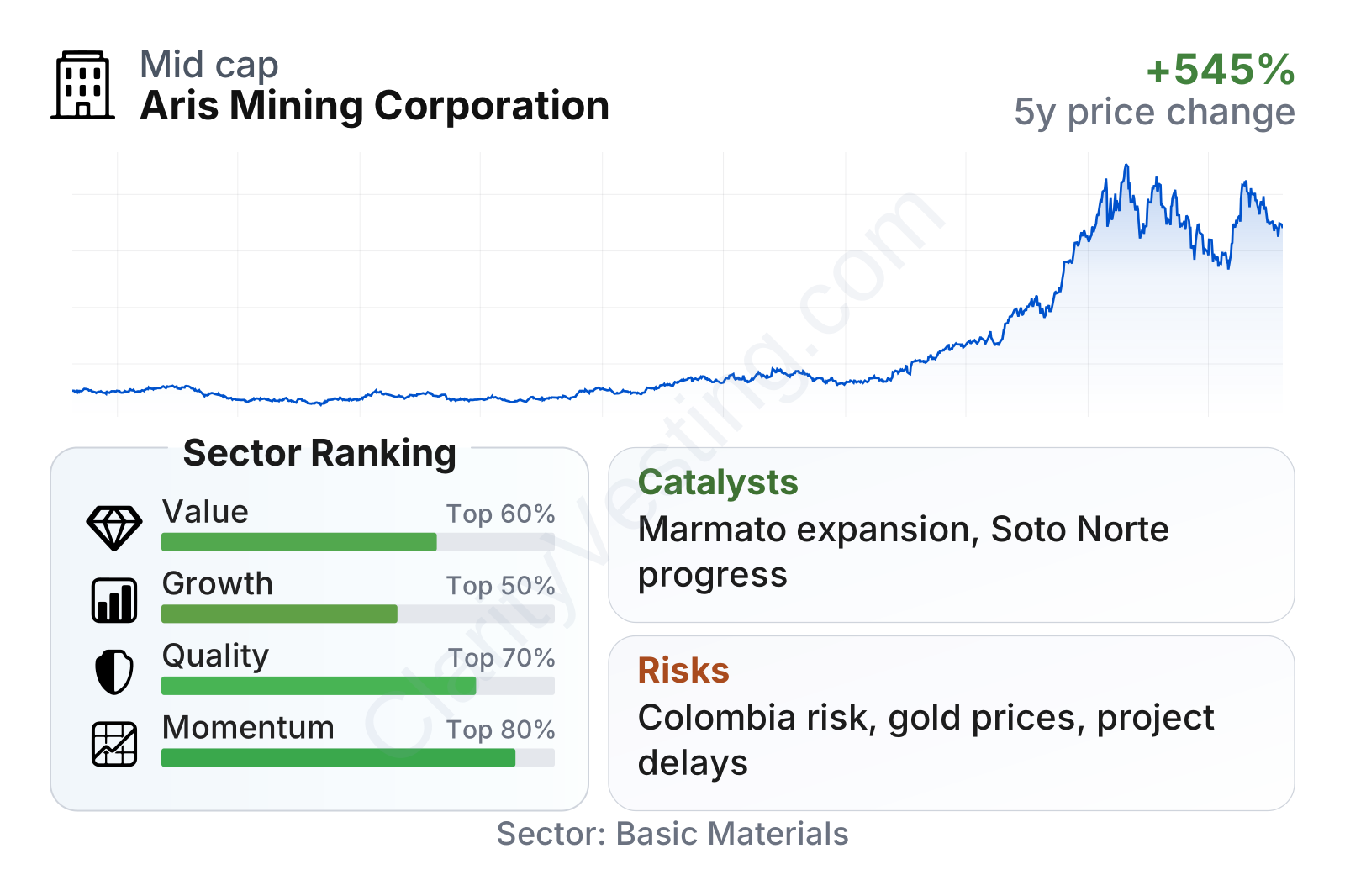
Aris Mining now sits in the mid-cap range, which is large enough to attract broader market attention but still small enough for mine expansions and project execution to meaningfully change the company’s profile. The table points to an unusual mix: value metrics are not stretched, quality measures are strong, and recent growth has clearly outpaced much of the gold sector. Profitability and returns on capital are above sector medians, while leverage looks controlled. The main caution from the snapshot is not balance sheet stress, but share-price volatility, with a beta above 2 showing that the stock can move much more sharply than the broader market.
The stock chart also highlights how dramatic the re-rating has been. After trading near very low levels in 2022 and 2023, the shares climbed strongly through 2024 and into 2026 before pulling back. That pattern often reflects a market that has started to recognize improved operations, but it also shows that sentiment around gold miners can change quickly.
Growth
Gold mining remains a sector with long-term relevance, though not a high-growth industry in the same sense as software or healthcare innovation. What supports the sector is different: limited new global supply, long permitting timelines, central bank gold buying, and gold’s role as a store of value during inflation, currency weakness, or geopolitical stress. For a producer like Aris, that backdrop can be attractive if it is also increasing output from its own asset base.
Aris Mining’s strategy is coherent for future growth because it combines producing mines with expansion projects. Segovia provides current cash generation, Marmato offers a visible path to larger production, and Soto Norte plus Toroparu create longer-dated upside if they move ahead successfully. This is more appealing than a miner that depends on a single mature asset with no obvious pipeline.
Recent revenue growth has been far above the sector median, including a very strong acceleration through 2025 and still elevated year-over-year growth in 2026. Part of that reflects stronger gold prices, but the scale of the increase suggests company-specific progress as well. Fast growth in mining needs careful interpretation because acquisitions, project ramp-ups, and metal prices can all distort one-year comparisons, yet the broader direction is clearly positive.
Cash generation has also turned materially stronger. Free cash flow was negative at points during the build-out phase, which is common when a mining company is investing heavily, but it has since moved decisively into positive territory. That shift is important because mining companies ultimately need to prove that accounting profits can become real cash after capital spending.
A major catalyst is the expansion work at Marmato Lower Mine, which is intended to transform the scale and life of that asset. In addition, Segovia continues to offer optimization potential through plant improvements and mining development. The company has also highlighted progress across its development portfolio, especially Soto Norte, which is one of the larger undeveloped gold-copper opportunities in the region. If execution remains on track, Aris could move from being primarily a Colombian producer to a broader multi-asset growth platform.
Recent company updates have also emphasized higher production and stronger financial performance, which matter more than promotional exploration headlines. In mining, growth becomes much more durable when it is backed by operating mines, expanding throughput, and better cash flow rather than just resource estimates.
Risks
This article is for informational purposes only and does not constitute financial advice. Some content is AI-generated. See Disclaimer


