Stock Analysis · argenx SE (ARGNF)
Overview
argenx SE is a biotechnology company focused on treatments for severe autoimmune diseases. Its central idea is to reduce harmful antibodies that attack the body by using a targeted approach built around the FcRn pathway. In simpler terms, the company develops medicines for diseases in which the immune system is overactive and damages nerves, muscles, blood cells, or other tissues.
The business today is largely driven by one product family: efgartigimod, marketed as Vyvgart and Vyvgart Hytrulo. These products are approved in generalized myasthenia gravis, and the company is working to expand them into additional autoimmune indications. argenx also has earlier-stage pipeline programs, but commercial revenue is still overwhelmingly tied to its lead franchise.
Based on recent annual reporting and company disclosures, the main revenue sources are approximately the following:
- Product net sales of Vyvgart / Vyvgart Hytrulo: about 95% to 99% of total revenue. This includes sales in approved autoimmune indications, with the U.S. as the main market.
- Collaboration and license revenue: about 1% to 5% of total revenue. This can include partner-related payments, milestones, and other collaboration items.
- Other revenue: minimal. This is not a major driver of the business at this stage.
The company’s financial profile has changed quickly over the last few years. Revenue moved from a pre-profit biotech model into a commercial-stage model with billions of dollars in annual sales, while research and launch spending also remained high. That combination makes argenx different from many biotechnology peers that still have no meaningful product revenue.
The broad pattern is clear: revenue has risen sharply since 2023, gross profit remains very strong because product cost is relatively low compared with sales, and the business crossed from losses into sizable profitability in 2024 and 2025 even while research and commercial spending kept expanding.
Key Figures
| Metric | Value | Sector ⓘ |
|---|---|---|
| Date | Oct 10, 2026 | |
| Context | ||
| Sector | Healthcare | |
| Industry | Biotechnology | |
| Market Cap ⓘ | $58.86B | |
| Beta ⓘ | -0.04 | |
Value (Cheapness) | ||
| P/E Ratio ⓘ | 35.67 | 24.79 |
| P/B Ratio ⓘ | 6.95 | 2.97 |
| FCF Yield ⓘ | N/A | 3.11% |
| Dividend Yield ⓘ | N/A | 2.04% |
| EBIT / EV ⓘ | 3.97% | 0.57% |
| PEG ⓘ | 1.38 | |
Growth (Business expansion) | ||
| Revenue Growth ⓘ | 59.30% | 7.35% |
| RPS Growth (5Y CAGR) ⓘ | 62.50% | 8.61% |
| EPS Growth (5Y CAGR) ⓘ | N/A | -18.43% |
| BVPS Growth (5Y CAGR) ⓘ | 24.63% | 3.94% |
| Margin Growth (5Y Trend) ⓘ | N/A | -0.61% |
| FCF Growth (5Y CAGR) ⓘ | N/A | 0.88% |
| DPS Growth (5Y CAGR) ⓘ | N/A | 6.74% |
Quality (Business durability) | ||
| ROIC (Latest) ⓘ | N/A | 3.34% |
| ROA (Latest) ⓘ | N/A | 2.95% |
| ROIC (5Y Median) ⓘ | -2.71% | 4.60% |
| ROA (5Y Median) ⓘ | -7.69% | 1.89% |
| Net Debt / EBIT (Latest) ⓘ | N/A | 1.36 |
| Net Debt / EBIT (5Y Median) ⓘ | N/A | 1.86 |
| Net Debt / EBITDA (Latest) ⓘ | N/A | 1.02 |
| Net Debt / Assets ⓘ | N/A | 5.85% |
| EBITDA / Interest ⓘ | 458.30 | 9.60 |
| Operating Margin (Latest) ⓘ | 33.50% | 9.19% |
| Operating Margin (5Y Median) ⓘ | -24.76% | 7.53% |
| Debt to Equity (Latest) ⓘ | N/A | 29.44% |
| Profit Margin (Latest) ⓘ | 32.27% | 3.52% |
| Free Cash Flow (Latest) ⓘ | N/A | |
Momentum (Price trend) | ||
| 3Y Return ⓘ | +106.60% | +34.80% |
| 12M Return (excl. last month) ⓘ | +48.47% | +19.33% |
| 6M Return ⓘ | +31.46% | +7.18% |
| Price vs. 200-Day MA ⓘ | +8.75% | +3.20% |
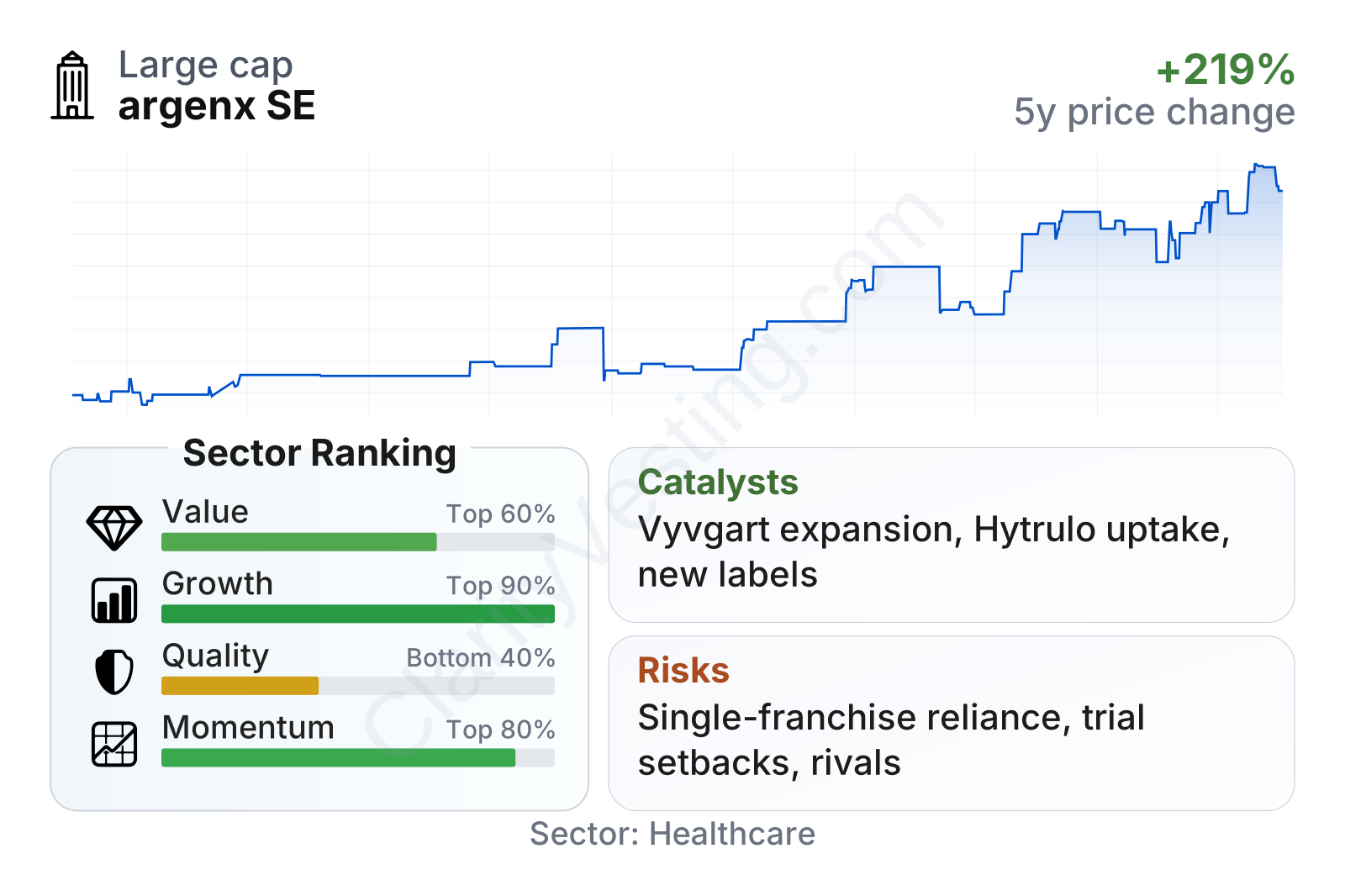
argenx is now a large biotechnology company rather than an early-stage developer. Growth stands out versus most healthcare peers, with revenue expanding far faster than the sector median over both one-year and five-year periods. Profitability has also improved materially, and the recent profit margin is far above the industry median. On valuation, the shares trade at higher earnings and book multiples than the sector median, which shows that the market already recognizes the company’s stronger growth and improving economics.
The share price history also reflects that transition. The stock has been volatile, which is common in biotechnology, but the multi-year trend has been strongly upward as the company moved from pipeline expectations to large-scale commercial execution.
Growth
argenx operates in a part of healthcare with long-term structural growth. Autoimmune diseases are common, many are chronic, and a meaningful number of patients still cycle through treatments that are not fully effective or have difficult side effects. A therapy that is both targeted and usable across several diseases can therefore create a large opportunity if clinical results remain strong.
The company’s strategy is relatively easy to understand: build one core mechanism across multiple autoimmune conditions, deepen physician adoption in approved uses, and add new formulations that make treatment easier. That approach can create growth in several ways at once: more patients in current indications, launches in additional diseases, and wider international penetration.
Recent growth has been unusually strong even by biotechnology standards. The company’s latest growth metrics place it near the top of the healthcare sector, and the longer-term trend shows that expansion is not limited to one isolated quarter. This matters because fast growth in biotech is often uneven, whereas argenx has now established a commercial base large enough to make the business model more durable.
A major catalyst is continued expansion of the Vyvgart franchise. New indication approvals, broader reimbursement, and increased physician familiarity can all lift sales without requiring a completely new commercial infrastructure. The subcutaneous Hytrulo version is also important because easier administration can support broader use and improve the product’s competitive position.
Another growth driver is the pipeline beyond current approvals. argenx has advanced programs in additional immune-mediated diseases, and positive trial readouts could expand the addressable market considerably. Recent company updates have continued to emphasize label expansion and execution in chronic inflammatory demyelinating polyneuropathy and other autoimmune settings as major opportunities for the next phase of growth.
Risks
This article is for informational purposes only and does not constitute financial advice. Some content is AI-generated. See Disclaimer


