Stock Analysis · Alexandria Real Estate Equities Inc (ARE)
Overview
Alexandria Real Estate Equities is a real estate investment trust, or REIT, focused on life science, biotech, pharmaceutical, medical technology, and advanced research campuses. Instead of operating typical office buildings, it develops, owns, and manages specialized laboratory and innovation properties in major research clusters such as Greater Boston, the San Francisco Bay Area, San Diego, Seattle, New York City, Maryland, and the Research Triangle.
The company’s business is built around renting highly technical space to tenants that need labs, research facilities, and related offices near top universities, hospitals, and talent pools. That specialization matters because laboratory real estate is harder to replicate than standard office space: buildings often require advanced ventilation, power, safety systems, and regulatory compliance.
Its revenue comes primarily from rental income and related tenant recoveries, with additional contributions from real estate services and occasional property sales or development-related activity. Based on the company’s recent annual reporting structure, the mix is approximately:
- Rental and tenant-related income: about 90% to 95% — recurring lease revenue from laboratory, office, and campus properties, plus reimbursements for operating costs.
- Other real estate operations and services: about 3% to 7% — parking, amenity income, management-related items, and other property-linked revenue streams.
- Gains on asset sales and other non-recurring items: usually below 5% — these can vary significantly from year to year and are not the core earnings engine.
That model makes Alexandria much closer to an infrastructure landlord for the life science industry than a traditional office owner. Over the last several years, total revenue expanded from a little above $2.1 billion in 2021 to roughly $3.0 billion in 2024, before easing slightly in 2025, while gross profit remained substantial even as operating profitability became more volatile.
The long-term revenue base has grown meaningfully since 2021, but the most recent period shows pressure on operating income and net income. In other words, the top line has held up much better than the bottom line, which points to asset charges, higher financing costs, and weaker earnings quality rather than a collapse in the underlying rental model.
Key Figures
| Metric | Value | Sector ⓘ |
|---|---|---|
| Date | Oct 17, 2026 | |
| Context | ||
| Sector | Real Estate | |
| Industry | REIT - Office | |
| Market Cap ⓘ | $7.14B | |
| Beta ⓘ | 1.18 | |
Value (Cheapness) | ||
| P/E Ratio ⓘ | N/A | 17.38 |
| P/B Ratio ⓘ | 0.67 | 0.85 |
| FCF Yield ⓘ | 12.27% | 7.38% |
| Dividend Yield ⓘ | 7.94% | 4.85% |
| EBIT / EV ⓘ | -3.91% | 3.78% |
| PEG ⓘ | 3.24 | |
Growth (Business expansion) | ||
| Revenue Growth ⓘ | -11.90% | 5.30% |
| RPS Growth (5Y CAGR) ⓘ | 5.01% | 6.02% |
| EPS Growth (5Y CAGR) ⓘ | 16.65% | -11.37% |
| BVPS Growth (5Y CAGR) ⓘ | -14.44% | 0.45% |
| Margin Growth (5Y Trend) ⓘ | -58.41% | -0.22% |
| FCF Growth (5Y CAGR) ⓘ | N/A | 5.40% |
| DPS Growth (5Y CAGR) ⓘ | 4.72% | 5.02% |
Quality (Business durability) | ||
| ROIC (Latest) ⓘ | -2.29% | 5.69% |
| ROE (Latest) ⓘ | -7.52% | 7.56% |
| ROA (Latest) ⓘ | -2.51% | 2.85% |
| ROIC (5Y Median) ⓘ | 1.81% | 4.22% |
| ROE (5Y Median) ⓘ | 2.24% | 6.03% |
| ROA (5Y Median) ⓘ | 0.87% | 2.44% |
| Net Debt / EBIT (Latest) ⓘ | N/A | 7.59 |
| Net Debt / EBIT (5Y Median) ⓘ | 16.71 | 8.40 |
| Net Debt / EBITDA (Latest) ⓘ | 29.00 | 5.27 |
| Net Debt / Assets ⓘ | 35.64% | 37.76% |
| EBITDA / Interest ⓘ | 1.71 | 4.10 |
| Operating Margin (Latest) ⓘ | -28.62% | 35.29% |
| Operating Margin (5Y Median) ⓘ | 22.84% | 37.31% |
| Debt to Equity (Latest) ⓘ | 82.38% | 88.87% |
| Profit Margin (Latest) ⓘ | -36.08% | 19.61% |
| Free Cash Flow (Latest) ⓘ | $876.13M | |
Momentum (Price trend) | ||
| 3Y Return ⓘ | -50.66% | +30.75% |
| 12M Return (excl. last month) ⓘ | -34.38% | +4.36% |
| 6M Return ⓘ | -8.54% | -2.52% |
| Price vs. 200-Day MA ⓘ | -13.19% | -2.34% |
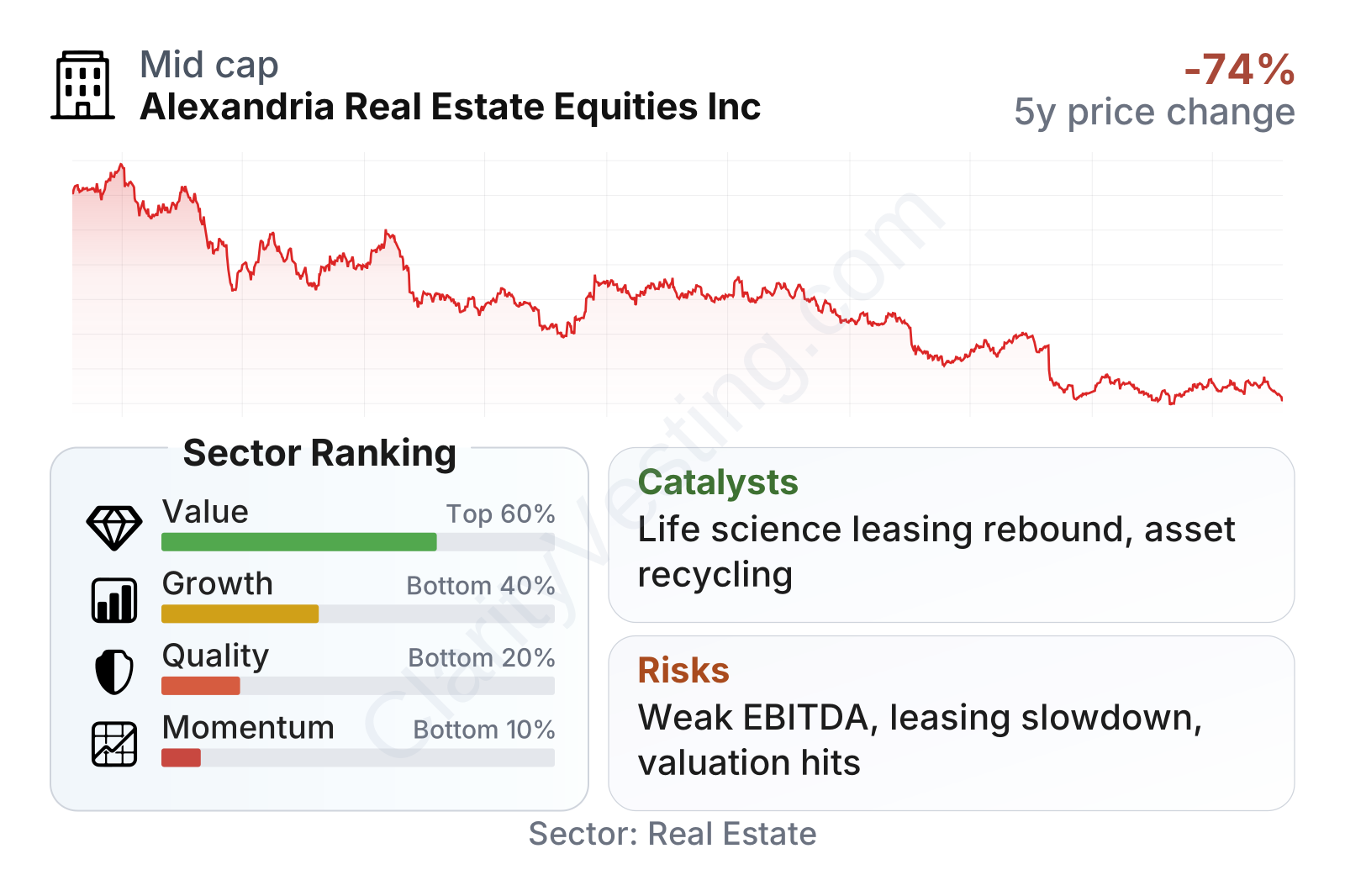
Alexandria remains a sizable REIT, but the current profile is mixed. On value measures, the stock screens cheaper than much of the sector, helped by a price-to-book ratio below the sector median, a free cash flow yield above the median, and a dividend yield around 7%. By contrast, growth, quality, and momentum are notably weaker. Recent revenue declined year over year, profitability has turned negative on several measures, and the share price has fallen sharply over the last three years despite a modest recovery in the last six months.
The broad message is that the market is treating Alexandria as a discounted asset-heavy company facing earnings pressure rather than as a high-quality growth REIT. That gap between asset value and operating performance is central to the investment debate.
Growth
Alexandria operates in a part of real estate that still has structural relevance. Life science research requires physical labs, not just software tools or remote work setups. Drug discovery, biologics, medical devices, and research collaborations are tied to specialized buildings near academic and clinical ecosystems. That gives the sector a stronger long-term purpose than conventional office real estate.
Its strategy also has a clear logic. The company concentrates on leading innovation clusters where tenants benefit from proximity to universities, hospitals, venture capital, and skilled labor. This cluster approach can create stickier demand because moving a wet lab is expensive, disruptive, and technically difficult. In a stronger funding environment, that can support occupancy, development leasing, and pricing power.
Revenue per share rose steadily from 2021 through 2024 before flattening slightly in 2025. That suggests the portfolio has produced meaningful long-term expansion, even if the most recent year no longer shows the same momentum. It is a sign of a business that built scale successfully, but has now entered a slower phase.
The dividend per share has also continued to climb over the last five years at a mid-single-digit pace. For a REIT, that consistency matters because it points to a management team that has tried to preserve cash distributions even during a more difficult operating period. The recent yield moved much higher largely because the share price dropped, not because dividend growth accelerated.
The main catalyst for future growth is a recovery in life science leasing and capital availability for biotech tenants. If funding conditions improve and tenants resume expansion, Alexandria is positioned to benefit because it already controls a large, established footprint in the most important U.S. research hubs. Another potential catalyst is development stabilization: when newly delivered projects move from construction to leased operation, cash flow can improve without needing entirely new land positions.
Recent company updates have also emphasized selective asset sales, capital recycling, and a tighter focus on balance sheet discipline. That does not create fast growth by itself, but it can improve the quality of future growth by lowering funding pressure and concentrating resources on the strongest campuses.
Risks
This article is for informational purposes only and does not constitute financial advice. Some content is AI-generated. See Disclaimer


