Stock Analysis · Ardent Health Partners Inc (ARDT)
Overview
Ardent Health Partners is a hospital operator focused on delivering medical care through a network of hospitals, outpatient facilities, physician practices, and related services in mid-sized urban markets across the United States. Its business is centered on running local health systems rather than developing drugs or medical devices. That makes its results primarily tied to patient volumes, reimbursement rates, labor costs, and how efficiently it manages hospital operations.
The company generates most of its revenue from patient care activities. Based on its public filings, the revenue mix is heavily concentrated in care delivery and can be summarized as follows:
- Inpatient hospital services: approximately 45% to 55% of revenue. This includes admissions for surgeries, acute care, emergency follow-up admissions, and other hospital stays.
- Outpatient services: approximately 35% to 45% of revenue. This generally includes emergency room visits that do not convert to admission, imaging, same-day procedures, ambulatory care, and other non-overnight services.
- Other patient-related and ancillary services: approximately 5% to 15% of revenue. This can include physician services, pharmacy-related activities, and other support services tied to the company’s care network.
Like most hospital systems, Ardent is paid by a mix of commercial insurers, Medicare, Medicaid, and self-pay patients. Commercial plans usually produce higher reimbursement, while government programs are a large volume source but typically lower margin. That payer mix matters because even small changes in reimbursement or uninsured volumes can meaningfully affect profits.
The company’s financial profile shows a business with multi-billion-dollar annual revenue, modest accounting margins, and stronger cash generation than its net income alone might suggest. Over the last several years, revenue has generally trended upward, but earnings have been more uneven because hospital operations are sensitive to staffing expense, utilization shifts, and payer dynamics.
Over time, revenue has moved higher, and operating income recovered strongly in 2024 after a weaker 2023. The broader pattern suggests that scale is improving, but profitability still depends heavily on keeping labor and administrative costs under control.
Key Figures
| Metric | Value | Sector ⓘ |
|---|---|---|
| Date | Oct 24, 2026 | |
| Context | ||
| Sector | Healthcare | |
| Industry | Medical Care Facilities | |
| Market Cap ⓘ | $1.70B | |
| Beta ⓘ | 0.72 | |
Value (Cheapness) | ||
| P/E Ratio ⓘ | 22.33 | 25.42 |
| P/B Ratio ⓘ | 1.84 | 3.08 |
| FCF Yield ⓘ | 17.67% | 3.12% |
| Dividend Yield ⓘ | N/A | 1.85% |
| EBIT / EV ⓘ | 7.80% | 0.56% |
| PEG ⓘ | N/A | |
Growth (Business expansion) | ||
| Revenue Growth ⓘ | -1.40% | 7.50% |
| RPS Growth (5Y CAGR) ⓘ | 7.09% | 8.60% |
| EPS Growth (5Y CAGR) ⓘ | -54.47% | -17.73% |
| BVPS Growth (5Y CAGR) ⓘ | 21.34% | 3.72% |
| Margin Growth (5Y Trend) ⓘ | -2.60% | -0.57% |
| FCF Growth (5Y CAGR) ⓘ | 139.15% | 0.96% |
| DPS Growth (5Y CAGR) ⓘ | N/A | 6.69% |
Quality (Business durability) | ||
| ROIC (Latest) ⓘ | 7.83% | 3.17% |
| ROA (Latest) ⓘ | 1.50% | 2.98% |
| ROIC (5Y Median) ⓘ | N/A | 4.56% |
| ROA (5Y Median) ⓘ | 4.18% | 1.87% |
| Net Debt / EBIT (Latest) ⓘ | 6.50 | 1.34 |
| Net Debt / EBIT (5Y Median) ⓘ | 4.73 | 1.86 |
| Net Debt / EBITDA (Latest) ⓘ | 3.84 | 1.00 |
| Net Debt / Assets ⓘ | 29.20% | 5.06% |
| EBITDA / Interest ⓘ | 8.10 | 9.55 |
| Operating Margin (Latest) ⓘ | 3.70% | 9.25% |
| Operating Margin (5Y Median) ⓘ | 7.18% | 7.33% |
| Debt to Equity (Latest) ⓘ | 167.81% | 26.68% |
| Profit Margin (Latest) ⓘ | 1.22% | 3.34% |
| Free Cash Flow (Latest) ⓘ | $300.57M | |
Momentum (Price trend) | ||
| 3Y Return ⓘ | N/A | +51.61% |
| 12M Return (excl. last month) ⓘ | -15.96% | +19.90% |
| 6M Return ⓘ | +25.48% | +10.10% |
| Price vs. 200-Day MA ⓘ | +25.00% | +6.44% |
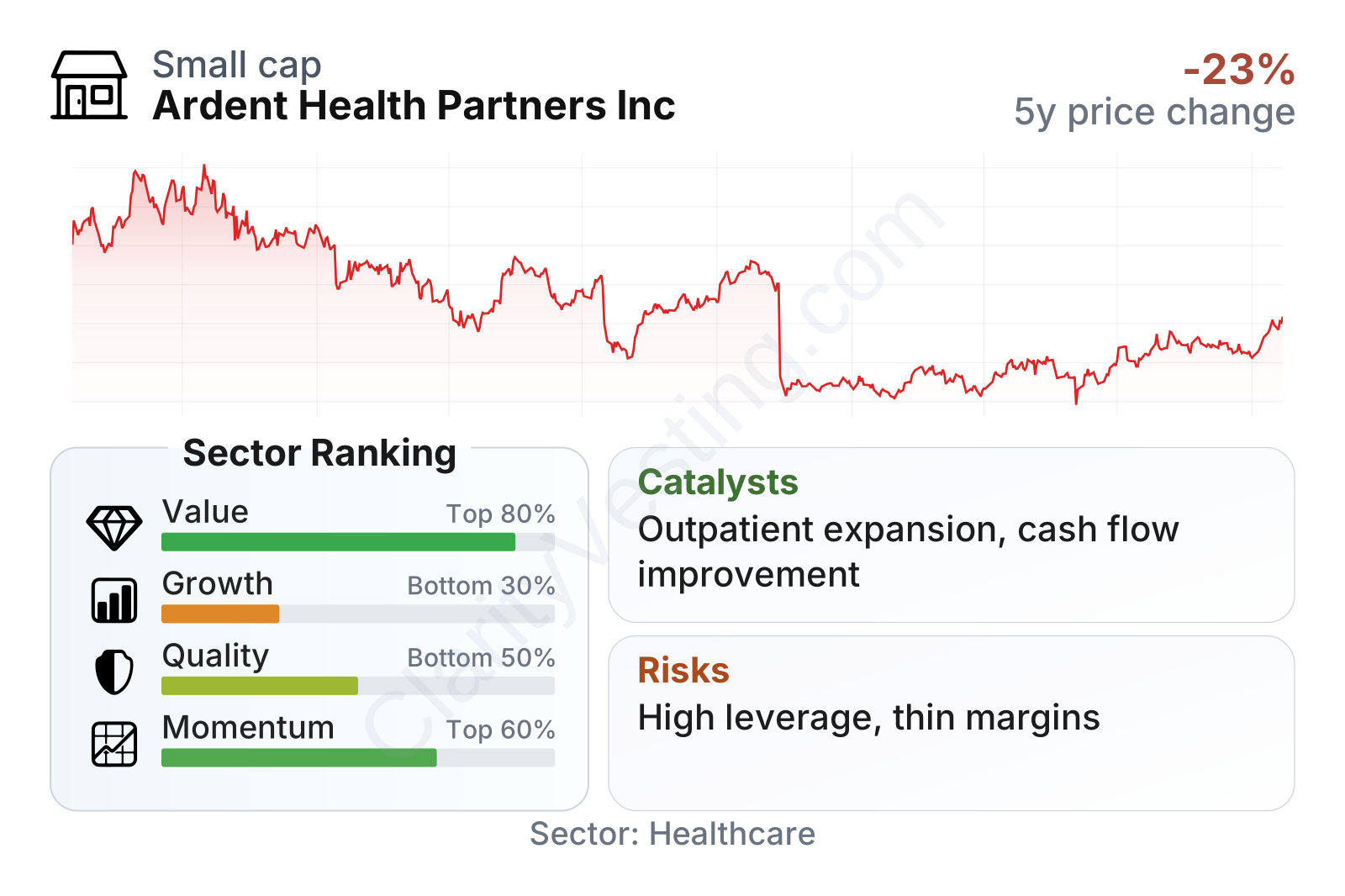
Ardent sits in the smaller publicly traded tier of healthcare providers, with a stock that has been volatile since listing. On relative metrics, valuation looks lighter than the sector on earnings and book value, while free cash flow measures stand out positively. The weaker side is growth and operating quality: recent revenue momentum has lagged the sector, margins are thin, and leverage remains well above typical healthcare levels.
The stock history shows a sharp decline after the initial public period, followed by a partial recovery. That pattern usually signals that the market is still debating the durability of margins and the company’s ability to convert revenue growth into more stable earnings.
Growth
Ardent operates in a healthcare segment with durable long-term demand. Hospital care benefits from population aging, ongoing demand for emergency and surgical services, and the gradual shift of more care into coordinated local systems that combine hospitals, clinics, and physicians. This is not a fast-growth industry in the way software can be, but it can offer steady expansion when operators add outpatient capacity, improve service mix, and deepen market share in the communities they already serve.
Ardent’s strategy appears logical for that environment. The company has focused on regional health systems, partnerships with local physicians, and expansion across outpatient settings. That matters because outpatient care is often where patient relationships start, and it can feed higher-value hospital procedures later. It also helps diversify away from relying only on inpatient admissions.
Recent growth has been uneven rather than consistently strong. Through 2025 and into early 2026, revenue growth showed several solid quarters, but the latest reading turned slightly negative year over year. That does not automatically mean the growth case is broken, but it does show that demand and reimbursement gains are not yet translating into a smooth trend.
Cash generation is a brighter point. Free cash flow improved materially from late 2024 to early 2026, which is important for a hospital company carrying meaningful debt. Stronger cash flow gives management more room to invest in facilities, expand outpatient operations, and reduce financial pressure over time.
A notable growth catalyst is execution on operational improvement after the company’s public listing period. If Ardent can keep labor costs in check, improve patient mix, and continue building outpatient and physician alignment, it has room to lift earnings faster than revenue. The company also operates in markets where local scale can matter, since hospital systems with recognized regional positions can attract referrals and negotiate more effectively with insurers.
Recent company updates have also emphasized transaction activity and network development, which can create opportunity when acquisitions or partnerships strengthen a market position without overextending the balance sheet. For a business like Ardent, well-integrated expansion can be more valuable than headline growth alone.
Risks
This article is for informational purposes only and does not constitute financial advice. Some content is AI-generated. See Disclaimer


