Stock Analysis · ArcBest Corp (ARCB)
Overview
ArcBest Corp is a transportation and logistics company best known for its less-than-truckload, or LTL, freight business. In simple terms, it helps businesses move goods across the country, either by filling part of a trailer with shipments from several customers or by arranging other forms of transportation and supply chain services. The company operates through a mix of asset-based operations, which use its own tractors, trailers, terminals, and employees, and asset-light operations, which rely more on third-party carriers, brokerage, and logistics coordination.
Its business is still centered on freight transportation, but ArcBest has been trying to broaden its role from a traditional trucking operator into a wider logistics platform. That matters because logistics services can deepen customer relationships and, in stronger freight markets, create opportunities beyond basic linehaul pricing.
Based on recent annual reporting, ArcBest’s revenue mix is approximately:
- Asset-Based: about 70% to 75% of revenue. This is the company’s core LTL freight segment, primarily operated through ABF Freight, and includes regional, interregional, and expedited freight moved through ArcBest’s owned network.
- Asset-Light: about 25% to 30% of revenue. This segment includes truckload brokerage, expedite, managed transportation, and other logistics and household-goods related services that use third-party capacity.
The broad pattern in recent years has been that the asset-based segment remains the economic backbone of the group, while the asset-light business gives ArcBest a way to offer customers a fuller menu of shipping options. Revenue has moved with freight demand and pricing cycles, so the mix is important: owned-network freight tends to provide scale and brand recognition, while asset-light services can support flexibility.
The long-term picture shows a business that expanded strongly during the freight upcycle of 2021 and 2022, then experienced a meaningful drop in profitability as the market normalized. Revenue stayed near the $4 billion level in more recent years, but earnings conversion weakened sharply, showing how sensitive this business can be to freight conditions and pricing discipline.
Key Figures
| Metric | Value | Sector ⓘ |
|---|---|---|
| Date | Oct 03, 2026 | |
| Context | ||
| Sector | Industrials | |
| Industry | Trucking | |
| Market Cap ⓘ | $2.88B | |
| Beta ⓘ | 1.55 | |
Value (Cheapness) | ||
| P/E Ratio ⓘ | 184.10 | 22.45 |
| P/B Ratio ⓘ | 2.25 | 1.98 |
| FCF Yield ⓘ | 6.68% | 6.31% |
| Dividend Yield ⓘ | 0.38% | 1.96% |
| EBIT / EV ⓘ | 1.01% | 4.81% |
| PEG ⓘ | 0.50 | |
Growth (Business expansion) | ||
| Revenue Growth ⓘ | 15.90% | 9.10% |
| RPS Growth (5Y CAGR) ⓘ | 5.59% | 7.75% |
| EPS Growth (5Y CAGR) ⓘ | -35.08% | -13.59% |
| BVPS Growth (5Y CAGR) ⓘ | 12.96% | 6.22% |
| Margin Growth (5Y Trend) ⓘ | -5.11% | 0.72% |
| FCF Growth (5Y CAGR) ⓘ | -19.92% | 10.98% |
| DPS Growth (5Y CAGR) ⓘ | 12.00% | 9.48% |
Quality (Business durability) | ||
| ROIC (Latest) ⓘ | 1.50% | 10.92% |
| ROA (Latest) ⓘ | 0.66% | 5.41% |
| ROIC (5Y Median) ⓘ | 12.13% | 9.21% |
| ROA (5Y Median) ⓘ | 7.08% | 4.94% |
| Net Debt / EBIT (Latest) ⓘ | 9.68 | 2.07 |
| Net Debt / EBIT (5Y Median) ⓘ | 1.02 | 2.28 |
| Net Debt / EBITDA (Latest) ⓘ | 2.58 | 1.43 |
| Net Debt / Assets ⓘ | 12.80% | 19.27% |
| EBITDA / Interest ⓘ | 8.00 | 9.53 |
| Operating Margin (Latest) ⓘ | 0.77% | 10.50% |
| Operating Margin (5Y Median) ⓘ | 5.45% | 10.27% |
| Debt to Equity (Latest) ⓘ | 36.27% | 65.48% |
| Profit Margin (Latest) ⓘ | 0.39% | 6.62% |
| Free Cash Flow (Latest) ⓘ | $192.38M | |
Momentum (Price trend) | ||
| 3Y Return ⓘ | +27.24% | +58.56% |
| 12M Return (excl. last month) ⓘ | +87.96% | +15.63% |
| 6M Return ⓘ | +29.81% | +4.19% |
| Price vs. 200-Day MA ⓘ | +7.02% | +0.93% |
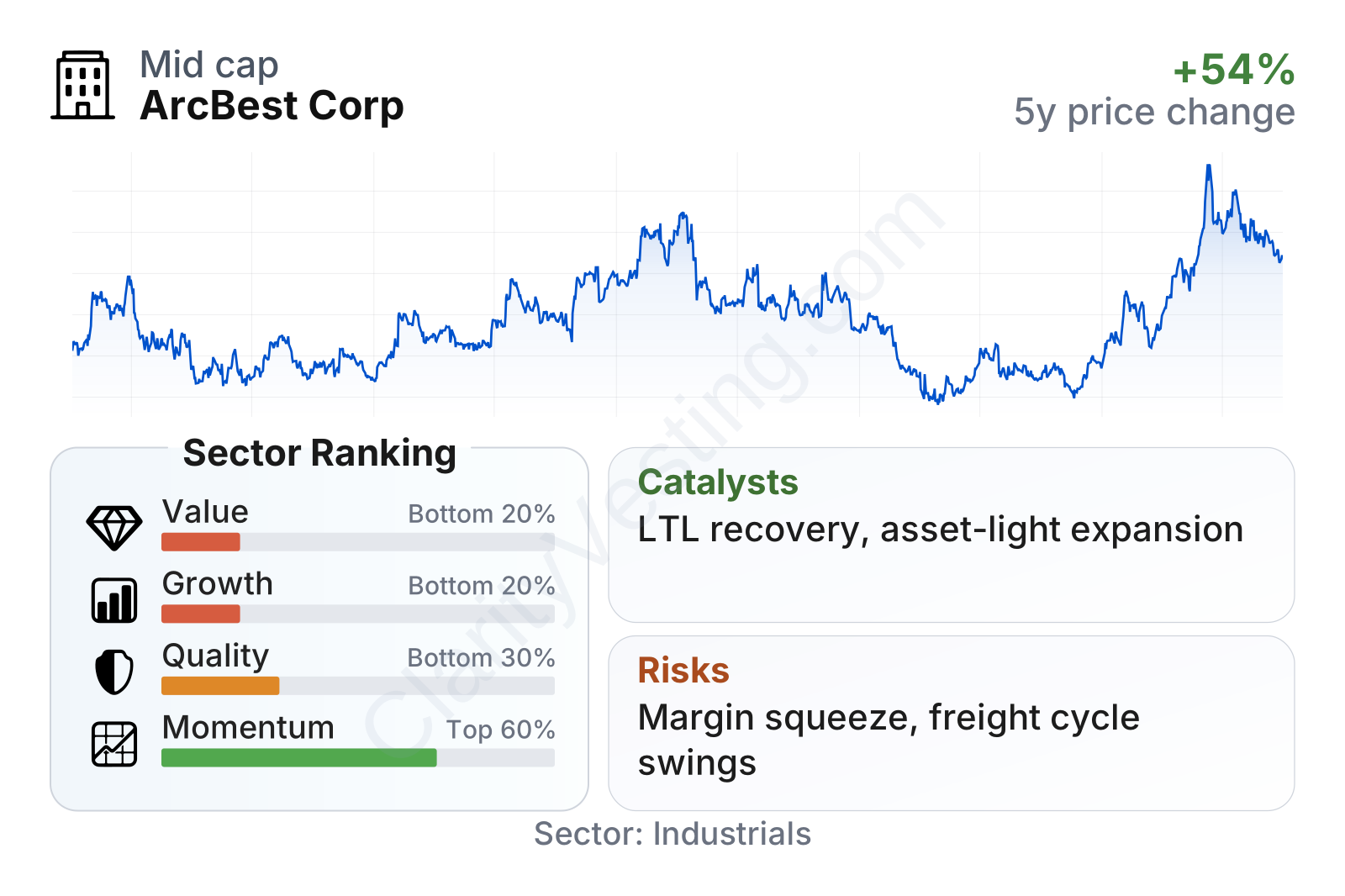
ArcBest is a mid-sized public company in the transportation space, and its share price has been volatile, which fits a cyclical freight operator with a beta above 1.5. The factor breakdown is mixed. Momentum has been relatively strong in the recent period, but value, growth, and quality rank in the lower part of the sector. The main reason is that current earnings and margins are unusually compressed, which makes headline valuation ratios look stretched even though free cash flow remains positive and leverage by debt-to-equity is not aggressive.
Growth
The company operates in a sector that should remain essential over the long run. Freight transportation is tied to industrial production, retail replenishment, manufacturing activity, and e-commerce supply chains. Those are durable needs, even if year-to-year demand can be uneven. On top of that, shippers increasingly want fewer vendors and more integrated logistics support, which supports ArcBest’s effort to combine LTL transportation with brokerage, managed transportation, and technology-enabled supply chain services.
Its strategy is sensible in that context. ArcBest is not trying to abandon its core network business; instead, it is using that network as the anchor while expanding cross-selling into broader logistics solutions. This can strengthen customer retention and reduce reliance on a single service category. The company has also emphasized technology, terminal investments, fleet modernization, and service quality, all of which matter in LTL where on-time performance and network density can help protect pricing.
Recent top-line trends suggest the business may be emerging from a difficult freight cycle. Revenue growth turned negative through much of 2023, 2024, and 2025, reflecting weaker freight conditions, but the latest readings moved back into positive territory and recently accelerated into the mid-teens. That does not prove a full cycle recovery, but it is an encouraging sign that demand and pricing pressure may be easing.
Cash generation has also improved from the lows seen after the freight downturn. Free cash flow remains positive and has rebounded meaningfully from weaker levels, which gives the company flexibility for equipment spending, technology investment, dividends, and share repurchases. For a transportation company, staying cash generative during a tougher cycle is an important marker of resilience.
A major catalyst is any sustained recovery in the LTL pricing environment and industrial freight volumes. Another is execution in the asset-light business, where ArcBest can deepen its customer role without needing to own all the underlying transportation capacity. If the company can pair stabilizing volumes with better margins, the earnings rebound could be stronger than revenue growth alone suggests.
Recent company communications have also highlighted continued investment in technology, customer-facing digital tools, and network optimization. Those initiatives are not instant growth drivers, but they can help improve efficiency and customer stickiness over time.
Risks
This article is for informational purposes only and does not constitute financial advice. Some content is AI-generated. See Disclaimer