Stock Analysis · Arcadis NV (ARCAY)
Overview
Arcadis NV is a global design, engineering, and consulting company focused on the built and natural environment. In simple terms, it helps governments, utilities, transport agencies, real estate owners, and industrial clients plan, design, improve, and manage infrastructure and buildings. Its work ranges from water systems and flood protection to transportation networks, environmental remediation, data centers, offices, and urban development.
The business is mainly service-based rather than asset-heavy. Arcadis earns revenue from professional fees tied to engineering, consulting, architecture, program management, and digital solutions. Based on the company’s recent annual reporting, revenue is broadly split across three global business areas:
- Resilience: approximately 34% of revenue. This includes water management, climate adaptation, environmental services, flood defense, coastal protection, and related infrastructure.
- Places: approximately 33% of revenue. This covers buildings, architecture, urban development, workplace design, and projects tied to healthcare, education, commercial real estate, and data centers.
- Mobility: approximately 33% of revenue. This includes transportation engineering and advisory work for roads, rail, bridges, tunnels, aviation, ports, and transit systems.
Geographically, Arcadis is diversified across Europe, North America, and Asia-Pacific, which reduces dependence on any one local market. A meaningful share of activity also comes from public-sector and regulated clients, especially in water, environmental, and transportation work, which can support demand through different economic cycles.
The business model has shown a clear improvement in converting revenue into operating profit over the last several years, even though revenue leveled off more recently. That points to better project mix and execution rather than growth coming only from volume.
Key Figures
| Metric | Value | Sector ⓘ |
|---|---|---|
| Date | Oct 03, 2026 | |
| Context | ||
| Sector | Industrials | |
| Industry | Engineering & Construction | |
| Market Cap ⓘ | $4.18B | |
| Beta ⓘ | 0.73 | |
Value (Cheapness) | ||
| P/E Ratio ⓘ | 18.49 | 22.45 |
| P/B Ratio ⓘ | 3.88 | 1.98 |
| FCF Yield ⓘ | 15.97% | 6.31% |
| Dividend Yield ⓘ | 2.14% | 1.96% |
| EBIT / EV ⓘ | N/A | 4.81% |
| PEG ⓘ | 1.65 | |
Growth (Business expansion) | ||
| Revenue Growth ⓘ | 1.10% | 9.10% |
| RPS Growth (5Y CAGR) ⓘ | 9.81% | 7.75% |
| EPS Growth (5Y CAGR) ⓘ | N/A | -13.59% |
| BVPS Growth (5Y CAGR) ⓘ | 0.58% | 6.22% |
| Margin Growth (5Y Trend) ⓘ | 0.35% | 0.72% |
| FCF Growth (5Y CAGR) ⓘ | 5.78% | 10.98% |
| DPS Growth (5Y CAGR) ⓘ | 29.99% | 9.48% |
Quality (Business durability) | ||
| ROIC (Latest) ⓘ | 25.73% | 10.92% |
| ROA (Latest) ⓘ | 11.44% | 5.41% |
| ROIC (5Y Median) ⓘ | 13.54% | 9.21% |
| ROA (5Y Median) ⓘ | 5.52% | 4.94% |
| Net Debt / EBIT (Latest) ⓘ | 1.44 | 2.07 |
| Net Debt / EBIT (5Y Median) ⓘ | 2.21 | 2.28 |
| Net Debt / EBITDA (Latest) ⓘ | 1.15 | 1.43 |
| Net Debt / Assets ⓘ | 27.36% | 19.27% |
| EBITDA / Interest ⓘ | 6.00 | 9.53 |
| Operating Margin (Latest) ⓘ | 7.36% | 10.50% |
| Operating Margin (5Y Median) ⓘ | 7.16% | 10.27% |
| Debt to Equity (Latest) ⓘ | 125.50% | 65.48% |
| Profit Margin (Latest) ⓘ | 4.16% | 6.62% |
| Free Cash Flow (Latest) ⓘ | $666.74M | |
Momentum (Price trend) | ||
| 3Y Return ⓘ | +16.11% | +58.56% |
| 12M Return (excl. last month) ⓘ | +15.09% | +15.63% |
| 6M Return ⓘ | +56.95% | +4.19% |
| Price vs. 200-Day MA ⓘ | +4.70% | +0.93% |
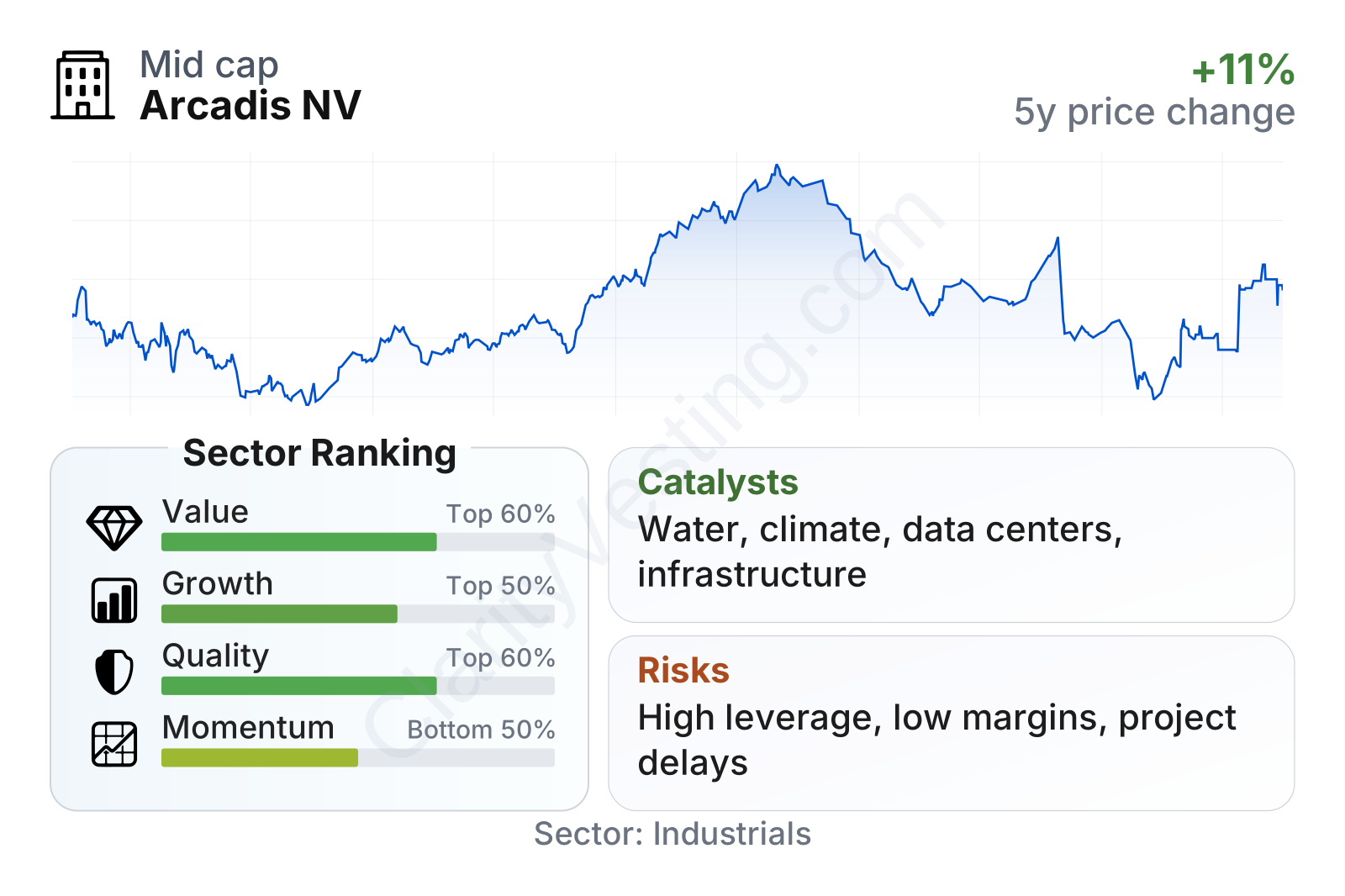
Arcadis sits in the mid-cap range and has shown lower share-price volatility than the broader market, with a beta below 1. On valuation, earnings and cash-flow measures look more favorable than much of the sector, while the price-to-book ratio is notably richer. Profitability and returns on capital are stronger than many peers, but recent revenue growth has been softer. The market picture is mixed: long-term share performance has lagged many industrial peers, yet the shorter-term trend has improved.
Growth
Arcadis operates in several areas with long-duration demand drivers. Water scarcity, climate adaptation, environmental cleanup, aging infrastructure, urbanization, transportation modernization, and the buildout of digital infrastructure all support steady demand for engineering and advisory services. These are not narrow themes; they are broad spending priorities for governments and large institutions across many regions.
The company’s strategy appears aligned with those trends. Arcadis has been emphasizing higher-value consulting, program management, resilience-related work, and digital capabilities rather than competing only on basic engineering capacity. That matters because these services can support better margins and stickier client relationships. The company has also spent recent years integrating acquisitions and reshaping its portfolio toward markets where demand is more structural than cyclical.
Revenue growth was very strong in 2022 and 2023, then slowed materially and turned slightly negative in the more recent annual comparisons. That cooling should be seen in context: it follows a period of unusually strong expansion. For a long-term view, the more useful point is that five-year revenue per share growth remains ahead of the sector median, which suggests Arcadis has still expanded its business base at a respectable pace over time.
Cash generation is an encouraging part of the picture. Free cash flow has improved meaningfully, and the latest trailing cash-flow yield stands well above the sector median. For a services company, this is important because it shows that earnings are not only accounting profits; a solid portion is translating into cash that can support debt reduction, acquisitions, and dividends.
Recent company updates have also highlighted continued focus on large infrastructure, water, energy transition, and data-center-related opportunities. Those markets are attractive because clients often commit capital over multi-year periods, which can improve revenue visibility. In particular, resilience and environmental work could remain a strong catalyst as regulation, adaptation spending, and water-system upgrades continue to expand globally.
Risks
This article is for informational purposes only and does not constitute financial advice. Some content is AI-generated. See Disclaimer


