Stock Analysis · Aspen Pharmacare Holdings Ltd (APNHY)
Overview
Aspen Pharmacare Holdings Ltd is a South Africa-based pharmaceutical company focused on manufacturing, marketing, and distributing prescription medicines, specialty products, and selected consumer health items across emerging and developed markets. In simple terms, it is a global drugmaker with a strong presence in branded generics, hospital products, and sterile manufacturing. Its American depositary shares trade in the U.S. under the symbol APNHY, while its primary listing is in Johannesburg.
The business has been reshaped over the past few years. Aspen has moved away from some lower-return activities and has been putting more emphasis on higher-value pharmaceutical manufacturing, including sterile injectables and products used in hospitals. It also has a significant footprint in Africa, Latin America, Europe, and parts of Asia-Pacific, which makes it less dependent on a single healthcare market.
Based on the latest annual reporting structure, Aspen’s revenue is mainly generated from three broad areas:
- Manufacturing business: approximately 45% to 55% of revenue. This includes sterile manufacturing, contract manufacturing, active pharmaceutical ingredients, and production for third parties.
- Commercial pharmaceuticals: approximately 35% to 45% of revenue. This covers branded and generic prescription medicines sold through Aspen’s own commercial channels, including hospital and specialty products.
- Consumer and other activities: approximately 5% to 10% of revenue. This includes over-the-counter and other smaller business lines where relevant.
The exact split can vary from one year to the next because Aspen has been changing its portfolio and entering or exiting selected products and contracts. What stands out is that manufacturing has become increasingly important to the group’s strategic direction, especially where Aspen can use its production assets to serve global pharmaceutical partners.
Over the last several reporting periods, revenue expanded into 2024 and then came under pressure, while operating profit fell much more sharply than sales. That pattern suggests margins were hit by weaker product mix, higher operating costs, or one-off business disruptions rather than by a complete breakdown in demand.
Key Figures
| Metric | Value | Sector ⓘ |
|---|---|---|
| Date | Oct 24, 2026 | |
| Context | ||
| Sector | Healthcare | |
| Industry | Drug Manufacturers - Specialty & Generic | |
| Market Cap ⓘ | $4.17B | |
| Beta ⓘ | 0.52 | |
Value (Cheapness) | ||
| P/E Ratio ⓘ | N/A | 25.42 |
| P/B Ratio ⓘ | 0.05 | 3.08 |
| FCF Yield ⓘ | 177.63% | 3.12% |
| Dividend Yield ⓘ | 1.46% | 1.85% |
| EBIT / EV ⓘ | 99.78% | 0.56% |
| PEG ⓘ | N/A | |
Growth (Business expansion) | ||
| Revenue Growth ⓘ | 1.70% | 7.50% |
| RPS Growth (5Y CAGR) ⓘ | -2.54% | 8.60% |
| EPS Growth (5Y CAGR) ⓘ | N/A | -17.73% |
| BVPS Growth (5Y CAGR) ⓘ | 3.47% | 3.72% |
| Margin Growth (5Y Trend) ⓘ | -7.16% | -0.57% |
| FCF Growth (5Y CAGR) ⓘ | 14.68% | 0.96% |
| DPS Growth (5Y CAGR) ⓘ | -5.85% | 6.69% |
Quality (Business durability) | ||
| ROIC (Latest) ⓘ | N/A | 3.17% |
| ROA (Latest) ⓘ | 1.26% | 2.98% |
| ROIC (5Y Median) ⓘ | 5.18% | 4.56% |
| ROA (5Y Median) ⓘ | 3.22% | 1.87% |
| Net Debt / EBIT (Latest) ⓘ | -0.07 | 1.34 |
| Net Debt / EBIT (5Y Median) ⓘ | 2.06 | 1.86 |
| Net Debt / EBITDA (Latest) ⓘ | -0.04 | 1.00 |
| Net Debt / Assets ⓘ | -0.40% | 5.06% |
| EBITDA / Interest ⓘ | 3.24 | 9.55 |
| Operating Margin (Latest) ⓘ | 7.58% | 9.25% |
| Operating Margin (5Y Median) ⓘ | 17.74% | 7.33% |
| Debt to Equity (Latest) ⓘ | 19.37% | 26.68% |
| Profit Margin (Latest) ⓘ | 7.59% | 3.34% |
| Free Cash Flow (Latest) ⓘ | $7.41B | |
Momentum (Price trend) | ||
| 3Y Return ⓘ | +17.76% | +51.61% |
| 12M Return (excl. last month) ⓘ | +76.26% | +19.90% |
| 6M Return ⓘ | +19.57% | +10.10% |
| Price vs. 200-Day MA ⓘ | +36.67% | +6.44% |
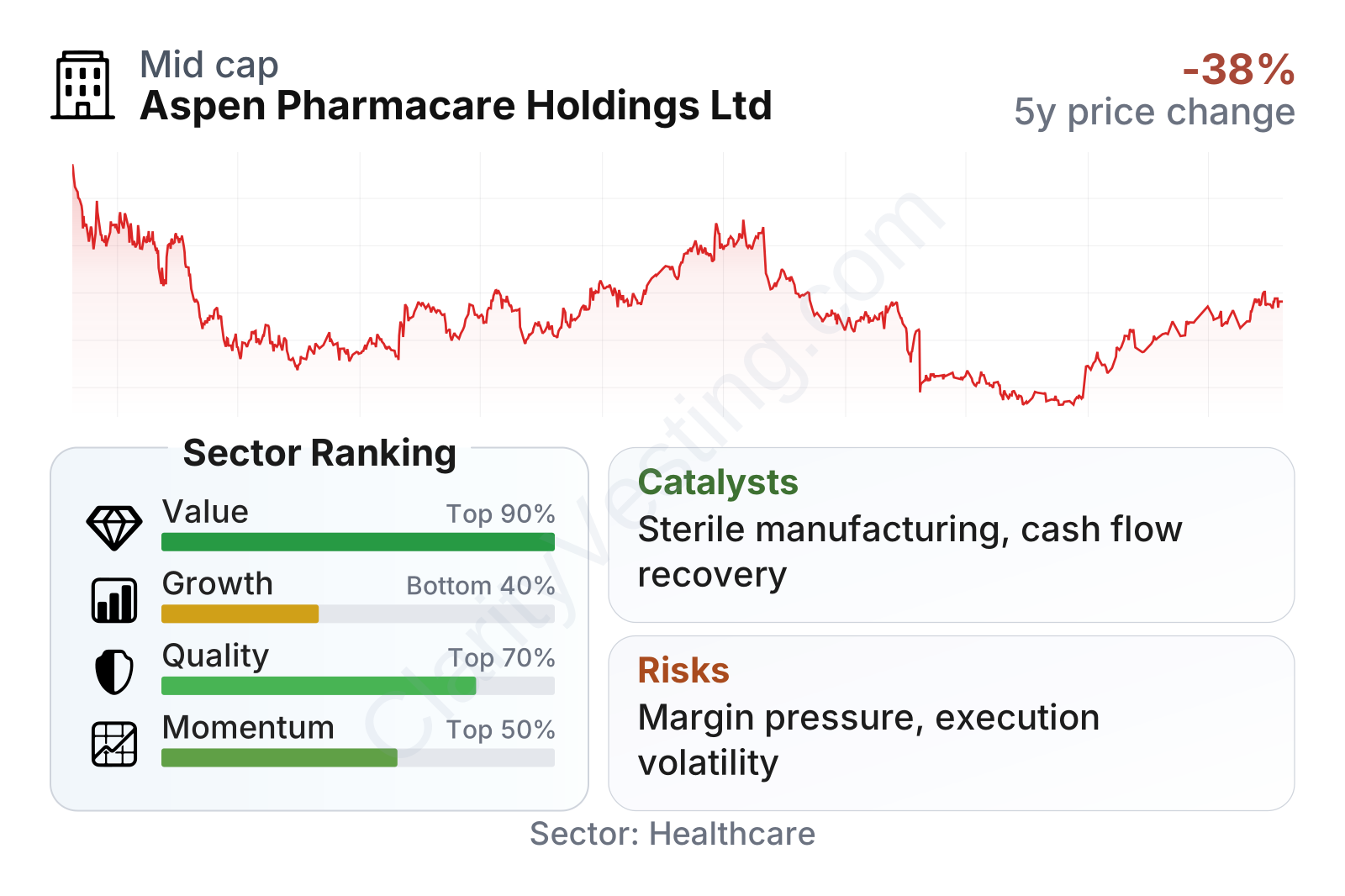
Aspen sits in the mid-sized range within healthcare by market value and has shown relatively low share-price volatility, with a beta well below 1. The factor picture is unusual: value metrics appear extremely strong versus the sector, quality looks above average, but growth ranks below many healthcare peers. Recent price momentum has improved meaningfully even though the longer multi-year share-price record remains weak and uneven.
The stock history reflects that mixed backdrop. After a steep decline from 2021 into 2022, the shares partially recovered, then weakened again through much of 2025 before rebounding in early 2026. That tells a clear story: the market has not treated Aspen as a steady compounder, but it has responded when profitability and balance-sheet confidence improved.
Growth
Aspen operates in a sector with durable long-term demand. Pharmaceuticals benefit from aging populations, rising healthcare access in emerging markets, and continued demand for lower-cost medicines and outsourced manufacturing. Those are supportive industry conditions, especially for a company with established production capacity and distribution in regions that are often harder for larger multinational drugmakers to reach directly.
The main strategic logic for future growth is Aspen’s combination of manufacturing infrastructure and market access. The company has been emphasizing sterile production, hospital products, and partnerships where its facilities can be used more efficiently. That can make sense because pharmaceutical manufacturing is expensive to build, difficult to qualify, and valuable when demand is secured through long-term contracts.
Aspen also has a practical growth angle in emerging markets. In many of these regions, demand for branded generics and essential medicines can rise over time as healthcare systems broaden access. Aspen’s established commercial footprint gives it a base that is hard to replicate quickly.
Cash generation is an encouraging part of the picture. While revenue growth has been inconsistent, free cash flow has improved sharply over the last five years and remained solid in the latest trailing period. That matters because it gives management more flexibility to reduce debt, support capital spending, and strengthen returns even when reported earnings are volatile.
A notable recent opportunity is Aspen’s continuing effort to position itself as a specialized manufacturing partner rather than only a seller of medicines under its own labels. If that shift continues successfully, the company could become less exposed to some of the pricing pressure that often weighs on pure generics businesses. In addition, management has highlighted manufacturing utilization and portfolio optimization as important drivers, which suggests future improvement does not depend only on acquiring new assets.
Risks
This article is for informational purposes only and does not constitute financial advice. Some content is AI-generated. See Disclaimer


