Stock Analysis · Apple Hospitality REIT Inc (APLE)
Overview
Apple Hospitality REIT is a lodging real estate investment trust that owns a large portfolio of upscale, select-service hotels across the United States. Its properties operate mainly under Marriott and Hilton brands, while day-to-day hotel operations are handled by third-party managers. In simple terms, Apple Hospitality owns the hotel real estate and earns money from the cash flow those hotels generate.
The company’s portfolio is concentrated in rooms sold to travelers, with demand coming from business travel, leisure trips, group events, and other overnight stays. Because it focuses on select-service hotels rather than full-service resorts, its model is generally built around simpler operations, lower staffing needs, and steadier margins than more service-heavy hotel formats.
Its revenue is overwhelmingly tied to hotel operations. Based on company reporting, the mix is best understood as follows:
- Room revenue: approximately 70% to 75% of total hotel revenue. This is the core source of income and comes from nightly room bookings.
- Food and beverage revenue: approximately 10% to 15%. This mainly includes breakfast offerings, small bars, limited-service restaurant activity, and meeting-related catering where applicable.
- Other hotel revenue: approximately 10% to 15%. This can include parking, guest fees, retail items, meeting space income, and other on-property services.
Geographically, the company is diversified across many U.S. markets rather than depending on one city or one type of travel customer. That matters in lodging, where local economic swings, weather events, or convention calendars can affect occupancy and room pricing.
Financially, Apple Hospitality has rebuilt revenue and earnings well since the pandemic disruption. Revenue rose materially from 2021 through 2024, and profitability improved as travel normalized. Even with some uneven industry conditions in 2025 and 2026, the company still stands out for maintaining a relatively conservative balance sheet compared with many hotel REIT peers.
The long-term picture shows a business that has recovered meaningfully: revenue and operating income improved strongly between 2021 and 2024, while interest expense remained manageable. One 2025 flow item appears distorted, but the broader trend still points to a hotel owner that regained scale and cash generation after the industry downturn.
Key Figures
| Metric | Value | Sector ⓘ |
|---|---|---|
| Date | Oct 04, 2026 | |
| Context | ||
| Sector | Real Estate | |
| Industry | REIT - Hotel & Motel | |
| Market Cap ⓘ | $3.90B | |
| Beta ⓘ | 0.87 | |
Value (Cheapness) | ||
| P/E Ratio ⓘ | 22.01 | 17.35 |
| P/B Ratio ⓘ | 1.24 | 0.86 |
| FCF Yield ⓘ | 8.62% | 7.47% |
| Dividend Yield ⓘ | 5.86% | 4.75% |
| EBIT / EV ⓘ | 4.09% | 3.81% |
| PEG ⓘ | N/A | |
Growth (Business expansion) | ||
| Revenue Growth ⓘ | 4.70% | 5.30% |
| RPS Growth (5Y CAGR) ⓘ | 9.54% | 5.96% |
| EPS Growth (5Y CAGR) ⓘ | -3.80% | -11.41% |
| BVPS Growth (5Y CAGR) ⓘ | -1.21% | 0.41% |
| Margin Growth (5Y Trend) ⓘ | 9.50% | 0.53% |
| FCF Growth (5Y CAGR) ⓘ | 9.15% | 5.40% |
| DPS Growth (5Y CAGR) ⓘ | 140.89% | 5.02% |
Quality (Business durability) | ||
| ROIC (Latest) ⓘ | 4.63% | 5.77% |
| ROE (Latest) ⓘ | 5.54% | 7.64% |
| ROA (Latest) ⓘ | 3.58% | 2.85% |
| ROIC (5Y Median) ⓘ | 5.32% | 4.20% |
| ROE (5Y Median) ⓘ | 5.46% | 6.03% |
| ROA (5Y Median) ⓘ | 3.55% | 2.45% |
| Net Debt / EBIT (Latest) ⓘ | 0.47 | 7.57 |
| Net Debt / EBIT (5Y Median) ⓘ | 6.53 | 8.41 |
| Net Debt / EBITDA (Latest) ⓘ | 0.25 | 5.12 |
| Net Debt / Assets ⓘ | 2.10% | 37.84% |
| EBITDA / Interest ⓘ | 4.92 | 4.11 |
| Operating Margin (Latest) ⓘ | 15.15% | 35.40% |
| Operating Margin (5Y Median) ⓘ | 18.42% | 36.59% |
| Debt to Equity (Latest) ⓘ | 3.58% | 89.06% |
| Profit Margin (Latest) ⓘ | 12.17% | 19.99% |
| Free Cash Flow (Latest) ⓘ | $336.11M | |
Momentum (Price trend) | ||
| 3Y Return ⓘ | +38.19% | +30.66% |
| 12M Return (excl. last month) ⓘ | +32.17% | +7.55% |
| 6M Return ⓘ | +47.65% | +0.69% |
| Price vs. 200-Day MA ⓘ | +19.73% | -2.27% |
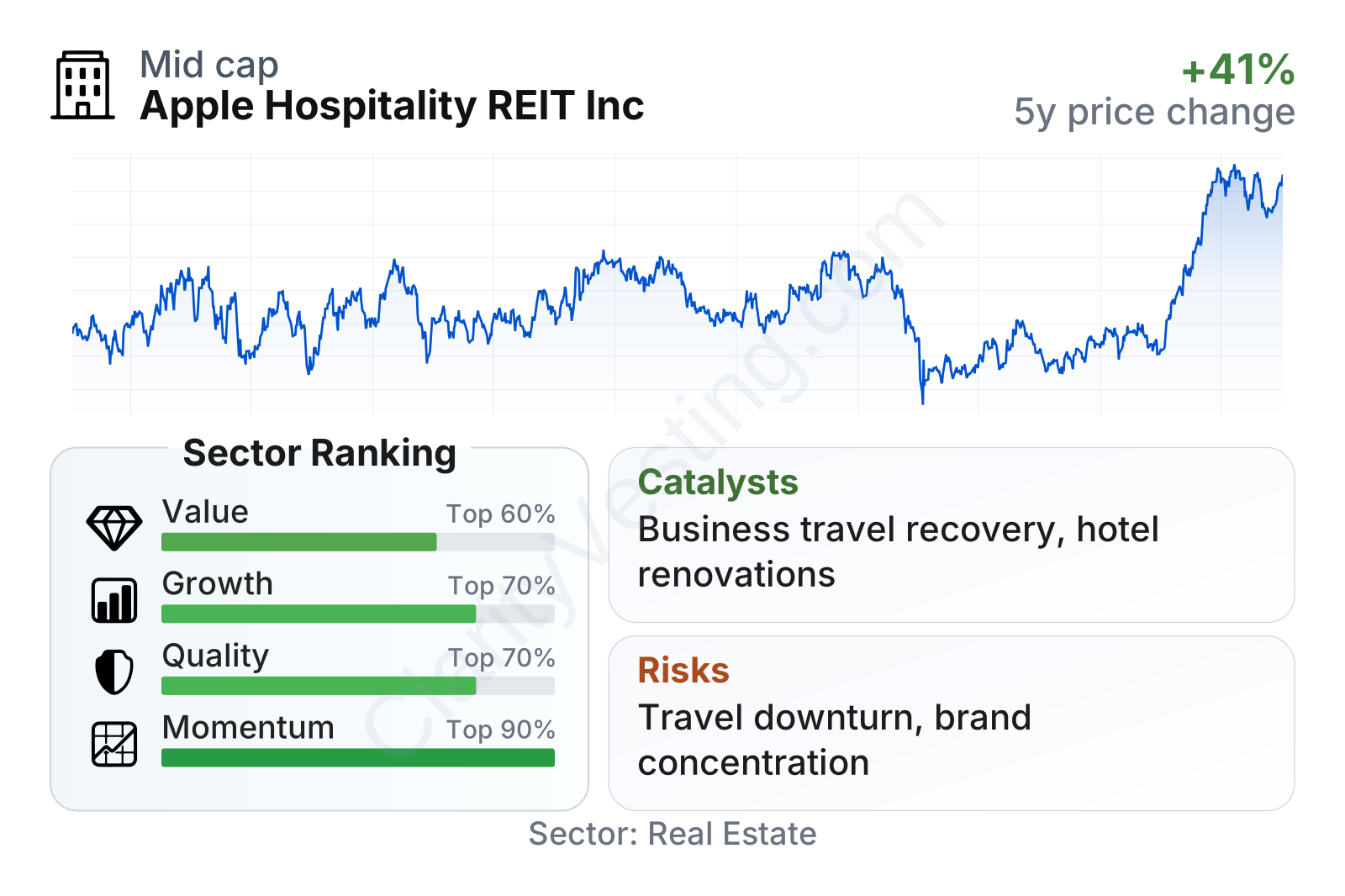
Apple Hospitality sits in the mid-to-upper range of the real estate sector on valuation and business quality, but its profile is mixed. Income-related measures look solid, with free cash flow yield and dividend yield above sector medians. Growth has also been better than many peers over the last five years, especially in revenue per share, cash flow, and margin improvement. On the other hand, profitability ratios such as return on capital and return on equity are not standout levels, and the shares currently trade somewhat above sector medians on earnings and book value multiples. Price momentum has been notably strong in recent months, which suggests the market has been recognizing improving sentiment around the company.
Growth
Apple Hospitality operates in the hotel sector, which is cyclical but still supported by durable long-term demand drivers. Travel remains a large and necessary part of the U.S. economy, and select-service hotels are often positioned in the more resilient part of the market because they can serve both business and leisure travelers without the heavier operating cost structure of luxury or convention-focused hotels.
The company’s strategy is straightforward and sensible for long-term expansion: stay focused on widely recognized brands, maintain broad geographic diversification, reinvest in existing properties, and selectively recycle capital when management sees better returns elsewhere. Marriott- and Hilton-branded hotels give Apple Hospitality access to reservation systems, loyalty programs, and brand standards that would be difficult to replicate independently. That can help keep occupancy and pricing more stable over time.
Revenue per share has climbed strongly since 2021 and has largely held its gains even as the industry moved past the initial reopening surge. That suggests the portfolio is not just recovering on a temporary spike, but operating at a meaningfully higher level than it did earlier in the cycle.
The dividend also rebounded sharply from the post-pandemic low and has been relatively steady more recently. For a REIT, that matters because it signals that operating cash flow has normalized enough to support regular distributions again, even if future increases are likely to depend on room-rate growth and broader travel demand.
A key catalyst is the continued normalization of business travel and group demand. Leisure travel has already done much of the recovery work across the hotel industry, so further improvement in weekday corporate travel can still support occupancy and pricing. Another useful tailwind is that hotel leases reset daily through room rates, which means inflation can sometimes be offset faster than in other property types if demand remains healthy.
Recent company updates have also emphasized capital allocation discipline, renovation activity, and balance-sheet flexibility. For a hotel REIT, that combination can create opportunity: upgraded properties can support rate growth, while a healthier balance sheet can leave room for acquisitions or share-friendly capital decisions if attractive conditions appear.
Risks
This article is for informational purposes only and does not constitute financial advice. Some content is AI-generated. See Disclaimer