Stock Analysis · ARKO Petroleum Corp (APC)
Overview
ARKO Petroleum Corp operates in the fuel retail and convenience business. In practical terms, it makes money by selling gasoline and diesel to drivers, while also earning higher-margin revenue from merchandise and services inside convenience stores. The company is part of the oil refining and marketing industry, but its economics are closer to a fuel distributor and convenience-store operator than to a large integrated oil producer.
Its revenue base is dominated by fuel sales, which is typical for the sector because gasoline and diesel generate very large dollar volume even when margins are thin. Based on the company’s recent annual profile and segment disclosures, the main sources of revenue are approximately:
- Retail fuel sales: about 75% to 85% of revenue. This includes gasoline and diesel sold at company-operated sites.
- Merchandise and other retail sales: about 10% to 20% of revenue. This usually includes food, beverages, tobacco, packaged goods, and other in-store items.
- Wholesale fuel and other activities: about 5% to 15% of revenue. This can include fuel supply arrangements, dealer sales, and related operations.
That revenue mix matters because fuel brings scale and customer traffic, while in-store products usually carry better profit margins. For a business like ARKO, long-term performance depends less on the headline fuel revenue number and more on traffic, per-store productivity, merchandise mix, and the company’s ability to protect margins while managing debt and interest costs.
Over the last several years, the business has shown a familiar pattern for fuel retailing: very high cost of goods sold, modest operating margins, and limited room for error. Revenue moved from roughly $7.1 billion in 2022 to $7.6 billion in 2025, while gross profit improved more noticeably than sales. However, higher interest expense absorbed much of that operating improvement, which is an important point for long-term analysis.
The financial flow highlights a business where most revenue is consumed by fuel costs. Gross profit and operating income improved through 2025, but net income weakened because interest expense rose sharply. That suggests the core stores and fuel network became more productive, while the capital structure became a heavier burden.
Key Figures
| Metric | Value | Sector ⓘ |
|---|---|---|
| Date | Oct 17, 2026 | |
| Context | ||
| Sector | Energy | |
| Industry | Oil & Gas Refining & Marketing | |
| Market Cap ⓘ | $1.23B | |
| Beta ⓘ | N/A | |
Value (Cheapness) | ||
| P/E Ratio ⓘ | 18.35 | 15.44 |
| P/B Ratio ⓘ | 2.74 | 1.73 |
| FCF Yield ⓘ | 1.63% | 8.20% |
| Dividend Yield ⓘ | 5.04% | 3.59% |
| EBIT / EV ⓘ | 5.47% | 7.46% |
| PEG ⓘ | N/A | |
Growth (Business expansion) | ||
| Revenue Growth ⓘ | 27.40% | 26.90% |
| RPS Growth (5Y CAGR) ⓘ | 29.90% | 6.90% |
| EPS Growth (5Y CAGR) ⓘ | N/A | -15.73% |
| BVPS Growth (5Y CAGR) ⓘ | -10.60% | 6.07% |
| Margin Growth (5Y Trend) ⓘ | -15.55% | 0.58% |
| FCF Growth (5Y CAGR) ⓘ | N/A | 1.86% |
| DPS Growth (5Y CAGR) ⓘ | -9.08% | 16.79% |
Quality (Business durability) | ||
| ROIC (Latest) ⓘ | 17.25% | 11.40% |
| ROA (Latest) ⓘ | 1.33% | 6.06% |
| ROIC (5Y Median) ⓘ | N/A | 10.30% |
| ROA (5Y Median) ⓘ | 0.98% | 5.42% |
| Net Debt / EBIT (Latest) ⓘ | 8.92 | 1.64 |
| Net Debt / EBIT (5Y Median) ⓘ | 7.10 | 1.83 |
| Net Debt / EBITDA (Latest) ⓘ | 4.27 | 1.08 |
| Net Debt / Assets ⓘ | 55.50% | 17.29% |
| EBITDA / Interest ⓘ | 2.89 | 9.64 |
| Operating Margin (Latest) ⓘ | 1.25% | 16.27% |
| Operating Margin (5Y Median) ⓘ | 1.50% | 20.39% |
| Debt to Equity (Latest) ⓘ | 303.91% | 54.76% |
| Profit Margin (Latest) ⓘ | 0.64% | 8.82% |
| Free Cash Flow (Latest) ⓘ | $20.03M | |
Momentum (Price trend) | ||
| 3Y Return ⓘ | N/A | +67.38% |
| 12M Return (excl. last month) ⓘ | N/A | +49.19% |
| 6M Return ⓘ | -13.55% | +7.07% |
| Price vs. 200-Day MA ⓘ | N/A | +9.56% |
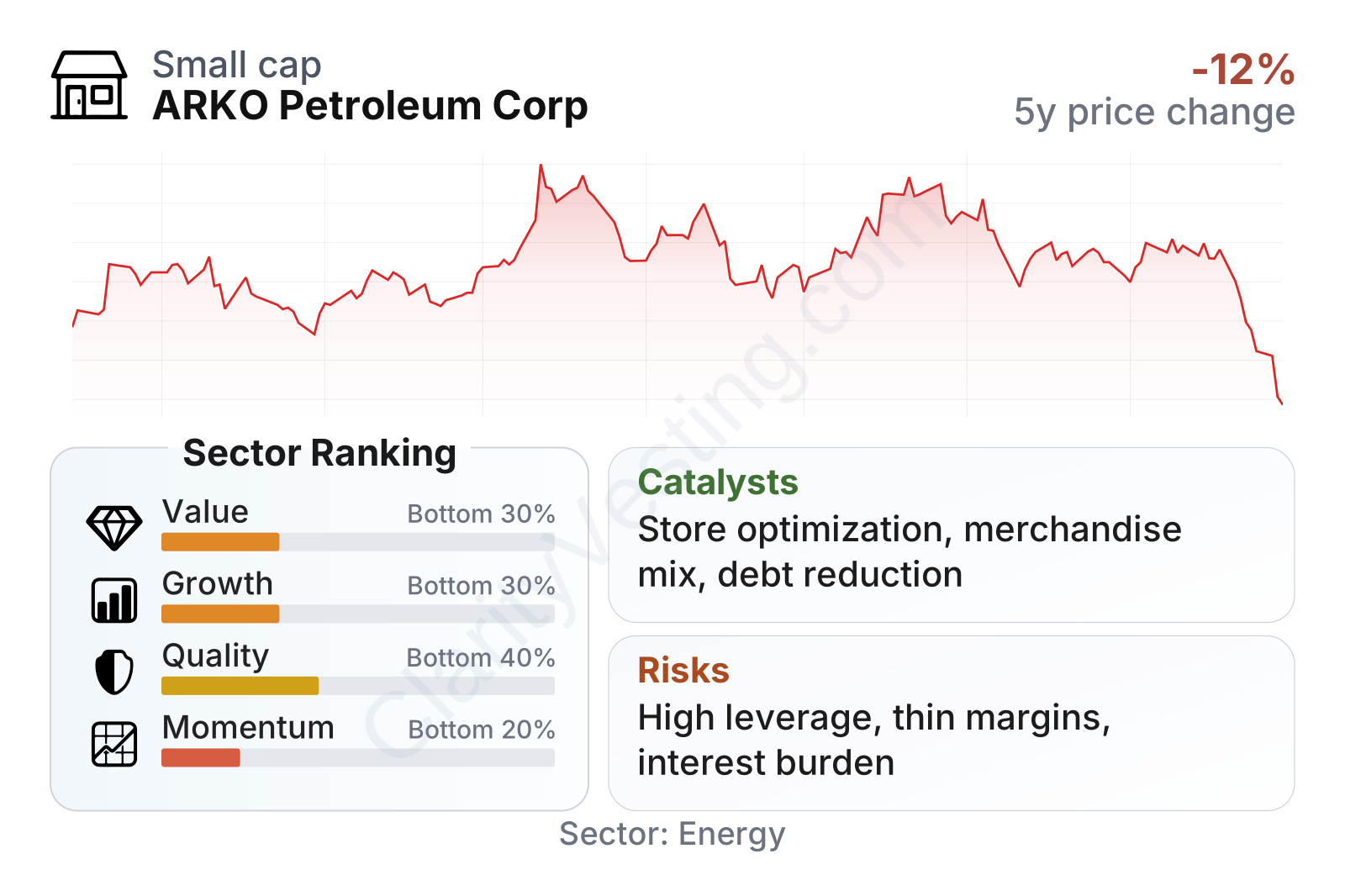
ARKO is a small-cap energy and fuel retail company, so it naturally carries more operating and financing risk than the largest convenience-store chains. The metrics show a mixed picture. On valuation, the shares screen weaker than the sector median on several measures, with a higher earnings multiple, a higher price-to-book ratio, and a free cash flow yield that is well below the typical energy company. The dividend yield is relatively high at about 5%, but that comes alongside modest free cash generation.
Growth metrics are uneven. Revenue growth has been strong over a five-year span, especially on a per-share basis, but that expansion has not translated into stronger margins or balance-sheet progress. Quality measures tell the same story: return on invested capital is respectable, yet operating margin, profit margin, interest coverage, and leverage all look weaker than the sector median. Recent share-price performance also trails much of the sector, which shows the market has remained cautious despite the business still producing profits.
Growth
The sector itself is mature rather than fast-growing. Demand for transportation fuels does not usually expand at high rates in developed markets, and convenience retail is a competitive business. That means ARKO’s growth case is less about a booming industry and more about execution: improving store operations, increasing sales of higher-margin merchandise, expanding loyalty programs, optimizing fuel supply, and making acquisitions that lift scale and purchasing power.
This strategy is logical for the business model. In fuel retail, larger networks can negotiate better supply terms, spread overhead across more stores, and use data and promotions more effectively. Store upgrades and better product mix can also raise profit per visit even if fuel volumes grow slowly. In that sense, ARKO does have realistic levers for growth, but they are operational levers rather than transformational industry tailwinds.
A meaningful catalyst is the company’s ability to shift more of its earnings mix toward merchandise and other higher-margin categories. Fuel drives traffic, but inside sales usually determine whether a convenience chain creates durable profit growth. Another catalyst is further integration and optimization of its network if management continues to streamline underperforming sites and improve the better ones.
Recent company communications have also emphasized ongoing capital allocation discipline, site optimization, and efforts to strengthen retail economics. For long-term analysis, the most significant opportunity is not simple top-line growth, but whether ARKO can convert its large sales base into consistently better cash flow after interest expense.
Risks
This article is for informational purposes only and does not constitute financial advice. Some content is AI-generated. See Disclaimer


