Stock Analysis · Precinct Properties New Zealand Limited (AOTUF)
Overview
Precinct Properties New Zealand Limited is a New Zealand-listed real estate company focused on owning, developing, and managing large-scale urban properties. Its portfolio is concentrated in prime central business district locations, especially Auckland and Wellington, and is built around office assets, mixed-use developments, and related spaces that serve corporate tenants, government occupiers, and city-center users. In practice, the company makes money from collecting rent, improving and repositioning buildings, and developing major projects that can raise future rental income and asset values.
The business is largely centered on recurring property income, with additional contributions from development activity and valuation-related movements. Based on the company’s recent annual disclosures and the earnings mix visible in recent years, the main revenue sources can be summarized as follows:
- Rental and property income: approximately 70% to 80% — office rent, retail and mixed-use rent, car parking, and other tenant-related property revenue from the investment portfolio.
- Development and other property-related income: approximately 10% to 20% — income connected to project delivery, leasing-up of new space, and other property services or recoveries.
- Fair-value and other non-cash property movements: variable — these can materially affect reported profit in some years, but they are not the same as recurring cash rent and can swing with property-market conditions and interest rates.
The overall earnings profile shows a familiar pattern for a property owner: strong gross profit from rental assets, but net profit can move sharply because financing costs and property valuations have a large effect. Over the last several years, revenue has generally trended upward, while interest expense has also risen meaningfully as borrowing costs increased.
The business mix suggests that recurring rent remains the economic core of the company, while reported earnings can look much more volatile than the underlying buildings and leases might imply.
Key Figures
| Metric | Value | Sector ⓘ |
|---|---|---|
| Date | Oct 17, 2026 | |
| Context | ||
| Sector | Real Estate | |
| Industry | REIT - Diversified | |
| Market Cap ⓘ | $1.22B | |
| Beta ⓘ | 0.46 | |
Value (Cheapness) | ||
| P/E Ratio ⓘ | N/A | 17.38 |
| P/B Ratio ⓘ | 0.28 | 0.85 |
| FCF Yield ⓘ | 8.76% | 7.38% |
| Dividend Yield ⓘ | 10.43% | 4.85% |
| EBIT / EV ⓘ | 8.58% | 3.78% |
| PEG ⓘ | 5.07 | |
Growth (Business expansion) | ||
| Revenue Growth ⓘ | 9.60% | 5.30% |
| RPS Growth (5Y CAGR) ⓘ | 21.02% | 6.02% |
| EPS Growth (5Y CAGR) ⓘ | -10.99% | -11.37% |
| BVPS Growth (5Y CAGR) ⓘ | 8.78% | 0.45% |
| Margin Growth (5Y Trend) ⓘ | -57.61% | -0.22% |
| FCF Growth (5Y CAGR) ⓘ | N/A | 5.40% |
| DPS Growth (5Y CAGR) ⓘ | 15.77% | 5.02% |
Quality (Business durability) | ||
| ROIC (Latest) ⓘ | N/A | 5.69% |
| ROE (Latest) ⓘ | 0.09% | 7.56% |
| ROA (Latest) ⓘ | 0.05% | 2.85% |
| ROIC (5Y Median) ⓘ | 0.41% | 4.22% |
| ROE (5Y Median) ⓘ | -0.39% | 6.03% |
| ROA (5Y Median) ⓘ | -0.22% | 2.44% |
| Net Debt / EBIT (Latest) ⓘ | 8.92 | 7.59 |
| Net Debt / EBIT (5Y Median) ⓘ | 11.11 | 8.40 |
| Net Debt / EBITDA (Latest) ⓘ | 7.81 | 5.27 |
| Net Debt / Assets ⓘ | 38.66% | 37.76% |
| EBITDA / Interest ⓘ | 1.49 | 4.10 |
| Operating Margin (Latest) ⓘ | 33.44% | 35.29% |
| Operating Margin (5Y Median) ⓘ | 18.88% | 37.31% |
| Debt to Equity (Latest) ⓘ | 67.05% | 88.87% |
| Profit Margin (Latest) ⓘ | -2.91% | 19.61% |
| Free Cash Flow (Latest) ⓘ | $107.28M | |
Momentum (Price trend) | ||
| 3Y Return ⓘ | +7.05% | +30.75% |
| 12M Return (excl. last month) ⓘ | -18.45% | +4.36% |
| 6M Return ⓘ | -13.86% | -2.52% |
| Price vs. 200-Day MA ⓘ | -8.91% | -2.34% |
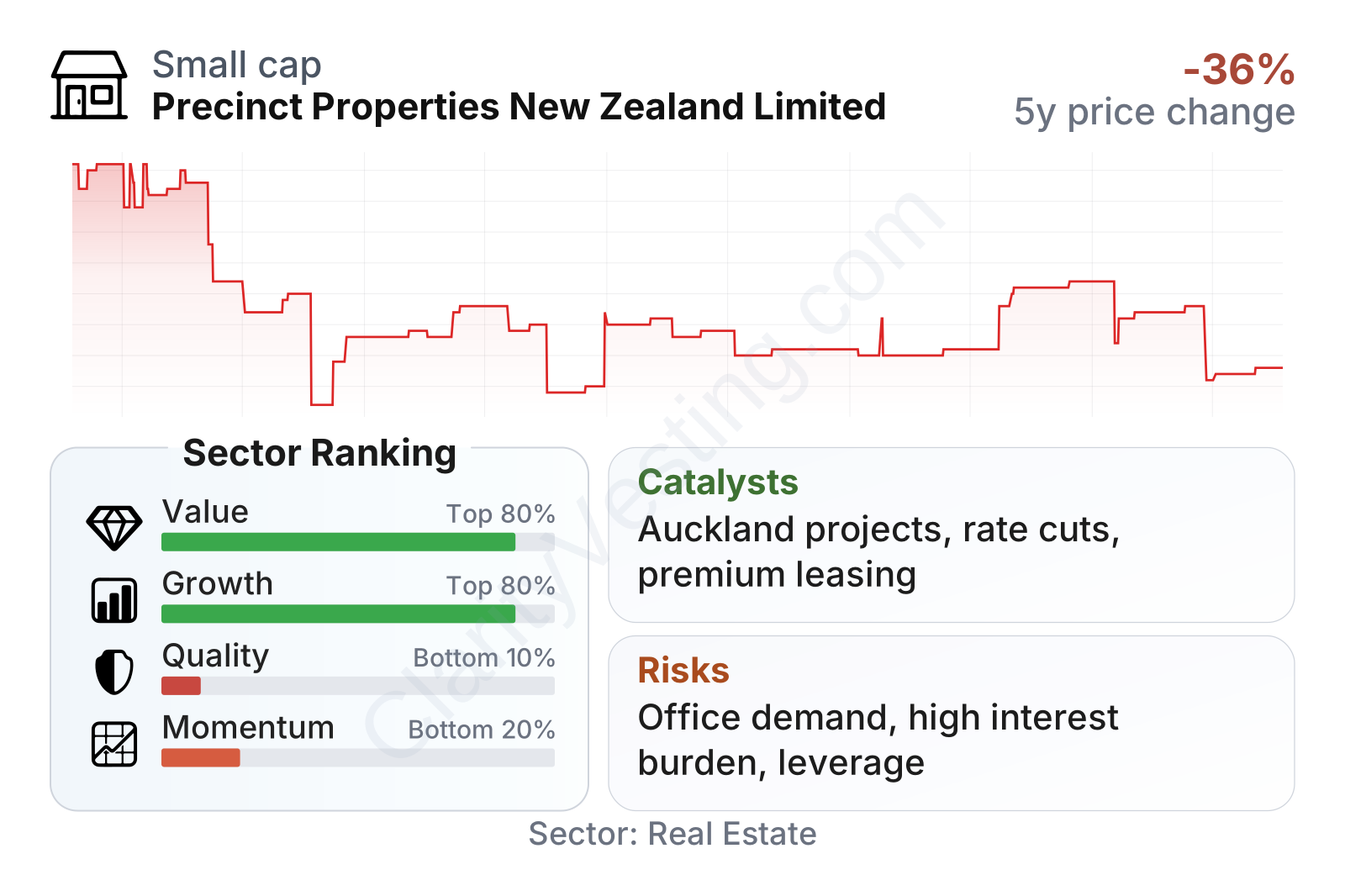
Precinct Properties is a mid-sized real estate company with a stock that has been relatively low-volatility compared with the broader market, reflected in a beta of about 0.44. On valuation and income metrics, it screens attractively versus much of the real estate sector: the price-to-book ratio is far below the sector median, free cash flow yield is above the sector median, and the trailing dividend yield is notably high. Growth metrics also look stronger than sector norms, helped by revenue growth of about 10% year over year and a five-year revenue-per-share growth rate above 20%.
The weak area is quality. Returns on equity and assets are close to flat, profit margin is negative, leverage is elevated, and interest coverage is thin at roughly 1.4 times EBITDA. Momentum is also weak, with the share price down over the last 6 months, the last year excluding the most recent month, and over 3 years, all trailing the sector median. This combination points to a company that looks inexpensive and income-heavy on the surface, but where debt costs and uneven profitability remain central to the investment debate.
Growth
Precinct operates in a sector that is mature rather than fast-growing, but it still has identifiable long-term drivers. Prime city-center real estate in New Zealand benefits from limited land supply, the need for high-quality office environments, and the gradual reshaping of downtown districts into more mixed-use destinations. Demand is no longer just about having office space; it is increasingly about having better-located, more modern, more sustainable buildings that large tenants are willing to commit to for long lease terms. That trend can favor landlords with premium assets and active development capability.
The company’s strategy appears aligned with that environment. Rather than relying only on passive rent collection, Precinct has focused on upgrading its portfolio, developing landmark projects, and concentrating on major urban precincts. That approach can support rental growth, improve occupancy quality, and create embedded upside if newly delivered space is leased at better rates than older stock. It also helps the company stay relevant in an office market where older, less efficient buildings may struggle.
The rise in revenue per share over the last five years is a constructive sign. It suggests the portfolio has been expanding its earning power on a per-share basis, not just through higher asset values but through stronger operating output. That matters for a property company because it indicates that development activity and leasing progress have translated into a larger income base for each share outstanding.
Dividend per share has also moved upward over time, with a particularly noticeable step-up in the latest period. For a real estate company, that usually signals management’s confidence in recurring cash generation, although the durability of that increase still needs to be weighed against leverage and financing costs.
A meaningful catalyst is the company’s exposure to premium green and modern office stock. Many corporate and institutional tenants are becoming more selective about energy efficiency, building quality, and employee experience. If that preference continues, better assets can capture stronger occupancy and rent resilience than average office buildings. Another support factor is any easing in interest rates over time: lower debt costs and lower property yield pressure would both help a leveraged landlord like Precinct.
Recent company updates have also pointed to ongoing development and precinct activation work in Auckland and Wellington. Those projects can create long-duration optionality because success is not limited to immediate rent collection; it can also reshape surrounding land use, improve tenant demand, and lift the strategic value of core holdings.
Risks
This article is for informational purposes only and does not constitute financial advice. Some content is AI-generated. See Disclaimer


