Stock Analysis · Smith AO Corporation (AOS)
Overview
Smith AO Corporation, better known as A. O. Smith, is an industrial company focused on water technology. Its core business is manufacturing water heaters, boilers, and water treatment products for homes and commercial buildings. The company operates in a part of the industrial sector that is tied to everyday needs rather than discretionary spending: people and businesses still need hot water, replacement parts, and clean water systems in most economic environments.
The business is organized mainly around two reporting segments: North America and Rest of World. North America is the larger contributor, driven by residential and commercial water heaters, boilers, and related products sold through wholesalers, contractors, and retail channels. Rest of World is led largely by China and India, where the company sells water heaters and a broader mix of water treatment products such as filtration, softening, and purification systems.
Based on recent annual reporting, the revenue mix appears approximately as follows:
- North America: about 75% of revenue. This includes residential water heaters, commercial water heaters, boilers, and water treatment products sold mainly in the U.S. and Canada.
- Rest of World: about 25% of revenue. This includes China, India, and other international markets, with a greater emphasis on consumer water treatment and regional water heating demand.
Within products, water heaters and boilers remain the dominant earnings engine, while water treatment is strategically important because it expands the company beyond replacement heating demand and gives it exposure to concerns around drinking water quality. Over the past several years, the business has shown a pattern of steady sales with strong profitability, even when annual revenue growth has been uneven.
The income flow shows a business with durable gross profit and disciplined operating structure. Revenue has stayed near the same broad range in recent years, but profitability recovered sharply after a weak 2022, suggesting pricing, mix, and execution have mattered as much as headline sales growth.
Key Figures
| Metric | Value | Sector ⓘ |
|---|---|---|
| Date | Oct 24, 2026 | |
| Context | ||
| Sector | Industrials | |
| Industry | Specialty Industrial Machinery | |
| Market Cap ⓘ | $8.09B | |
| Beta ⓘ | 1.11 | |
Value (Cheapness) | ||
| P/E Ratio ⓘ | 16.59 | 22.29 |
| P/B Ratio ⓘ | 4.49 | 1.98 |
| FCF Yield ⓘ | 7.90% | 6.26% |
| Dividend Yield ⓘ | 2.42% | 1.92% |
| EBIT / EV ⓘ | 7.99% | 4.83% |
| PEG ⓘ | 1.37 | |
Growth (Business expansion) | ||
| Revenue Growth ⓘ | -0.70% | 9.30% |
| RPS Growth (5Y CAGR) ⓘ | 5.69% | 7.76% |
| EPS Growth (5Y CAGR) ⓘ | -12.79% | -13.17% |
| BVPS Growth (5Y CAGR) ⓘ | 3.98% | 6.13% |
| Margin Growth (5Y Trend) ⓘ | 1.24% | 0.74% |
| FCF Growth (5Y CAGR) ⓘ | -0.90% | 10.79% |
| DPS Growth (5Y CAGR) ⓘ | 7.32% | 9.41% |
Quality (Business durability) | ||
| ROIC (Latest) ⓘ | 22.93% | 10.75% |
| ROA (Latest) ⓘ | 14.68% | 5.41% |
| ROIC (5Y Median) ⓘ | 45.45% | 9.37% |
| ROA (5Y Median) ⓘ | 16.54% | 4.95% |
| Net Debt / EBIT (Latest) ⓘ | 0.74 | 2.04 |
| Net Debt / EBIT (5Y Median) ⓘ | -0.10 | 2.27 |
| Net Debt / EBITDA (Latest) ⓘ | 0.65 | 1.39 |
| Net Debt / Assets ⓘ | 13.59% | 19.27% |
| EBITDA / Interest ⓘ | 35.79 | 9.58 |
| Operating Margin (Latest) ⓘ | 17.51% | 10.49% |
| Operating Margin (5Y Median) ⓘ | 18.54% | 10.30% |
| Debt to Equity (Latest) ⓘ | 36.74% | 64.82% |
| Profit Margin (Latest) ⓘ | 13.15% | 6.67% |
| Free Cash Flow (Latest) ⓘ | $639.40M | |
Momentum (Price trend) | ||
| 3Y Return ⓘ | -5.19% | +67.77% |
| 12M Return (excl. last month) ⓘ | -20.33% | +12.05% |
| 6M Return ⓘ | -7.14% | 0.00% |
| Price vs. 200-Day MA ⓘ | -5.67% | +0.67% |
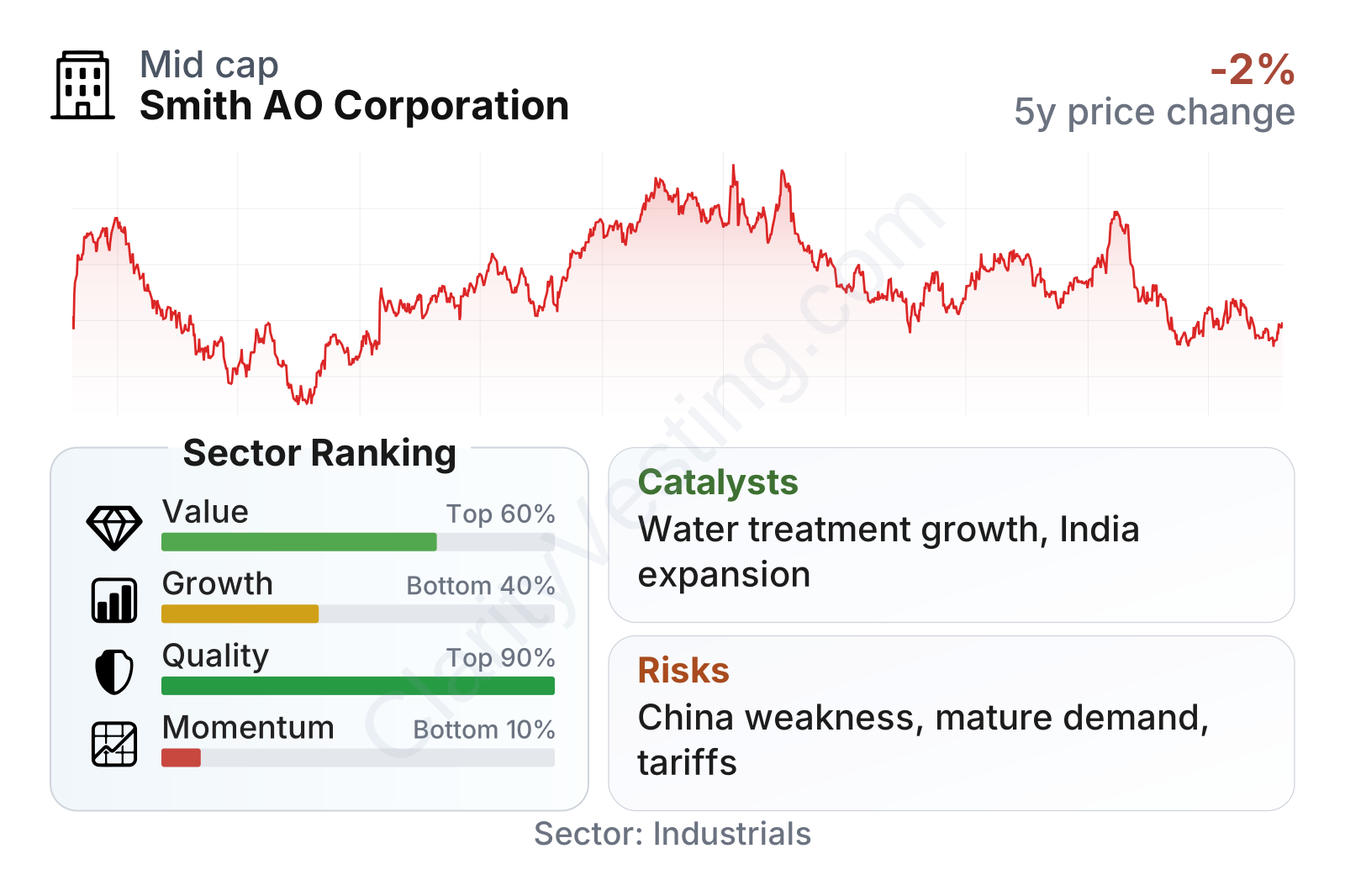
A. O. Smith stands out more for quality and balance-sheet strength than for rapid expansion or recent stock momentum. Returns on capital and assets are well above industry norms, margins are stronger than most peers, and leverage remains moderate. On the other hand, recent growth has lagged much of the industrial sector, and the share price has trailed peers over multiple time frames. At roughly a mid-sized industrial company scale, it combines cash generation and profitability with a less exciting near-term growth profile.
The stock price history reflects that mix. After strong periods earlier in the cycle, the shares have moved sideways to down more recently, which has brought the valuation multiple below the sector median. That weaker market performance does not point to a broken business by itself, but it does show that expectations have cooled.
Growth
A. O. Smith operates in markets with long-term support from housing stock replacement, commercial building infrastructure, tighter energy-efficiency standards, and rising attention to water quality. Water heating is not a high-growth niche in the way software or semiconductors can be, but it is a large recurring market because installed products eventually need replacement. That replacement dynamic tends to create steadier demand over long periods.
The company’s strategy for future growth is centered on three practical levers: gaining share in core North American water heating, expanding water treatment, and building its presence in international markets such as India. Water treatment is especially important because it broadens the business into adjacent categories with potentially better secular growth than traditional water heaters alone. Consumer concern around contaminants in drinking water and the need for point-of-use and whole-home filtration systems can support that direction.
Revenue growth has been inconsistent over the last several years, with positive and negative quarters alternating rather than showing a smooth upward climb. The recent pattern points to a mature company navigating cyclical demand, channel adjustments, and mixed international conditions rather than one enjoying a strong volume surge. That said, flat or slightly declining revenue has not stopped the company from maintaining solid profitability.
Cash generation is a more encouraging part of the picture. Free cash flow has improved meaningfully from prior lows and is now running at a strong level, giving the company room for dividends, buybacks, acquisitions, and product investment. For a long-term business analysis, that matters because internally generated cash often says more about resilience than short-term sales fluctuations.
Recent company updates have continued to emphasize North American demand resilience, premium product mix, and the expansion of water treatment platforms. Another important opening is regulation and efficiency standards: when standards tighten, replacement cycles can shift toward newer, higher-value products. That does not guarantee rapid growth, but it can support better pricing and margins.
Risks
This article is for informational purposes only and does not constitute financial advice. Some content is AI-generated. See Disclaimer