Stock Analysis · Aon PLC (AON)
Overview
Aon plc is a global professional services company focused on risk, health, and wealth solutions. In simple terms, it helps businesses, governments, and institutions understand risks, buy insurance coverage, manage employee benefits, and make decisions around retirement and human capital. Aon does not mainly operate like a traditional insurer that takes underwriting risk on its own balance sheet. Instead, it is primarily an adviser, broker, and consultant that earns fees and commissions for arranging solutions and providing expertise.
The company reports its business through two main operating segments, with revenue heavily concentrated in insurance and reinsurance broking. Based on recent annual reporting, the mix is approximately:
- Risk Capital: about 66% of revenue — This is the largest business. It includes commercial risk solutions, retail insurance brokerage, specialty brokerage, and reinsurance advisory and placement. In practice, Aon helps clients transfer risk to insurers and reinsurers, design coverage programs, and manage claims-related needs.
- Human Capital: about 34% of revenue — This segment includes health solutions, talent and rewards consulting, retirement services, and broader human capital advisory work. It supports employers on employee benefits, workforce strategy, and retirement-related decisions.
Aon’s model is attractive because much of its revenue is service-based and recurring in nature. Large organizations often renew insurance programs annually, revisit benefit plans every year, and rely on advisers continuously as risk and regulation evolve. Over the last several years, revenue, operating income, and net income have all moved upward overall, while margins have improved, showing that scale and cost discipline have mattered alongside organic growth.
The long-term trend points to a business becoming larger and more efficient. Revenue has climbed meaningfully since 2021, while operating profit has expanded faster than sales, suggesting that Aon has been converting growth into stronger profitability rather than just adding volume.
Key Figures
| Metric | Value | Sector ⓘ |
|---|---|---|
| Date | Nov 21, 2026 | |
| Context | ||
| Sector | Financial Services | |
| Industry | Insurance Brokers | |
| Market Cap ⓘ | $70.54B | |
| Beta ⓘ | 0.61 | |
Value (Cheapness) | ||
| P/E Ratio ⓘ | 18.33 | 12.01 |
| P/B Ratio ⓘ | 7.06 | 1.48 |
| FCF Yield ⓘ | 4.63% | 8.77% |
| Dividend Yield ⓘ | 0.93% | 3.01% |
| EBIT / EV ⓘ | 5.50% | 8.31% |
| PEG ⓘ | 2.75 | |
Growth (Business expansion) | ||
| Revenue Growth ⓘ | 2.60% | 6.70% |
| RPS Growth (5Y CAGR) ⓘ | 10.14% | 12.35% |
| EPS Growth (5Y CAGR) ⓘ | 0.55% | -0.27% |
| BVPS Growth (5Y CAGR) ⓘ | 74.18% | 4.83% |
| Margin Growth (5Y Trend) ⓘ | 7.03% | -4.16% |
| FCF Growth (5Y CAGR) ⓘ | 12.00% | 4.69% |
| DPS Growth (5Y CAGR) ⓘ | 10.10% | 8.82% |
Quality (Business durability) | ||
| ROIC (Latest) ⓘ | 13.11% | 9.49% |
| ROE (Latest) ⓘ | 41.08% | 14.02% |
| ROA (Latest) ⓘ | 6.78% | 1.53% |
| ROIC (5Y Median) ⓘ | 19.93% | 7.80% |
| ROE (5Y Median) ⓘ | 55.09% | 12.09% |
| ROA (5Y Median) ⓘ | 7.41% | 1.28% |
| Net Debt / EBIT (Latest) ⓘ | 5.75 | 0.88 |
| Net Debt / EBIT (5Y Median) ⓘ | 3.50 | 0.73 |
| Net Debt / EBITDA (Latest) ⓘ | 4.83 | 0.71 |
| Operating Margin (Latest) ⓘ | 26.33% | 23.37% |
| Operating Margin (5Y Median) ⓘ | 27.07% | 24.29% |
| Debt to Equity (Latest) ⓘ | 284.84% | 59.34% |
| Profit Margin (Latest) ⓘ | 22.24% | 26.65% |
| Free Cash Flow (Latest) ⓘ | $3.27B | |
Momentum (Price trend) | ||
| 3Y Return ⓘ | +3.23% | +73.29% |
| 12M Return (excl. last month) ⓘ | -13.50% | +18.35% |
| 6M Return ⓘ | +3.23% | +3.24% |
| Price vs. 200-Day MA ⓘ | +2.83% | +2.17% |
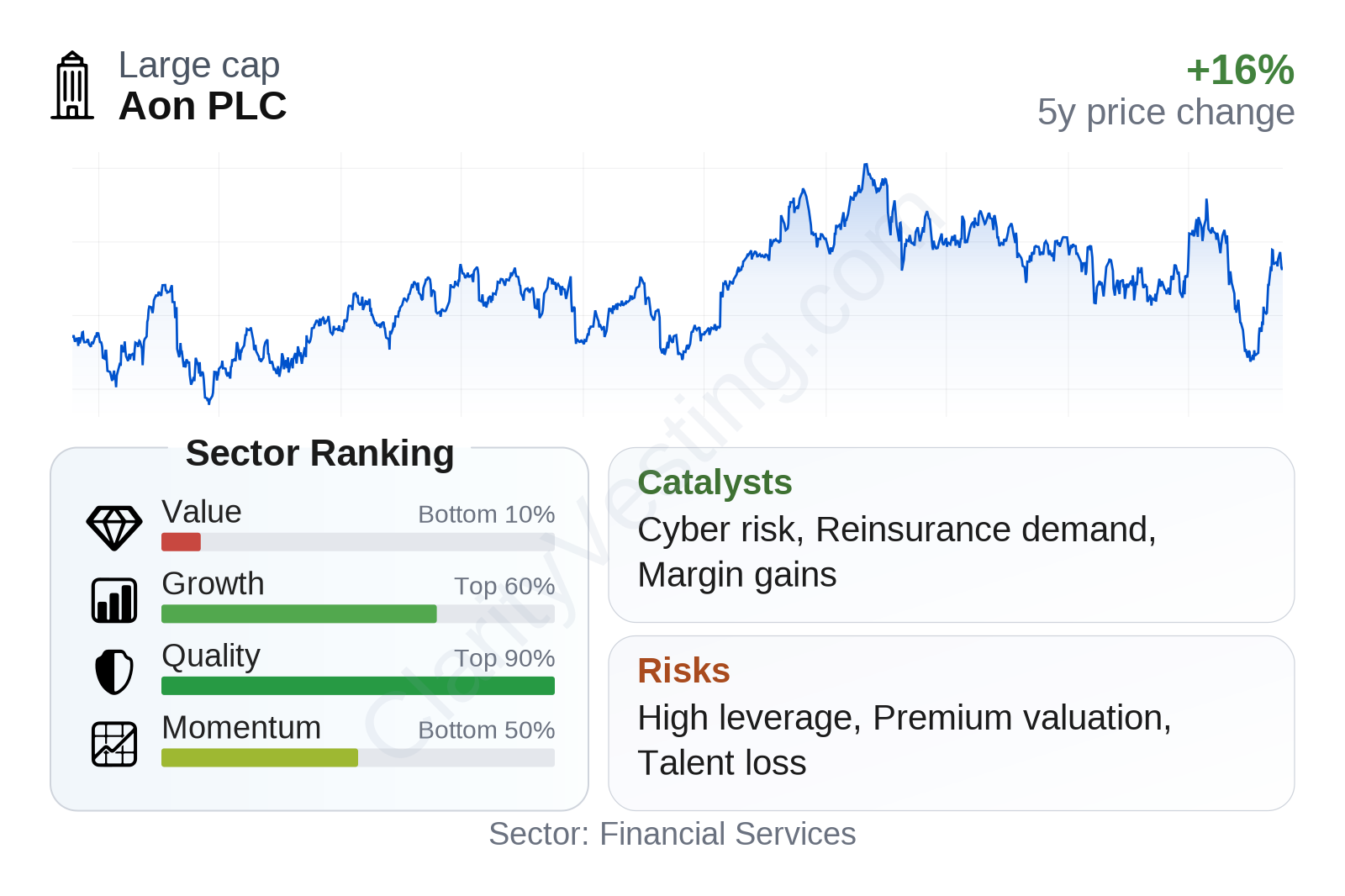
Aon is a very large company in the insurance brokerage space, and its share-price behavior has been relatively defensive, with a beta below 1. At the same time, the factor picture is mixed: quality stands out as a clear strength, growth is acceptable but not exceptional, momentum has been weak versus the broader financial sector, and valuation metrics sit on the expensive side relative to sector medians. Cash generation remains solid, but the income return from dividends is modest at around 1%.
Growth
Aon operates in a sector with durable long-term demand. Businesses face more complex risks than in the past, including cyber threats, climate-related disruption, supply-chain volatility, litigation pressure, geopolitical uncertainty, and rising healthcare and retirement costs. Those trends generally increase the need for outside advice and brokerage services, which supports steady demand for Aon’s core offerings.
The company’s strategy also fits this environment. Aon has been pushing an integrated model that combines risk, health, and human capital advice. That makes strategic sense because many client problems overlap: for example, employee health costs affect labor strategy, and litigation or cyber exposures can influence insurance structure and capital planning. Aon’s global data, client relationships, and specialist expertise can help it cross-sell services rather than relying on a single product line.
Earnings per share have trended upward over the last several years, which is important because it suggests that Aon has not only grown but has also translated that growth into higher profit on a per-share basis. Free cash flow has also compounded at a healthy pace over five years, and operating margins have improved noticeably, reinforcing the idea that the business has been scaling efficiently.
Book value per share has been more volatile and less intuitive than earnings because Aon’s balance sheet has been influenced by acquisitions, intangible assets, capital returns, and leverage. For this kind of asset-light advisory business, book value is less useful than cash flow, margins, and returns on capital when judging operating progress.
A recent and important growth angle is Aon’s increasing role in areas where risk is changing fastest. Commercial insurance pricing, reinsurance needs, cyber risk advisory, and health and benefits complexity all create opportunities for a broker with global reach. The company has also continued to invest in analytical capabilities and digital tools that can make its advice more embedded in client decision-making. That may not create explosive revenue growth, but it can support durable pricing power and deeper client retention.
Near-term growth, however, is unlikely to look like that of a high-growth technology company. Recent year-over-year revenue growth has been modest compared with the broader financial sector median. The more realistic case for Aon is steady expansion, margin improvement, and shareholder returns driven by cash generation rather than rapid top-line acceleration.
Risks
This article is for informational purposes only and does not constitute financial advice. Some content is AI-generated. See Disclaimer