Stock Analysis · Alstom SA (AOMFF)
Overview
Alstom is a French rail transportation company focused on equipment and systems used in public transit and mainline rail. In simple terms, it helps cities, regions, and national rail operators move people and freight by providing trains, signaling technology, infrastructure, and long-term maintenance. Its activities span the full life cycle of rail projects, from design and manufacturing to upgrades and servicing.
The business is broad, but its revenue usually comes from a few main categories. Based on recent annual reporting, the mix is approximately as follows:
- Rolling stock: about 50% to 55% — trains such as high-speed trains, regional trains, metros, trams, and locomotives.
- Services: about 25% to 30% — maintenance, spare parts, fleet modernization, repairs, and operational support under long-term contracts.
- Signaling: about 15% to 20% — train control systems, digital traffic management, interlocking, and safety software.
- Systems and infrastructure: about 5% to 10% — rail electrification, turnkey transport systems, and related infrastructure integration.
Geographically, Alstom is diversified across Europe, the Americas, Asia-Pacific, the Middle East, and Africa, with Europe remaining the core market. That matters because rail spending often depends on public budgets and long planning cycles, which can make demand more resilient than in many industrial sectors.
From a profitability perspective, the recent multi-year pattern shows a business that kept growing revenue while rebuilding margins after a difficult period. Sales rose from roughly €15.5 billion in fiscal 2022 to about €19.2 billion in fiscal 2026, while net income moved from losses to a modest profit. The biggest improvement appears to be in operating performance and cost control rather than explosive top-line growth.
The flow of revenue and costs points to a company with very large production expenses and relatively thin margins, but also one that has made visible progress since fiscal 2024. Gross profit has expanded gradually, operating income has recovered from negative territory, and net income has turned positive again, which is important for a capital-intensive manufacturer like Alstom.
Key Figures
| Metric | Value | Sector ⓘ |
|---|---|---|
| Date | Oct 24, 2026 | |
| Context | ||
| Sector | Industrials | |
| Industry | Railroads | |
| Market Cap ⓘ | $8.53B | |
| Beta ⓘ | 1.05 | |
Value (Cheapness) | ||
| P/E Ratio ⓘ | 26.34 | 22.29 |
| P/B Ratio ⓘ | 0.83 | 1.98 |
| FCF Yield ⓘ | 9.58% | 6.26% |
| Dividend Yield ⓘ | N/A | 1.92% |
| EBIT / EV ⓘ | N/A | 4.83% |
| PEG ⓘ | 0.49 | |
Growth (Business expansion) | ||
| Revenue Growth ⓘ | 4.10% | 9.30% |
| RPS Growth (5Y CAGR) ⓘ | 0.08% | 7.76% |
| EPS Growth (5Y CAGR) ⓘ | -19.54% | -13.17% |
| BVPS Growth (5Y CAGR) ⓘ | -2.88% | 6.13% |
| Margin Growth (5Y Trend) ⓘ | 2.92% | 0.74% |
| FCF Growth (5Y CAGR) ⓘ | N/A | 10.79% |
| DPS Growth (5Y CAGR) ⓘ | -9.15% | 9.41% |
Quality (Business durability) | ||
| ROIC (Latest) ⓘ | 5.30% | 10.75% |
| ROA (Latest) ⓘ | 1.37% | 5.41% |
| ROIC (5Y Median) ⓘ | 1.72% | 9.37% |
| ROA (5Y Median) ⓘ | -0.43% | 4.95% |
| Net Debt / EBIT (Latest) ⓘ | 1.61 | 2.04 |
| Net Debt / EBIT (5Y Median) ⓘ | 6.90 | 2.27 |
| Net Debt / EBITDA (Latest) ⓘ | 0.68 | 1.39 |
| Net Debt / Assets ⓘ | 5.74% | 19.27% |
| EBITDA / Interest ⓘ | 17.02 | 9.58 |
| Operating Margin (Latest) ⓘ | 3.32% | 10.49% |
| Operating Margin (5Y Median) ⓘ | 1.60% | 10.30% |
| Debt to Equity (Latest) ⓘ | 43.43% | 64.82% |
| Profit Margin (Latest) ⓘ | 1.69% | 6.67% |
| Free Cash Flow (Latest) ⓘ | $817.05M | |
Momentum (Price trend) | ||
| 3Y Return ⓘ | +47.04% | +67.77% |
| 12M Return (excl. last month) ⓘ | -25.11% | +12.05% |
| 6M Return ⓘ | -11.80% | 0.00% |
| Price vs. 200-Day MA ⓘ | -22.29% | +0.67% |
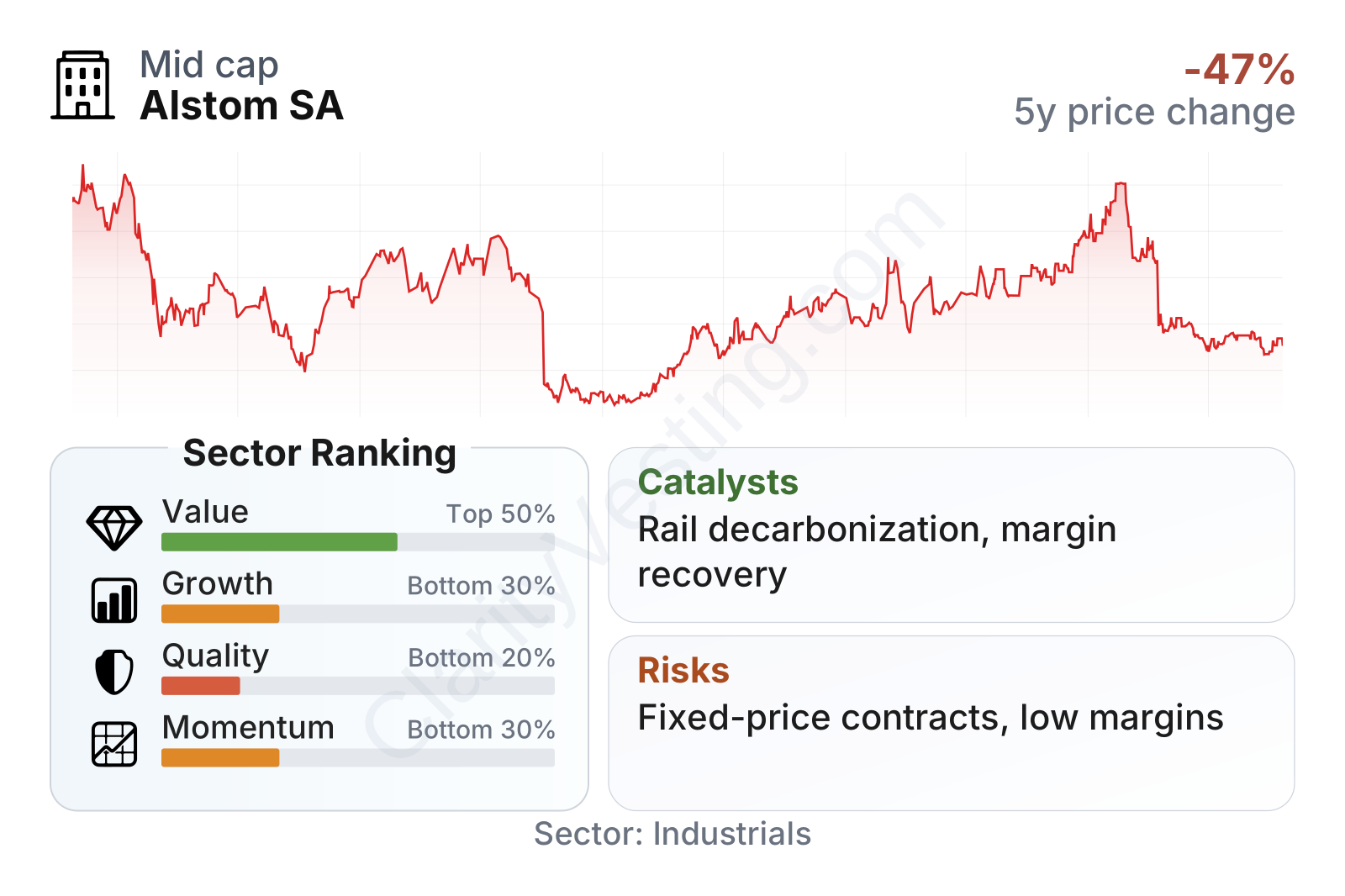
Alstom is a mid-sized industrial company in market value terms, with share price behavior that has been much more volatile than its end market would suggest. The stock has swung sharply over the past several years, reflecting changing views on execution, debt, cash generation, and margin recovery. In the latest factor snapshot, valuation looks mixed but not stretched on asset and cash flow measures, while growth, quality, and momentum remain weaker than much of the industrial sector. In other words, the market still seems cautious even though some operating metrics have improved.
Growth
Alstom operates in a sector with long-term structural support. Rail transportation benefits from urbanization, public investment in mobility, decarbonization goals, congestion relief, and the need to modernize aging train fleets and signaling networks. Compared with road and air transport, rail is often positioned by policymakers as a lower-emission transport option, which supports demand for new trains and network upgrades over many years.
The company’s strategy also makes industrial sense. Alstom is not only selling trains once; it is trying to build a large installed base that can generate recurring service revenue for decades. That combination matters because services and signaling can be more stable and often carry better economics than pure manufacturing. A larger installed fleet can therefore strengthen future revenue visibility even when large train orders are uneven from year to year.
Another important growth driver is the size of the rail project pipeline. This industry works on long contract cycles, and Alstom’s order book has historically been large relative to annual sales. That gives the company a degree of forward visibility that many industrial businesses do not have. It also means growth depends less on short-term consumer demand and more on public transport investment programs.
Recent growth, however, has been steady rather than fast. Year-over-year revenue expansion has been in the low single digits recently, below the industrial sector median, which suggests Alstom is still in a normalization phase rather than a high-growth phase. The more encouraging sign is that margin recovery has improved faster than revenue growth over the last couple of years, meaning better execution may matter more than raw sales acceleration in the near term.
As for recent opportunities, the company has continued to emphasize deleveraging, cash generation, project discipline, and selective bidding. In the current rail market, that is significant. Many governments are still supporting fleet renewals, metro expansion, and digital signaling upgrades, especially in Europe. If Alstom can convert that demand into higher-margin contracts while continuing to improve cash flow, that could be more meaningful than simply chasing volume.
Risks
This article is for informational purposes only and does not constitute financial advice. Some content is AI-generated. See Disclaimer