Stock Analysis · Ansell Ltd (ANSLY)
Overview
Ansell Ltd is a protective solutions company best known for gloves and other barrier products used in healthcare, industrial work, and clean environments. Its products are designed to reduce exposure to infection, chemicals, cuts, and other workplace hazards. The company sells globally through hospitals, distributors, industrial channels, and specialized safety markets, giving it exposure to both everyday recurring demand and more technical, specification-driven purchases.
Ansell reports its business through two main operating segments. Based on the latest annual reporting, revenue is primarily generated from:
- Healthcare: approximately 57% of revenue. This includes surgical gloves, examination gloves, and broader products used by hospitals, clinics, and healthcare providers.
- Industrial: approximately 43% of revenue. This includes hand and body protection used in manufacturing, chemical handling, life sciences, automotive, food processing, and cleanroom applications.
Within those categories, Ansell’s mix benefits from a combination of high-volume disposable products and more specialized protection products that can carry stronger pricing and customer retention. The business is international rather than concentrated in one country, which helps diversify demand but also adds currency and execution complexity.
The financial profile has improved meaningfully in the latest year. Revenue moved back above $2.1 billion in fiscal 2026, while operating income and net income recovered strongly after a weaker fiscal 2024 and a transition-heavy fiscal 2025. The latest period also shows a healthier spread between sales and operating costs, suggesting that integration work, pricing, and product mix are helping profitability.
The multi-year revenue and profit flow shows a business that went through a post-pandemic reset, then returned to growth with a sharp rebound in operating earnings in fiscal 2026. Gross profit has expanded faster than cost of goods in the latest year, which is a constructive sign for margin recovery.
Key Figures
| Metric | Value | Sector ⓘ |
|---|---|---|
| Date | Oct 24, 2026 | |
| Context | ||
| Sector | Healthcare | |
| Industry | Medical Instruments & Supplies | |
| Market Cap ⓘ | $4.36B | |
| Beta ⓘ | 0.55 | |
Value (Cheapness) | ||
| P/E Ratio ⓘ | 21.38 | 25.42 |
| P/B Ratio ⓘ | 2.26 | 3.08 |
| FCF Yield ⓘ | 9.82% | 3.12% |
| Dividend Yield ⓘ | 2.18% | 1.85% |
| EBIT / EV ⓘ | 10.12% | 0.56% |
| PEG ⓘ | N/A | |
Growth (Business expansion) | ||
| Revenue Growth ⓘ | 13.20% | 7.50% |
| RPS Growth (5Y CAGR) ⓘ | -0.46% | 8.60% |
| EPS Growth (5Y CAGR) ⓘ | 12.70% | -17.73% |
| BVPS Growth (5Y CAGR) ⓘ | 3.17% | 3.72% |
| Margin Growth (5Y Trend) ⓘ | 4.09% | -0.57% |
| FCF Growth (5Y CAGR) ⓘ | 4.76% | 0.96% |
| DPS Growth (5Y CAGR) ⓘ | -5.04% | 6.69% |
Quality (Business durability) | ||
| ROIC (Latest) ⓘ | N/A | 3.17% |
| ROA (Latest) ⓘ | N/A | 2.98% |
| ROIC (5Y Median) ⓘ | 8.23% | 4.56% |
| ROA (5Y Median) ⓘ | 5.90% | 1.87% |
| Net Debt / EBIT (Latest) ⓘ | 1.05 | 1.34 |
| Net Debt / EBIT (5Y Median) ⓘ | 1.50 | 1.86 |
| Net Debt / EBITDA (Latest) ⓘ | 0.83 | 1.00 |
| Net Debt / Assets ⓘ | 14.96% | 5.06% |
| EBITDA / Interest ⓘ | 8.30 | 9.55 |
| Operating Margin (Latest) ⓘ | 12.92% | 9.25% |
| Operating Margin (5Y Median) ⓘ | 11.61% | 7.33% |
| Debt to Equity (Latest) ⓘ | 38.00% | 26.68% |
| Profit Margin (Latest) ⓘ | 9.75% | 3.34% |
| Free Cash Flow (Latest) ⓘ | $428.54M | |
Momentum (Price trend) | ||
| 3Y Return ⓘ | +141.83% | +51.61% |
| 12M Return (excl. last month) ⓘ | +20.88% | +19.90% |
| 6M Return ⓘ | +46.84% | +10.10% |
| Price vs. 200-Day MA ⓘ | +56.32% | +6.44% |
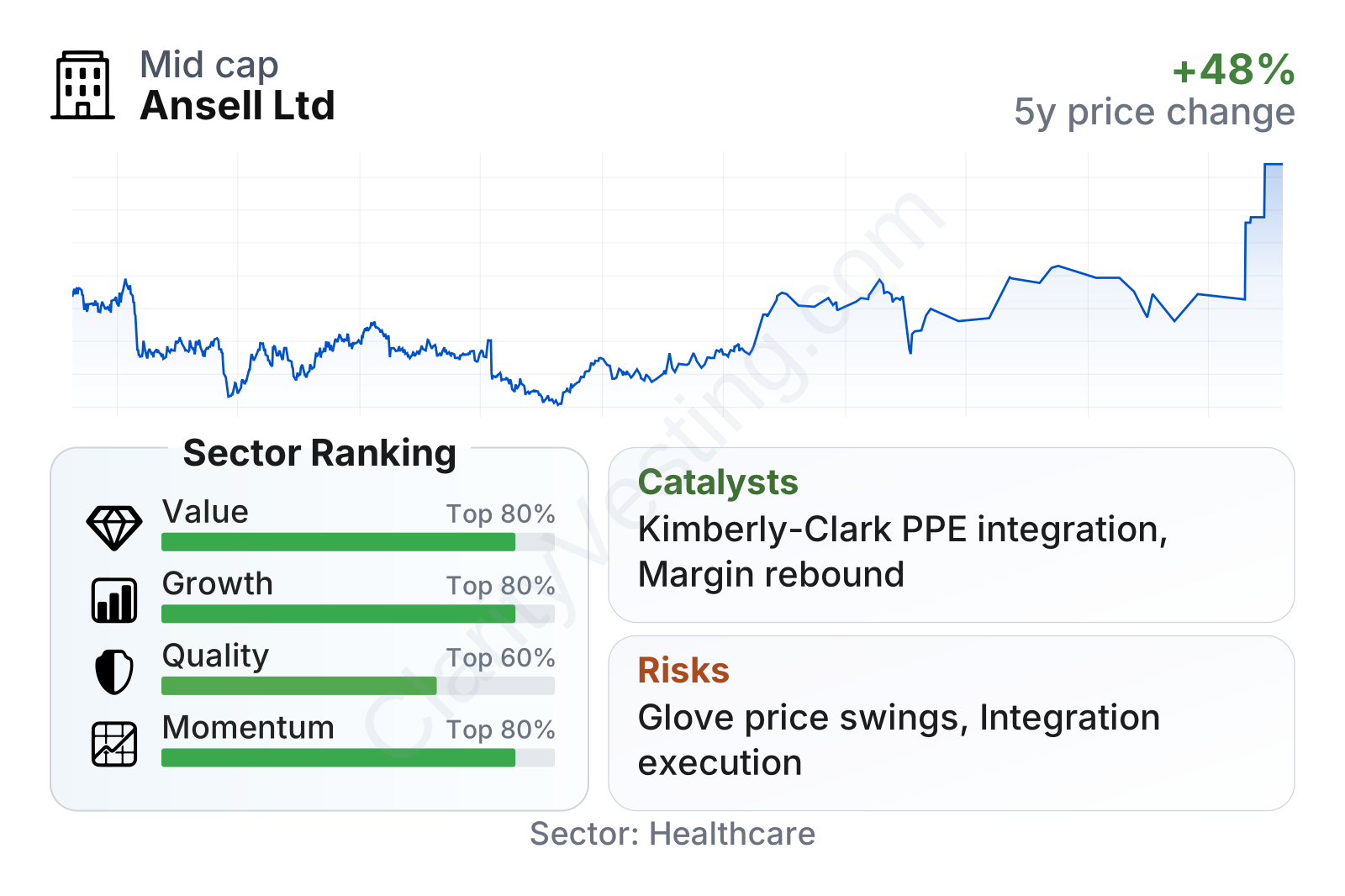
Ansell stands out as a mid-sized healthcare supplies company with relatively low share-price volatility and a balanced financial profile. On valuation, several measures sit below sector medians, while cash generation looks notably strong. On growth and momentum, recent performance has been stronger than much of the healthcare group, helped by improving margins and a sharp recovery in earnings. Quality is solid rather than exceptional overall, with healthy profitability and manageable leverage, although debt-related metrics are not among the very best in the sector.
The stock chart reflects a business that fell sharply from its 2021 highs, then rebuilt momentum over the following years. That pattern is consistent with a company moving past an abnormal pandemic period, absorbing portfolio changes, and then regaining confidence as earnings improved.
Growth
Ansell operates in a sector with durable long-term demand. Infection prevention, worker safety, cleanroom standards, and industrial compliance are not short-lived themes. Hospitals continue to need examination and surgical gloves, while manufacturers and laboratories increasingly require higher-performance protective equipment. That does not mean growth is always smooth, but the underlying end markets remain relevant and structurally supported.
The company’s strategy also makes sense for future expansion. Management has been focusing on higher-value protection categories rather than competing only on commodity glove volume. That matters because commodity products can be highly exposed to price swings and oversupply, while specialized hand protection, surgical products, and cleanroom applications tend to reward product performance, certifications, and customer relationships.
A notable catalyst in recent years has been portfolio reshaping. Ansell completed the acquisition of Kimberly-Clark’s personal protective equipment business, adding brands, channels, and customer reach in industrial safety. If integration continues well, this can strengthen scale, broaden distribution, and create cross-selling opportunities across industrial and healthcare accounts. The latest annual results already suggest that the larger platform is contributing to stronger sales and materially better operating profit.
Recent numbers also indicate that growth is not only coming from revenue expansion but from better execution. Year-over-year revenue growth is ahead of the sector median, and the company’s five-year operating margin trend has improved meaningfully. That combination is often more durable than pure volume growth because it suggests the business is becoming more efficient as it grows.
Cash generation adds another positive layer. Free cash flow is strong relative to the company’s size and has improved over time, which gives Ansell flexibility for debt reduction, dividends, integration spending, and selective product investment. For a protective equipment company, that matters because demand can fluctuate, but steady cash conversion can help absorb cycles.
Another supportive element is regulation and safety standards. In many end markets, protective equipment is not discretionary. Tighter workplace safety requirements, hospital procurement standards, and contamination-control needs can support replacement demand even when broader industrial activity is uneven.
Risks
This article is for informational purposes only and does not constitute financial advice. Some content is AI-generated. See Disclaimer


