Stock Analysis · Ansell Limited (ANSLF)
Overview
Ansell Limited is a protective equipment company focused on products that help workers and healthcare staff reduce exposure to injury, chemicals, contamination, and infection. Its business is centered on gloves, protective clothing, and related safety solutions used in hospitals, laboratories, industrial settings, and clean environments. The company operates globally and sells through distributors, group purchasing channels, and direct commercial relationships.
Its revenue base is mainly organized around two operating segments.
- Healthcare — about 58% of revenue: This segment includes surgical gloves, examination gloves, and other products used in acute care, alternate care, dental, veterinary, and life sciences settings. It is the larger business and benefits from recurring demand tied to clinical procedures and routine infection prevention.
- Industrial — about 42% of revenue: This segment includes hand and body protection for manufacturing, chemical handling, automotive, food processing, laboratories, and cleanroom uses. Products include disposable and durable gloves, chemical-resistant gloves, and protective garments.
That mix gives Ansell a balance between medical demand, which is usually steadier, and industrial demand, which can rise and fall more with economic activity. Geographically, the company is broadly diversified across the Americas, Europe, and Asia-Pacific, which reduces dependence on one national market but also exposes it to currency swings and regional demand changes.
The business flow has also become stronger recently. Revenue moved back above $2.1 billion in fiscal 2026, while gross profit and operating income expanded materially. That suggests the company is not only selling more, but also converting a larger share of sales into profit than it did during the softer 2023–2025 period.
The recent progression is notable: sales, gross profit, and operating income all improved in fiscal 2026 after a few uneven years. The sharper rise in net income points to a meaningful recovery in profitability, although selling and administrative costs also moved up, so cost discipline remains important.
Key Figures
| Metric | Value | Sector ⓘ |
|---|---|---|
| Date | Oct 17, 2026 | |
| Context | ||
| Sector | Healthcare | |
| Industry | Medical Instruments & Supplies | |
| Market Cap ⓘ | $3.38B | |
| Beta ⓘ | 0.55 | |
Value (Cheapness) | ||
| P/E Ratio ⓘ | 16.55 | 24.79 |
| P/B Ratio ⓘ | 1.58 | 3.08 |
| FCF Yield ⓘ | 12.43% | 3.15% |
| Dividend Yield ⓘ | 2.99% | 1.94% |
| EBIT / EV ⓘ | N/A | 0.57% |
| PEG ⓘ | N/A | |
Growth (Business expansion) | ||
| Revenue Growth ⓘ | 13.20% | 7.45% |
| RPS Growth (5Y CAGR) ⓘ | 1.29% | 8.61% |
| EPS Growth (5Y CAGR) ⓘ | 16.45% | -17.81% |
| BVPS Growth (5Y CAGR) ⓘ | 3.13% | 3.72% |
| Margin Growth (5Y Trend) ⓘ | 2.38% | -0.62% |
| FCF Growth (5Y CAGR) ⓘ | 19.51% | 1.04% |
| DPS Growth (5Y CAGR) ⓘ | -4.66% | 6.77% |
Quality (Business durability) | ||
| ROIC (Latest) ⓘ | N/A | 3.24% |
| ROA (Latest) ⓘ | N/A | 3.01% |
| ROIC (5Y Median) ⓘ | 8.23% | 4.60% |
| ROA (5Y Median) ⓘ | 5.90% | 1.89% |
| Net Debt / EBIT (Latest) ⓘ | N/A | 1.34 |
| Net Debt / EBIT (5Y Median) ⓘ | 1.23 | 1.84 |
| Net Debt / EBITDA (Latest) ⓘ | -0.17 | 1.00 |
| Net Debt / Assets ⓘ | -2.91% | 5.45% |
| EBITDA / Interest ⓘ | 7.72 | 9.64 |
| Operating Margin (Latest) ⓘ | N/A | 9.27% |
| Operating Margin (5Y Median) ⓘ | 12.26% | 7.38% |
| Debt to Equity (Latest) ⓘ | 7.57% | 28.58% |
| Profit Margin (Latest) ⓘ | 9.75% | 3.59% |
| Free Cash Flow (Latest) ⓘ | $419.84M | |
Momentum (Price trend) | ||
| 3Y Return ⓘ | +70.32% | +42.80% |
| 12M Return (excl. last month) ⓘ | +8.53% | +18.50% |
| 6M Return ⓘ | -3.53% | +7.57% |
| Price vs. 200-Day MA ⓘ | +10.57% | +5.12% |
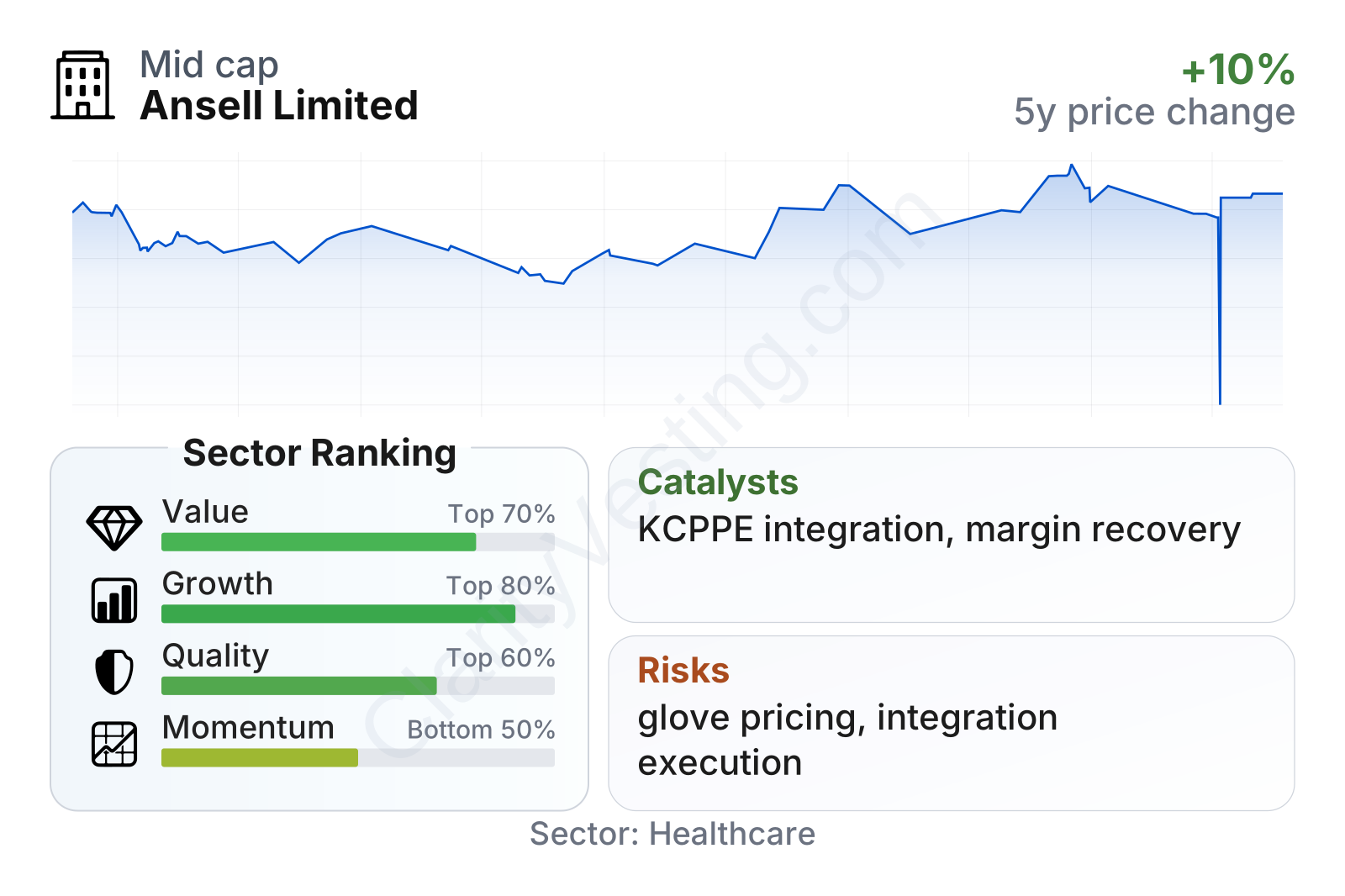
Ansell stands out more on cash generation, margins, and balance-sheet strength than on pure share-price momentum. Valuation measures sit below typical healthcare sector medians, while free cash flow yield and dividend yield are comparatively stronger. Growth metrics are helped by a good recent rebound in revenue and a solid multi-year earnings and cash flow trend, but the longer-term revenue-per-share pace has been modest. Financial quality looks healthy: debt is low, net cash metrics are favorable, and profitability sits above many sector peers. Momentum is the weakest area, reflecting softer recent trading despite a respectable three-year share-price gain.
Growth
Ansell operates in a sector with durable long-term demand drivers. Healthcare systems continuously need infection-control products, while industrial employers face rising safety, compliance, and worker-protection requirements. Those end markets are not fast-changing in the way software or consumer technology can be, but they are supported by recurring replacement demand, stricter workplace standards, and growing awareness of occupational safety.
The company’s strategy appears logical for that environment. Its portfolio spans both disposable and reusable protection products, which broadens its addressable market. It also combines premium medical products with industrial safety solutions, giving it more than one route to expansion. In recent years, management has emphasized mix improvement, higher-value categories, and targeted acquisitions to strengthen market positions rather than relying only on volume growth.
A major recent catalyst is the integration of Kimberly-Clark’s Personal Protective Equipment business, acquired in 2024 and increasingly reflected in fiscal 2025 and 2026 results. That deal expanded Ansell’s product range, customer reach, and manufacturing scale, particularly in gloves and protective apparel. The strong jump in fiscal 2026 revenue is consistent with that larger platform. If integration continues smoothly, the company has room to improve cross-selling, procurement efficiency, and operating leverage.
Another positive point is margin recovery. Recent results show a sizable improvement in operating income and net income, which suggests that pricing, product mix, and acquisition synergies are starting to work together. In a mature safety-products market, better margins can be as important as top-line growth.
Ansell may also benefit from a broader shift toward more specialized protection products. Customers in healthcare, cleanroom, chemical handling, and life sciences often prioritize reliability, regulatory compliance, and product performance over the lowest possible price. That can support stronger economics for established suppliers with recognized brands and testing capabilities.
Risks
This article is for informational purposes only and does not constitute financial advice. Some content is AI-generated. See Disclaimer


