Stock Analysis · Alto Neuroscience Inc (ANRO)
Overview
Alto Neuroscience is a clinical-stage biotechnology company focused on mental health conditions such as depression, bipolar depression, schizophrenia-related symptoms, and post-traumatic stress disorder. Its central idea is different from many traditional drug developers: instead of trying to treat broad patient groups the same way, Alto aims to match treatments to patients using biomarkers, including brain activity measurements, digital features, and other biological signals. In simple terms, the company is trying to improve drug development in psychiatry by identifying which patients are more likely to respond to a specific medicine.
At this stage, Alto does not operate like a mature pharmaceutical company with approved products sold in the market. It is still developing its pipeline, so its business is driven by research and clinical trials rather than commercial sales. That makes the company more dependent on clinical progress than on recurring product revenue.
The main sources of revenue are currently very limited. Based on recent financial statements, revenue has been close to 0%, meaning the business is effectively pre-revenue and financed primarily by cash on hand and capital raised rather than by product sales.
- Product revenue: approximately 0%. Alto has no approved commercial product generating meaningful sales.
- Collaboration or other operating revenue: minimal and not a meaningful contributor in recent reporting.
- Financing activity rather than revenue: the company mainly supports operations through cash reserves, equity issuance, and balance sheet funding typical of development-stage biotech companies.
The expense structure is much more informative than revenue. Research and development is the largest cost center by far, with spending consistently around 69% to 85% of operating expenses over the last several fiscal years, while general and administrative costs account for most of the remainder. That is typical for a company whose value depends on trial results and pipeline advancement rather than current sales.
The operating profile shows a company still fully in build-out mode: no meaningful revenue, heavy research spending, and persistent losses. Encouragingly, most spending is directed toward development rather than overhead, which fits the company’s stage and strategy.
Key Figures
| Metric | Value | Sector ⓘ |
|---|---|---|
| Date | Oct 17, 2026 | |
| Context | ||
| Sector | Healthcare | |
| Industry | Biotechnology | |
| Market Cap ⓘ | $1.00B | |
| Beta ⓘ | 1.16 | |
Value (Cheapness) | ||
| P/E Ratio ⓘ | N/A | 24.79 |
| P/B Ratio ⓘ | 4.94 | 3.08 |
| FCF Yield ⓘ | -6.87% | 3.15% |
| Dividend Yield ⓘ | N/A | 1.94% |
| EBIT / EV ⓘ | -9.55% | 0.57% |
| PEG ⓘ | N/A | |
Growth (Business expansion) | ||
| Revenue Growth ⓘ | N/A | 7.45% |
| RPS Growth (5Y CAGR) ⓘ | N/A | 8.61% |
| EPS Growth (5Y CAGR) ⓘ | -55.88% | -17.81% |
| BVPS Growth (5Y CAGR) ⓘ | N/A | 3.72% |
| Margin Growth (5Y Trend) ⓘ | N/A | -0.62% |
| FCF Growth (5Y CAGR) ⓘ | N/A | 1.04% |
| DPS Growth (5Y CAGR) ⓘ | N/A | 6.77% |
Quality (Business durability) | ||
| ROIC (Latest) ⓘ | -31.82% | 3.24% |
| ROA (Latest) ⓘ | -42.01% | 3.01% |
| ROIC (5Y Median) ⓘ | N/A | 4.60% |
| ROA (5Y Median) ⓘ | -49.66% | 1.89% |
| Net Debt / EBIT (Latest) ⓘ | N/A | 1.34 |
| Net Debt / EBIT (5Y Median) ⓘ | N/A | 1.84 |
| Net Debt / EBITDA (Latest) ⓘ | N/A | 1.00 |
| Net Debt / Assets ⓘ | -93.16% | 5.45% |
| EBITDA / Interest ⓘ | N/A | 9.64 |
| Operating Margin (Latest) ⓘ | N/A | 9.27% |
| Operating Margin (5Y Median) ⓘ | N/A | 7.38% |
| Debt to Equity (Latest) ⓘ | 3.22% | 28.58% |
| Profit Margin (Latest) ⓘ | N/A | 3.59% |
| Free Cash Flow (Latest) ⓘ | -$68.84M | |
Momentum (Price trend) | ||
| 3Y Return ⓘ | N/A | +42.80% |
| 12M Return (excl. last month) ⓘ | +856.52% | +18.50% |
| 6M Return ⓘ | +8.12% | +7.57% |
| Price vs. 200-Day MA ⓘ | +6.89% | +5.12% |
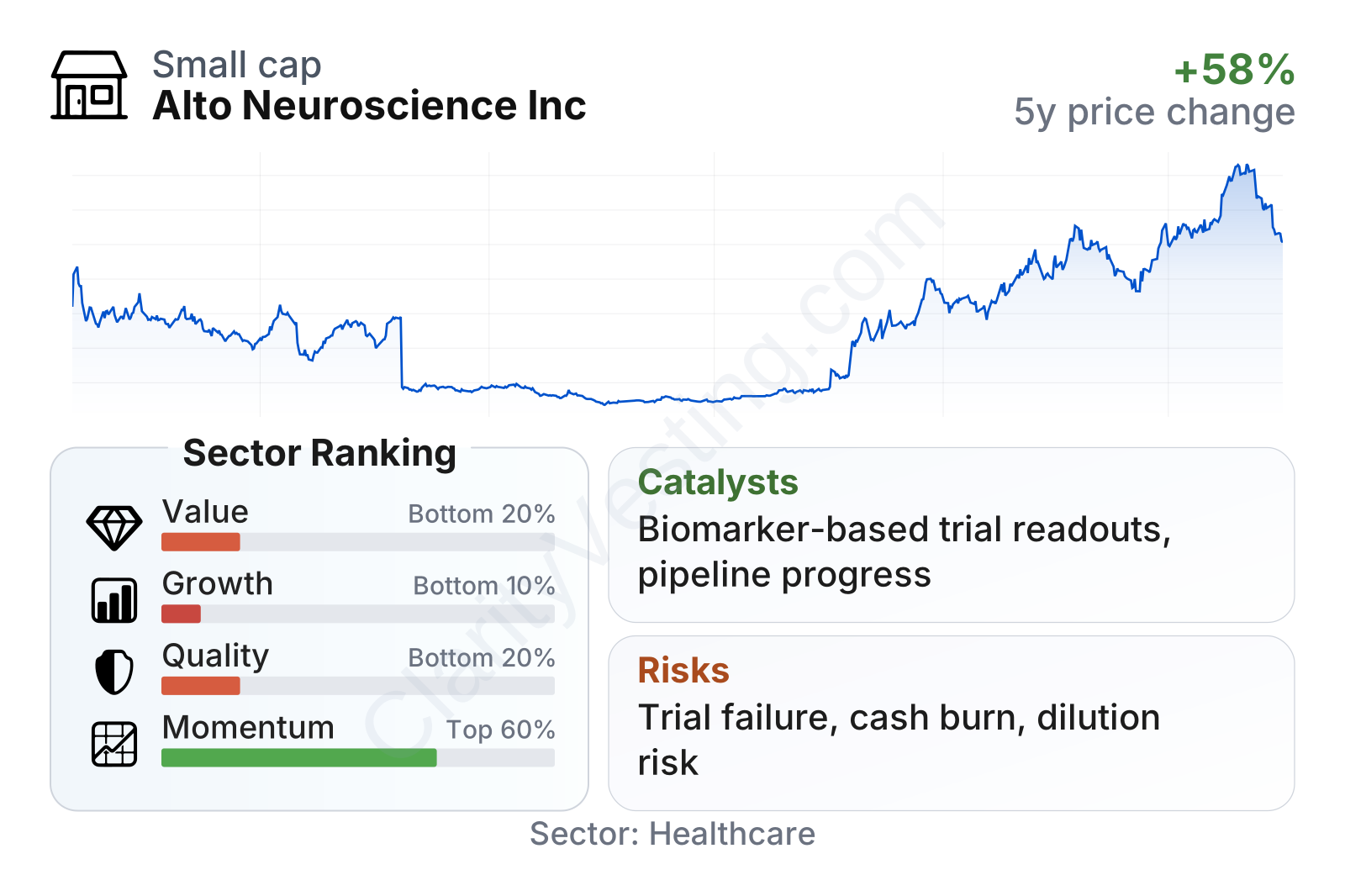
Alto is a small-cap biotech with a market value around $1 billion and above-average share price volatility. The stock has been highly event-driven, falling sharply after its public listing period and then rebounding strongly through 2026. On relative metrics, value, growth, and quality rank in the lower part of the healthcare sector, which is not surprising for a company without product revenue or earnings. Momentum is stronger, reflecting renewed market optimism, but that strength rests more on expectations around the pipeline than on operating fundamentals.
Growth
The company operates in a large and still underserved area of healthcare. Mental health disorders remain a major global burden, and drug development in psychiatry has historically been difficult because patient responses vary widely. A platform that can better identify likely responders could become valuable if it improves trial success rates or supports more targeted prescribing. That gives Alto exposure to a part of biotech where medical need is high and innovation has room to matter.
Alto’s growth strategy is based on advancing multiple neuroscience programs while using biomarker selection to improve the odds of success. The logic is straightforward: psychiatric drug development has often failed because trials included very broad patient populations, so selecting narrower groups may increase the chance of clearer efficacy signals. If that approach works consistently, it could give the company a differentiated place in CNS drug development even without being the largest player.
A key near-term growth driver is clinical readouts from its pipeline. For a company at Alto’s stage, trial milestones matter more than current income statements because one strong study can materially change partnership prospects, financing access, and the probability of future commercialization. Public company communications in 2026 have continued to emphasize progress across its biomarker-driven pipeline, which keeps Alto tied closely to upcoming data events.
Another recent opportunity indicator is the sharp improvement in share performance during 2026. Stock moves alone do not prove business quality, but in biotech they often reflect changing expectations around clinical timing, program relevance, or perceived probability of success. The market appears to be assigning more value to Alto’s platform and development assets than it did during the post-IPO decline.
The limiting factor is that growth in a clinical-stage biotech does not look like normal business growth. Revenue is flat because there are no products yet, while cash outflow has widened into the low tens of millions of dollars. That means future growth depends on pipeline execution first, and commercial scaling only later if one or more programs succeed.
Risks
This article is for informational purposes only and does not constitute financial advice. Some content is AI-generated. See Disclaimer


