Stock Analysis · Antofagasta PLC (ANFGF)
Overview
Antofagasta PLC is a Chile-focused mining company listed in London, with an over-the-counter U.S. share symbol of ANFGF. Its business is centered on copper, one of the most important metals for power grids, construction, electric vehicles, renewable energy equipment, and industrial machinery. The group also produces meaningful volumes of gold and molybdenum as by-products, and it has related transport infrastructure that supports its mining operations.
The company’s earnings are mainly tied to a small number of large mines in Chile, especially Los Pelambres, Centinela, Antucoya, and Zaldívar. This makes Antofagasta easier to understand than highly diversified global miners: when copper prices, production volumes, grades, and costs move, the impact on results is usually clear.
Based on recent annual reporting, revenue is overwhelmingly generated by mined products, led by copper. A simple way to think about the revenue mix is:
- Copper: approximately 85% to 90% of revenue. This is the company’s core product and the main driver of profit.
- Gold: approximately 7% to 10% of revenue. Gold is mainly produced as a by-product at some operations and helps offset mining costs.
- Molybdenum: approximately 2% to 5% of revenue. This alloy metal is smaller in sales contribution but still meaningful for margins in stronger pricing periods.
- Transport and other activities: typically a low single-digit share of revenue. This includes rail and related services, but it is not the central reason the company is valued by the market.
Operationally, Antofagasta combines long-life assets, a strong position in Chilean copper, and a structure that is more concentrated than peers such as BHP or Rio Tinto. That concentration increases exposure to copper and Chile, but it also gives the company a clearer identity and a more direct link to long-term copper demand.
The financial flow over the last several years shows a cyclical pattern rather than a straight line. Revenue fell from the 2021 peak, recovered gradually, and then rebounded strongly in 2025. Operating profitability remained high through the cycle, which suggests that the asset base is resilient even when copper prices and grades fluctuate. The latest rebound also points to improving earnings power when volume and pricing line up more favorably.
Key Figures
| Metric | Value | Sector ⓘ |
|---|---|---|
| Date | Oct 24, 2026 | |
| Context | ||
| Sector | Basic Materials | |
| Industry | Copper | |
| Market Cap ⓘ | $44.05B | |
| Beta ⓘ | 1.41 | |
Value (Cheapness) | ||
| P/E Ratio ⓘ | 26.60 | 16.92 |
| P/B Ratio ⓘ | 7.07 | 1.66 |
| FCF Yield ⓘ | -0.92% | 5.83% |
| Dividend Yield ⓘ | 1.76% | 2.07% |
| EBIT / EV ⓘ | 12.92% | 6.38% |
| PEG ⓘ | 0.90 | |
Growth (Business expansion) | ||
| Revenue Growth ⓘ | 17.90% | 11.25% |
| RPS Growth (5Y CAGR) ⓘ | 3.65% | 4.49% |
| EPS Growth (5Y CAGR) ⓘ | N/A | -15.24% |
| BVPS Growth (5Y CAGR) ⓘ | -6.70% | 5.49% |
| Margin Growth (5Y Trend) ⓘ | -6.25% | -1.54% |
| FCF Growth (5Y CAGR) ⓘ | N/A | 0.37% |
| DPS Growth (5Y CAGR) ⓘ | -13.16% | 5.91% |
Quality (Business durability) | ||
| ROIC (Latest) ⓘ | 27.05% | 9.59% |
| ROA (Latest) ⓘ | 10.88% | 4.92% |
| ROIC (5Y Median) ⓘ | 14.59% | 7.91% |
| ROA (5Y Median) ⓘ | 5.53% | 3.92% |
| Net Debt / EBIT (Latest) ⓘ | 0.83 | 1.36 |
| Net Debt / EBIT (5Y Median) ⓘ | 1.40 | 1.69 |
| Net Debt / EBITDA (Latest) ⓘ | 0.56 | 0.93 |
| Net Debt / Assets ⓘ | 20.73% | 13.69% |
| EBITDA / Interest ⓘ | 14.82 | 12.38 |
| Operating Margin (Latest) ⓘ | 40.95% | 13.24% |
| Operating Margin (5Y Median) ⓘ | 41.23% | 11.82% |
| Debt to Equity (Latest) ⓘ | 75.57% | 40.30% |
| Profit Margin (Latest) ⓘ | 17.79% | 6.38% |
| Free Cash Flow (Latest) ⓘ | -$404.59M | |
Momentum (Price trend) | ||
| 3Y Return ⓘ | +200.13% | +73.47% |
| 12M Return (excl. last month) ⓘ | +64.88% | +27.59% |
| 6M Return ⓘ | -7.67% | -4.02% |
| Price vs. 200-Day MA ⓘ | -8.64% | -0.65% |
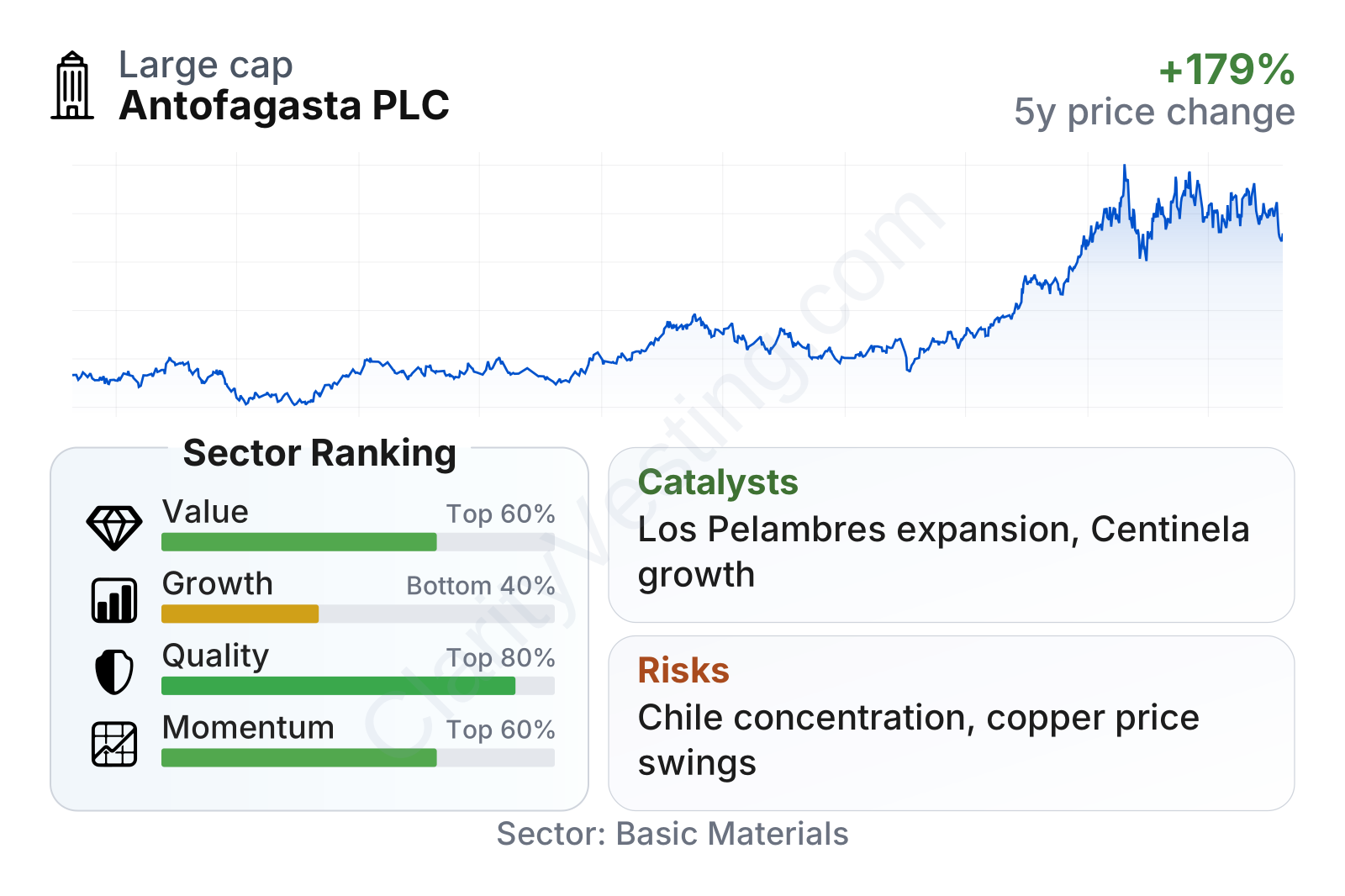
Antofagasta is a large copper producer with above-average operating quality relative to much of the basic materials sector. Profitability stands out: operating margin is around 41% versus a sector median near 12%, profit margin is around 18% versus roughly 7%, and returns on capital are also well ahead of typical peers. Balance sheet leverage is still manageable by mining standards, with net debt below annual EBIT and EBITDA, although debt relative to equity has risen. The weaker points are valuation and cash generation: earnings and book multiples are above sector norms, while trailing free cash flow is currently negative. Growth is mixed as well, with strong recent revenue growth but a less impressive longer-term trend and pressure on dividend growth over the past five years.
Growth
Copper is widely viewed as a favorable long-term mining market because electrification uses large amounts of the metal. Expanding power networks, renewable energy installations, electric vehicles, charging systems, and data-center-related grid investment all support this demand outlook. At the same time, building new copper mines is slow, expensive, and increasingly difficult because of permitting, water access, local community concerns, and declining ore grades across the industry. That combination can create a constructive backdrop for established producers with existing operations.
Antofagasta’s strategy fits that backdrop reasonably well. The company is not trying to become a sprawling global miner; instead, it is focused on improving and extending core Chilean assets. For a long-term reader, this matters because mine expansions at known operations are usually easier to understand and often less risky than entering completely new countries or unrelated commodities.
The recent revenue trend has improved noticeably after a choppier period in 2022 through 2024. The business returned to stronger top-line growth in 2025, helped by a better production and price environment. That does not remove cyclicality, but it does show how quickly earnings power can recover when conditions turn favorable.
One of the main catalysts is the Los Pelambres growth path, including infrastructure and debottlenecking work designed to support throughput and mine life. Centinela is also important, especially with development plans aimed at lifting copper output over time. In simple terms, these projects are meant to let Antofagasta sell more copper from assets it already knows well, rather than depending only on higher copper prices.
Another favorable point is product relevance. Copper is one of the few mined materials that sits directly at the intersection of industrial activity and decarbonization. That gives Antofagasta a clearer long-term demand narrative than miners focused on commodities with weaker structural growth drivers.
Recent company updates have also emphasized project execution, operating improvement, and production guidance tied to expansion work in Chile. For long-term analysis, the key opportunity is straightforward: if copper demand remains strong and Antofagasta lifts output from its existing base without a major cost blowout, earnings capacity could expand meaningfully from current levels.
Risks
This article is for informational purposes only and does not constitute financial advice. Some content is AI-generated. See Disclaimer


