Stock Analysis · The Andersons Inc (ANDE)
Overview
The Andersons Inc is a diversified agriculture and food-related company. Its activities are centered on moving, storing, processing, and merchandising grain and other agricultural products, producing renewable fuel ingredients, and supplying crop nutrients and farm services. In simple terms, the company sits in the middle of important parts of the farm economy: it connects growers, processors, fuel markets, and end customers.
The business is organized across several operating segments. Based on recent annual filings, the largest source of revenue is the Trade segment, which includes grain merchandising, commodity logistics, risk management, and asset-based operations such as grain elevators and terminals. The next largest source is Renewables, which includes ethanol production and the sale of co-products such as distillers dried grains, corn oil, and other feed-related outputs. Nutrient & Industrial contributes a smaller but still meaningful share through plant nutrients, agricultural inputs, specialty liquids, and industrial products.
Using the latest annual mix as a practical guide, revenue is approximately distributed as follows:
- Trade: about 74% of revenue. This includes grain origination, merchandising, storage, transportation, and related risk-management services.
- Renewables: about 20% of revenue. This is mainly ethanol and co-products tied to corn processing and fuel markets.
- Nutrient & Industrial: about 6% of revenue. This includes crop nutrients, specialty products, and related farm and industrial solutions.
That mix matters because it shows The Andersons is not a pure packaged-food company despite being grouped in a defensive sector classification. Its results are much more exposed to commodity prices, crop flows, basis opportunities, ethanol margins, and seasonal agricultural demand than a typical consumer staples business.
Over the last several years, revenue has come down from the unusual highs reached during the 2022 commodity boom, but the business has remained profitable. The broad pattern is that sales can swing sharply with grain and fuel prices, while earnings depend heavily on merchandising spreads, processing margins, and how efficiently the company uses its storage and logistics network.
The long-term pattern shows a business with very high cost of goods sold relative to revenue, which is typical for grain merchandising and ethanol. Revenue has fallen meaningfully since 2022, yet operating income has held up better than sales, suggesting that margin management and business mix have mattered more than headline revenue alone.
Key Figures
| Metric | Value | Sector ⓘ |
|---|---|---|
| Date | Oct 17, 2026 | |
| Context | ||
| Sector | Consumer Defensive | |
| Industry | Food Distribution | |
| Market Cap ⓘ | $2.21B | |
| Beta ⓘ | 0.66 | |
Value (Cheapness) | ||
| P/E Ratio ⓘ | 12.56 | 17.88 |
| P/B Ratio ⓘ | 1.81 | 1.29 |
| FCF Yield ⓘ | 2.57% | 12.39% |
| Dividend Yield ⓘ | 1.24% | 2.85% |
| EBIT / EV ⓘ | 6.62% | 6.43% |
| PEG ⓘ | 0.89 | |
Growth (Business expansion) | ||
| Revenue Growth ⓘ | -1.20% | 4.10% |
| RPS Growth (5Y CAGR) ⓘ | -3.57% | 6.18% |
| EPS Growth (5Y CAGR) ⓘ | -5.55% | -13.59% |
| BVPS Growth (5Y CAGR) ⓘ | 9.14% | 3.20% |
| Margin Growth (5Y Trend) ⓘ | 0.13% | -0.15% |
| FCF Growth (5Y CAGR) ⓘ | -19.38% | 4.10% |
| DPS Growth (5Y CAGR) ⓘ | 2.87% | 6.79% |
Quality (Business durability) | ||
| ROIC (Latest) ⓘ | 8.01% | 12.34% |
| ROA (Latest) ⓘ | 5.24% | 6.30% |
| ROIC (5Y Median) ⓘ | 9.64% | 10.49% |
| ROA (5Y Median) ⓘ | 2.44% | 5.44% |
| Net Debt / EBIT (Latest) ⓘ | 4.03 | 1.96 |
| Net Debt / EBIT (5Y Median) ⓘ | 3.17 | 2.35 |
| Net Debt / EBITDA (Latest) ⓘ | 2.44 | 1.38 |
| Net Debt / Assets ⓘ | 24.01% | 21.51% |
| EBITDA / Interest ⓘ | 5.87 | 9.46 |
| Operating Margin (Latest) ⓘ | 1.89% | 8.87% |
| Operating Margin (5Y Median) ⓘ | 1.58% | 9.53% |
| Debt to Equity (Latest) ⓘ | 68.31% | 72.35% |
| Profit Margin (Latest) ⓘ | 1.62% | 5.40% |
| Free Cash Flow (Latest) ⓘ | $56.91M | |
Momentum (Price trend) | ||
| 3Y Return ⓘ | +39.81% | +20.92% |
| 12M Return (excl. last month) ⓘ | +78.97% | +2.13% |
| 6M Return ⓘ | -8.41% | +1.26% |
| Price vs. 200-Day MA ⓘ | -1.07% | +1.39% |
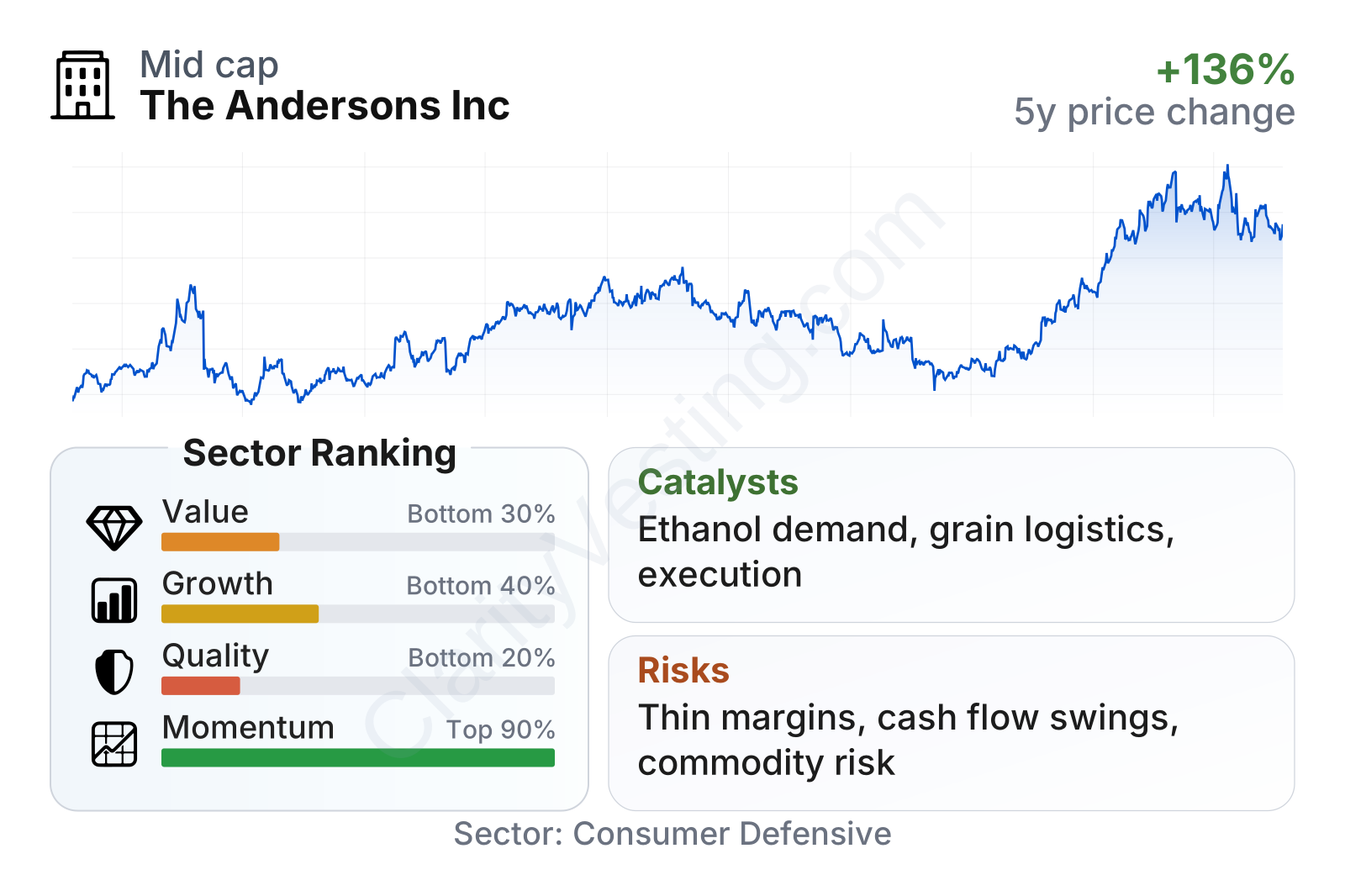
The Andersons is a mid-sized company with a relatively low share-price volatility profile, reflected in a beta below 1. The overall factor picture is mixed: valuation looks cheaper than much of the sector on earnings, momentum has been very strong over the last year and over three years, but quality and growth rank in the lower part of the sector. In practical terms, the market has recently rewarded the company’s improving outlook, even though profitability and long-term cash generation still trail many peers.
The stock’s path has been volatile but clearly upward over the past several years, with a particularly sharp re-rating in 2026. That kind of move usually means expectations have improved quickly, so the key question becomes whether operating performance can keep pace with the stronger share price.
Growth
The company operates in sectors that have durable relevance rather than fast structural expansion. Grain handling, crop inputs, and ethanol are all essential markets, but they do not usually grow in a straight line. Instead, opportunity comes from scale, logistics, regional advantages, operational execution, and the ability to capture favorable market dislocations. That gives The Andersons a reasonable long-term growth framework, but not the kind of easy growth that comes from a rapidly expanding end market.
A major part of the strategy is to use an integrated platform: grain origination and storage support merchandising, while corn processing feeds the renewables business and creates co-products for animal feed markets. This makes strategic sense because it allows the company to earn from multiple points in the agricultural value chain rather than depending on a single crop or customer type.
Recent revenue growth has been uneven. After extraordinary growth in 2021 and 2022, revenue turned negative for much of 2023 and 2024, then stabilized. The latest readings remain slightly below the prior year. For this company, that is not automatically a sign of deterioration because reported sales are heavily influenced by commodity price movements. More important is whether merchandising opportunities, processing economics, and operating income remain resilient.
Cash generation has been one of the less steady parts of the picture. Free cash flow has swung widely from strongly positive to negative, which is common in working-capital-heavy agricultural businesses. Inventory, receivables, and commodity price changes can create large short-term moves in cash flow. For long-term analysis, this means it is better to look for consistency across a cycle rather than focusing on one quarter or one year in isolation.
Several catalysts support the growth case. Ethanol and renewable fuel markets remain important demand outlets for corn processing. The company also continues to invest in its trade and logistics footprint, where scale and asset positioning can help capture grain flows and merchandising margins. In addition, a more normalized interest-rate environment could gradually ease financing pressure on working capital, which matters for a business that carries significant inventories and seasonal funding needs.
Recent company communications have also emphasized execution in the core grain and renewables businesses, as well as ongoing portfolio discipline. That does not create a dramatic one-time growth event, but it does support the view that future expansion is more likely to come from better returns on existing assets, operational improvements, and selective investment rather than from aggressive empire-building.
Risks
This article is for informational purposes only and does not constitute financial advice. Some content is AI-generated. See Disclaimer


