Stock Analysis · AMG Advanced Metallurgical Group N.V (AMVMF)
Overview
AMG Advanced Metallurgical Group N.V. is a specialty materials and engineering company focused on metals and systems used in demanding industrial applications. In simple terms, it produces and processes critical materials such as lithium, vanadium, tantalum, niobium, antimony, and titanium alloys, and it also builds thermal process systems used by customers in aerospace, energy, and other high-performance manufacturing markets. The business sits at the intersection of mining, refining, recycling, and industrial equipment.
Its revenue base is diversified across three operating segments disclosed by the company: AMG Lithium, AMG Vanadium, and AMG Technologies. Based on recent annual reporting, the mix can shift materially from year to year because metal prices are cyclical, but the broad ranking is usually led by technologies and vanadium-related activities, with lithium becoming increasingly important as new capacity ramps.
The main revenue sources can be summarized as follows.
- AMG Technologies: approximately 40% to 45% of revenue in recent periods. This segment includes vacuum furnace systems, turbine blade coating equipment, powder metallurgy equipment, and titanium aluminides for aerospace and industrial uses.
- AMG Vanadium: approximately 30% to 35% of revenue. This includes vanadium recycling and recovery, ferrovanadium, catalyst recycling, and related services tied to steel, refining, and energy storage markets.
- AMG Lithium: approximately 20% to 30% of revenue. This includes spodumene concentrate and lithium-related materials, with the exact contribution moving sharply depending on lithium prices and the timing of new production capacity.
That mix matters because AMG is not a pure lithium company, even though lithium often receives the most attention. Its earnings can be influenced by several end markets at once: electric vehicles and battery materials through lithium, steel and grid storage through vanadium, and aerospace and industrial capital spending through technologies. This diversification reduces dependence on a single commodity, but it also makes the business more complex to analyze.
The financial flow over the last several years shows a business with strong revenue recovery after 2021, peaking in profitability during the favorable commodity environment of 2022 and 2023, then coming under pressure as margins compressed and interest costs remained elevated. Revenue held up better than net income, which suggests that pricing, cost absorption, and financing costs have had a bigger effect than volume alone.
Key Figures
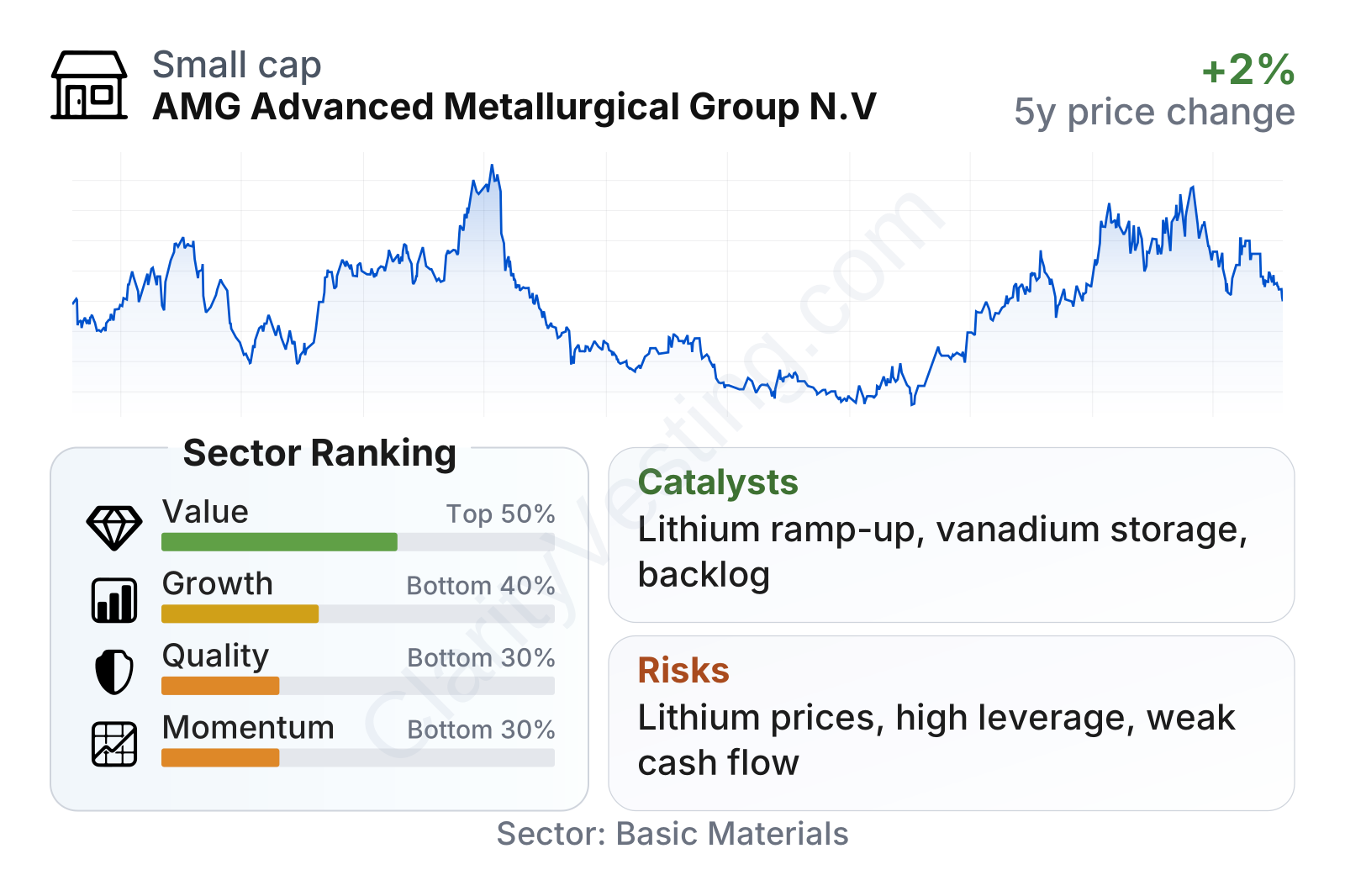
The share price history highlights a company with meaningful volatility. After falling sharply through 2024, the stock rebounded strongly into 2025 and early 2026 before easing again. That pattern is consistent with AMG’s exposure to cyclical metal markets and changing expectations around lithium, margins, and project execution.
| Metric | Value | Sector ⓘ |
|---|---|---|
| Date | Oct 17, 2026 | |
| Context | ||
| Sector | Basic Materials | |
| Industry | Other Industrial Metals & Mining | |
| Market Cap ⓘ | $1.09B | |
| Beta ⓘ | 1.08 | |
Value (Cheapness) | ||
| P/E Ratio ⓘ | 437.14 | 16.90 |
| P/B Ratio ⓘ | 1.54 | 1.65 |
| FCF Yield ⓘ | -0.17% | 5.76% |
| Dividend Yield ⓘ | 1.45% | 2.13% |
| EBIT / EV ⓘ | 7.98% | 6.30% |
| PEG ⓘ | N/A | |
Growth (Business expansion) | ||
| Revenue Growth ⓘ | 19.10% | 11.10% |
| RPS Growth (5Y CAGR) ⓘ | 8.50% | 4.49% |
| EPS Growth (5Y CAGR) ⓘ | -39.67% | -13.47% |
| BVPS Growth (5Y CAGR) ⓘ | 17.89% | 5.51% |
| Margin Growth (5Y Trend) ⓘ | 2.00% | -1.54% |
| FCF Growth (5Y CAGR) ⓘ | -27.62% | 0.37% |
| DPS Growth (5Y CAGR) ⓘ | 18.60% | 6.08% |
Quality (Business durability) | ||
| ROIC (Latest) ⓘ | N/A | 9.26% |
| ROA (Latest) ⓘ | 0.18% | 4.91% |
| ROIC (5Y Median) ⓘ | 6.50% | 7.70% |
| ROA (5Y Median) ⓘ | 0.88% | 3.86% |
| Net Debt / EBIT (Latest) ⓘ | 3.74 | 1.40 |
| Net Debt / EBIT (5Y Median) ⓘ | 4.99 | 1.70 |
| Net Debt / EBITDA (Latest) ⓘ | 2.42 | 0.95 |
| Net Debt / Assets ⓘ | 21.32% | 13.69% |
| EBITDA / Interest ⓘ | 3.02 | 12.34 |
| Operating Margin (Latest) ⓘ | 7.24% | 13.20% |
| Operating Margin (5Y Median) ⓘ | 7.24% | 11.80% |
| Debt to Equity (Latest) ⓘ | 116.52% | 40.56% |
| Profit Margin (Latest) ⓘ | 0.30% | 6.43% |
| Free Cash Flow (Latest) ⓘ | -$1.82M | |
Momentum (Price trend) | ||
| 3Y Return ⓘ | +16.52% | +68.89% |
| 12M Return (excl. last month) ⓘ | +5.88% | +30.21% |
| 6M Return ⓘ | -20.61% | -4.16% |
| Price vs. 200-Day MA ⓘ | -16.31% | -1.27% |
On the latest snapshot, AMG looks mixed. On valuation, the business screens better on enterprise value versus EBIT than on earnings-based ratios, because net income remains depressed. Price-to-book is close to the sector median, which is notable for a company with tangible industrial assets. Growth indicators are uneven: revenue growth has recovered and long-term book value growth has been strong, but earnings and free cash flow have been much weaker. Quality metrics are the main soft spot, with leverage, interest coverage, and profitability all trailing much of the sector. In short, the numbers describe a company with operating relevance and asset backing, but also a balance sheet and margin profile that still need improvement.
Growth
AMG operates in sectors with credible long-term demand drivers. Lithium remains linked to battery supply chains, vanadium has exposure to both steel alloys and grid-scale energy storage, and the technologies segment serves aerospace and advanced manufacturing markets that require highly specialized equipment. These are all areas where technical barriers are meaningful and where end-market demand can remain attractive over a multiyear period, even if annual results are volatile.
The company’s strategy also has a clear industrial logic. Rather than only mining raw materials, AMG aims to participate in higher-value processing, recycling, and engineered systems. That approach can create better margins over time than commodity extraction alone, especially when the company is able to secure long-term customer relationships or move materials further downstream. For a long-term view, the most important strategic question is whether AMG can translate this positioning into steadier returns, not just higher revenue.
Recent revenue growth points to a recovery after a weak stretch in 2024. The latest year-over-year figures are back in positive territory and are running ahead of the sector median. That is encouraging because it suggests demand and pricing are no longer moving only in the wrong direction. Still, AMG’s history shows that revenue growth can swing quickly, so the quality of that growth matters as much as the headline percentage.
Cash generation remains the weaker part of the growth picture. Free cash flow has been negative in several recent periods, which usually reflects a mix of lower earnings, working-capital movements, and ongoing investment. For AMG, this is especially relevant because the growth case depends in part on expanding processing capacity and building out projects that may take time to produce returns. If those investments convert into stronger operating cash flow later, the current pressure may look transitional; if not, growth will appear more expensive than initially expected.
A notable catalyst is AMG’s effort to build a stronger position in the lithium value chain, including refining and downstream processing capacity in Europe. This aligns with the broader push for localized battery supply chains outside China. Another catalyst is vanadium’s potential role in long-duration energy storage through vanadium redox flow batteries, a niche that is smaller than lithium-ion today but strategically attractive for grid applications. The technologies segment also adds a different kind of catalyst: order intake and backlog can improve when aerospace and industrial customers step up capital spending.
Recent company updates have also pointed to operating ramp-ups and a sharper focus on cost discipline. For a business like AMG, that combination is important. New capacity alone does not guarantee value creation; what matters is the timing of volumes, conversion costs, and realized prices. If management executes well, the company could emerge from a low point in profitability with a broader and more integrated earnings base than before.
Risks
This article is for informational purposes only and does not constitute financial advice. Some content is AI-generated. See Disclaimer


