Stock Analysis · Amerant Bancorp Inc (AMTB)
Overview
Amerant Bancorp is a U.S. regional bank headquartered in Florida. Through Amerant Bank and related subsidiaries, it provides traditional banking services such as commercial and consumer lending, deposit accounts, treasury and cash-management services, wealth management, and a small capital-markets and advisory operation. Its footprint is concentrated in South Florida, with additional operations in Texas and a meaningful connection to clients involved in international business, especially across the Americas.
Like most banks, Amerant mainly earns money from the spread between what it receives on loans and securities and what it pays on deposits and other funding. A smaller portion comes from fees tied to customer services. Based on recent annual filings, the revenue mix is roughly as follows:
- Net interest income: about 75% to 85% of total revenue. This is the core banking business, mainly loans to commercial real estate, owner-occupied real estate, commercial and industrial clients, and consumers, funded largely by deposits.
- Noninterest income: about 15% to 25% of total revenue. This includes deposit-service charges, wealth-management and trust fees, loan-related fees, treasury-management income, and capital-markets or advisory activity.
- Within lending, commercial banking is the main driver, with commercial real estate and broader business lending representing the largest share of the loan book, while residential and consumer lending are smaller contributors.
Over the last several years, Amerant expanded revenue, but profitability became much more volatile as funding costs rose sharply across the banking sector. The latest pattern suggests that the bank is still primarily a spread-based lender, and that changes in interest rates and deposit pricing have an outsized effect on results.
The long-term picture shows revenue rising meaningfully from 2021 to 2025, but with a clear squeeze in profitability during 2023 and 2024 as interest expense climbed much faster than operating costs. Results improved again in 2025, which suggests the pressure from funding costs may be easing, but margins remain below earlier levels.
Key Figures
| Metric | Value | Sector ⓘ |
|---|---|---|
| Date | Oct 03, 2026 | |
| Context | ||
| Sector | Financial Services | |
| Industry | Banks - Regional | |
| Market Cap ⓘ | $1.12B | |
| Beta ⓘ | 0.83 | |
Value (Cheapness) | ||
| P/E Ratio ⓘ | 20.48 | 12.60 |
| P/B Ratio ⓘ | 1.27 | 1.23 |
| FCF Yield ⓘ | 29.29% | 10.16% |
| Dividend Yield ⓘ | 1.24% | 2.96% |
| EBIT / EV ⓘ | 4.08% | 7.77% |
| PEG ⓘ | N/A | |
Growth (Business expansion) | ||
| Revenue Growth ⓘ | -7.90% | 9.50% |
| RPS Growth (5Y CAGR) ⓘ | 18.08% | 12.10% |
| EPS Growth (5Y CAGR) ⓘ | -18.73% | -9.45% |
| BVPS Growth (5Y CAGR) ⓘ | -1.17% | 5.01% |
| Margin Growth (5Y Trend) ⓘ | -36.70% | -4.07% |
| FCF Growth (5Y CAGR) ⓘ | 12.64% | 4.96% |
| DPS Growth (5Y CAGR) ⓘ | -3.94% | 8.79% |
Quality (Business durability) | ||
| ROIC (Latest) ⓘ | 3.19% | 9.60% |
| ROE (Latest) ⓘ | 6.61% | 13.84% |
| ROA (Latest) ⓘ | 0.59% | 1.53% |
| ROIC (5Y Median) ⓘ | 2.97% | 7.86% |
| ROE (5Y Median) ⓘ | 5.73% | 12.20% |
| ROA (5Y Median) ⓘ | 0.53% | 1.29% |
| Net Debt / EBIT (Latest) ⓘ | 12.27 | 0.91 |
| Net Debt / EBIT (5Y Median) ⓘ | 10.36 | 0.74 |
| Net Debt / EBITDA (Latest) ⓘ | 11.24 | 0.97 |
| Operating Margin (Latest) ⓘ | 12.47% | 22.12% |
| Operating Margin (5Y Median) ⓘ | 10.09% | 24.39% |
| Debt to Equity (Latest) ⓘ | 99.75% | 60.37% |
| Profit Margin (Latest) ⓘ | 14.41% | 26.62% |
| Free Cash Flow (Latest) ⓘ | $329.14M | |
Momentum (Price trend) | ||
| 3Y Return ⓘ | +76.93% | +89.23% |
| 12M Return (excl. last month) ⓘ | +34.39% | +17.35% |
| 6M Return ⓘ | +30.95% | +10.00% |
| Price vs. 200-Day MA ⓘ | +22.00% | +3.73% |
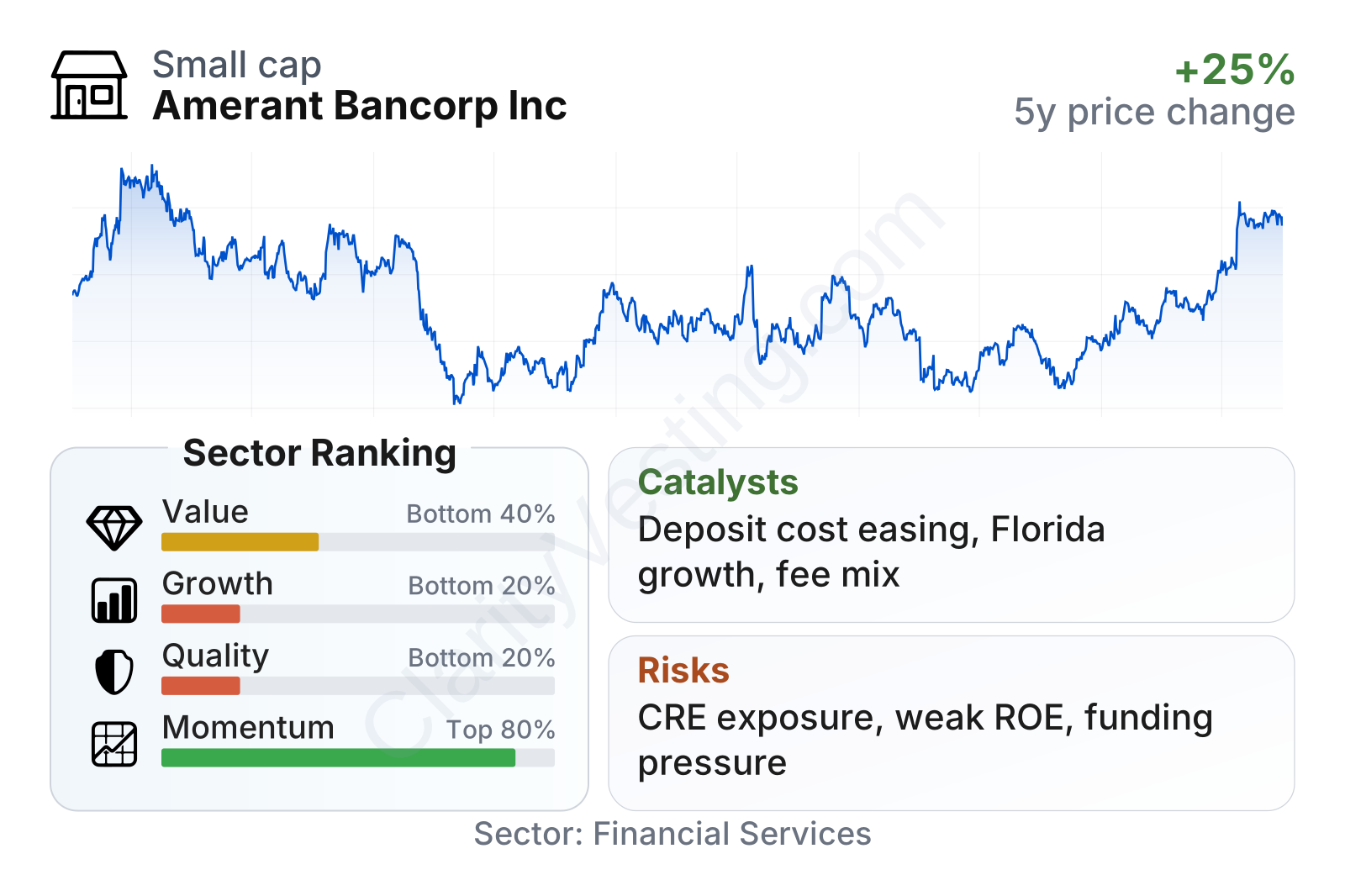
Amerant is a small-cap regional bank with a stock that has recently shown stronger momentum than much of its sector. That market strength stands in contrast to weaker underlying fundamentals: value metrics are not especially cheap relative to peers, growth scores are soft because recent revenue slipped and long-run earnings growth has been uneven, and quality measures rank near the lower end of the regional-bank group. Profitability and leverage are the main areas that still need improvement.
The stock-price history reflects that mixed backdrop. Shares fell sharply during the regional-banking stress period in 2023, then recovered through 2024 to 2026. That rebound indicates better sentiment, but it also means the market has already recognized part of the operational recovery.
Growth
Amerant operates in a mature industry rather than a fast-growing one, but its markets are more attractive than the average U.S. banking footprint. South Florida and Texas continue to benefit from population growth, business formation, real-estate activity, and cross-border wealth flows. Those trends support demand for commercial loans, private banking, treasury services, and wealth management, all of which fit Amerant’s model.
The company’s strategy also makes sense on paper for a bank of its size. It is focused on relationship-based commercial banking in attractive metropolitan areas, while trying to deepen fee income through wealth management and treasury services. For a regional bank, this is a reasonable path because it can improve customer retention and reduce total dependence on pure lending spreads. The challenge is execution: the bank still needs to translate that footprint into steadier profitability.
Earnings per share illustrate both the opportunity and the instability. Amerant produced solid earnings in 2021 through 2023, moved into a loss in 2024, and returned to positive earnings in 2025. That rebound is important because it shows the business was not structurally broken, but the uneven path also means growth has not been consistent enough yet to qualify as a clear long-term compounding profile.
Book value per share, a closely watched measure for banks, has also been uneven. It improved strongly at one stage, then pulled back again. For long-term analysis, that matters because durable growth in book value is often one of the clearest signs that a bank is creating value through the cycle. Amerant’s record here is mixed rather than clearly upward.
A practical catalyst is the normalization of deposit costs and loan yields. If funding pressure continues to moderate while loan production remains healthy, net interest margin can recover further. Another catalyst is balance-sheet remixing toward higher-quality and better-yielding loans, combined with growth in noninterest income from wealth management and treasury services. Recent company communications have also emphasized repositioning and efficiency efforts, which could help if expense growth stays controlled.
Risks
This article is for informational purposes only and does not constitute financial advice. Some content is AI-generated. See Disclaimer