Stock Analysis · ArcelorMittal SA (AMSYF)
Overview
ArcelorMittal is one of the world’s largest steel and mining groups. The company produces flat steel, long steel, tubular products, and specialty steels used in construction, automotive, appliances, energy, machinery, and infrastructure. It also owns iron ore and coal mining assets, which help supply part of its own steelmaking needs. In simple terms, ArcelorMittal turns raw materials into steel products that are essential for buildings, vehicles, industrial equipment, and public works.
The business is organized mainly by geography plus a mining segment. Based on the latest annual reporting structure, revenue is primarily generated by steel shipments in Europe and the Americas, with smaller contributions from other regions and mining.
- Europe: approximately 38% of revenue. This includes flat and long steel sold to automotive, construction, packaging, and industrial customers across the region.
- North America: approximately 27% of revenue. This is largely flat steel for automotive, appliances, construction, and service centers, plus some long products and tubing.
- Brazil: approximately 11% of revenue. This includes flat products, long products, and semi-finished steel for domestic and export markets.
- India joint ventures and associates: approximately 10% of revenue contribution at the operating level, though accounting presentation can differ from fully consolidated segments. India is strategically important because of rising steel demand and capacity expansion.
- Sustainable solutions / downstream processing and distribution activities: a smaller share embedded across regions, focused on higher-value processing, service, and lower-carbon offerings.
- Mining: approximately 4% to 6% of revenue in recent years. This includes iron ore and metallurgical coal production sold internally and to third parties.
- Other international activities: the balance comes from smaller regional operations, trading, and intersegment adjustments.
What stands out is that ArcelorMittal is not just a basic steel producer. It combines large-scale manufacturing, some raw material self-supply, and growing investment in lower-carbon steelmaking. That mix gives it more flexibility than a pure commodity steel company, even though earnings still depend heavily on steel prices and industrial demand.
The long-term pattern shows a business with very large revenue but highly variable profitability. Sales have come down from the 2022 peak, while operating income and net income have been much more volatile than revenue. That is typical of steel: small changes in pricing, energy, and utilization rates can have an outsized effect on profit.
Key Figures
| Metric | Value | Sector ⓘ |
|---|---|---|
| Date | Oct 17, 2026 | |
| Context | ||
| Sector | Basic Materials | |
| Industry | Steel | |
| Market Cap ⓘ | $49.33B | |
| Beta ⓘ | 1.75 | |
Value (Cheapness) | ||
| P/E Ratio ⓘ | 27.68 | 16.90 |
| P/B Ratio ⓘ | 0.95 | 1.65 |
| FCF Yield ⓘ | -3.71% | 5.76% |
| Dividend Yield ⓘ | 0.91% | 2.13% |
| EBIT / EV ⓘ | 5.88% | 6.30% |
| PEG ⓘ | 0.66 | |
Growth (Business expansion) | ||
| Revenue Growth ⓘ | 5.20% | 11.10% |
| RPS Growth (5Y CAGR) ⓘ | 3.76% | 4.49% |
| EPS Growth (5Y CAGR) ⓘ | N/A | -13.47% |
| BVPS Growth (5Y CAGR) ⓘ | 11.46% | 5.51% |
| Margin Growth (5Y Trend) ⓘ | -20.66% | -1.54% |
| FCF Growth (5Y CAGR) ⓘ | -48.37% | 0.37% |
| DPS Growth (5Y CAGR) ⓘ | 19.38% | 6.08% |
Quality (Business durability) | ||
| ROIC (Latest) ⓘ | 4.40% | 9.26% |
| ROA (Latest) ⓘ | 2.52% | 4.91% |
| ROIC (5Y Median) ⓘ | 2.93% | 7.70% |
| ROA (5Y Median) ⓘ | 3.51% | 3.86% |
| Net Debt / EBIT (Latest) ⓘ | 2.52 | 1.40 |
| Net Debt / EBIT (5Y Median) ⓘ | 1.51 | 1.70 |
| Net Debt / EBITDA (Latest) ⓘ | 1.23 | 0.95 |
| Net Debt / Assets ⓘ | 9.60% | 13.69% |
| EBITDA / Interest ⓘ | 11.78 | 12.34 |
| Operating Margin (Latest) ⓘ | 4.86% | 13.20% |
| Operating Margin (5Y Median) ⓘ | 5.49% | 11.80% |
| Debt to Equity (Latest) ⓘ | 26.31% | 40.56% |
| Profit Margin (Latest) ⓘ | 2.88% | 6.43% |
| Free Cash Flow (Latest) ⓘ | -$1.83B | |
Momentum (Price trend) | ||
| 3Y Return ⓘ | +188.82% | +68.89% |
| 12M Return (excl. last month) ⓘ | +97.34% | +30.21% |
| 6M Return ⓘ | +35.59% | -4.16% |
| Price vs. 200-Day MA ⓘ | +101.29% | -1.27% |
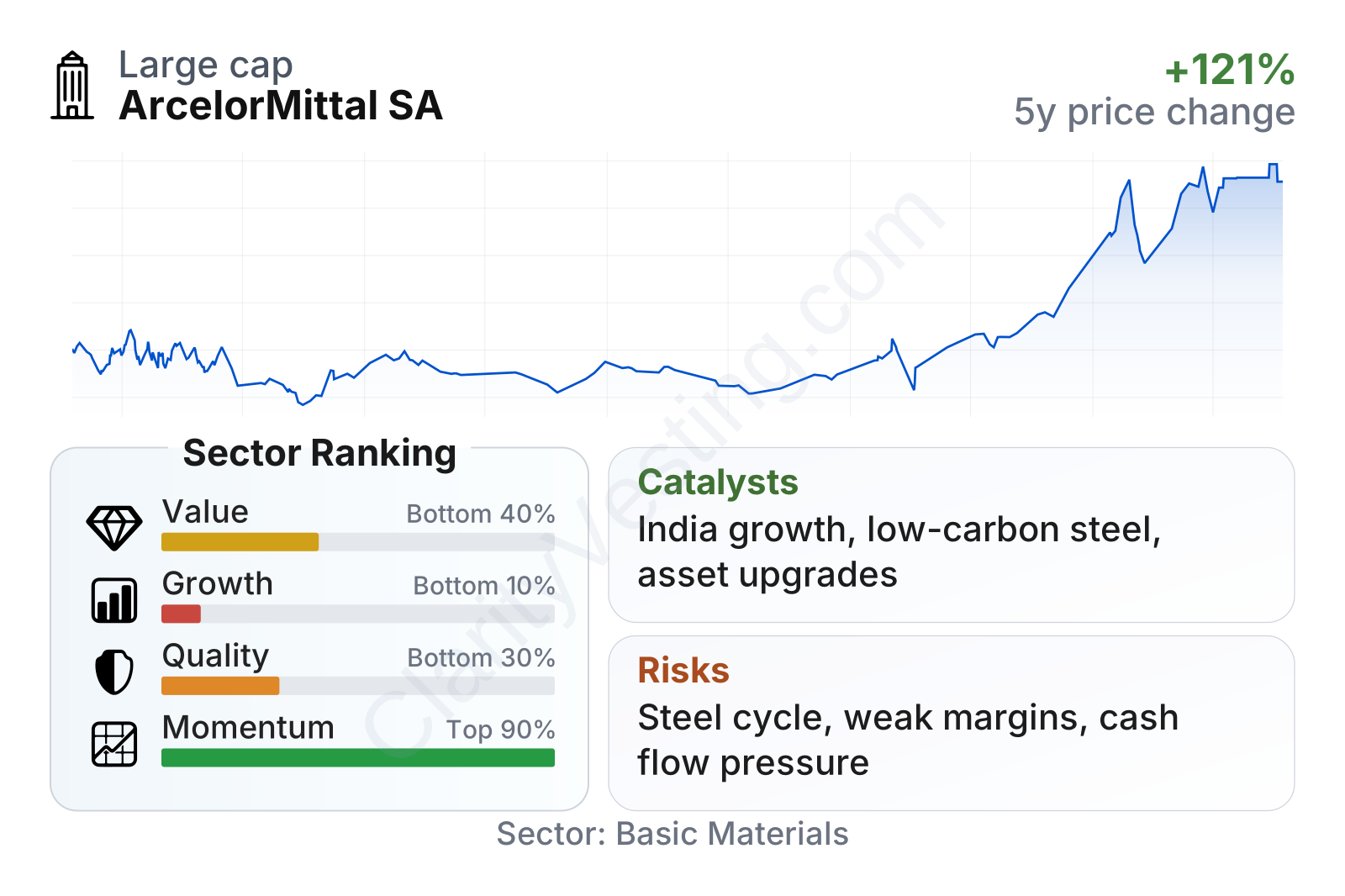
ArcelorMittal is a very large company with a market value above $50 billion, but its trading profile is more volatile than the average stock, reflected in a beta around 1.8. The stock’s recent price momentum has been very strong compared with the broader materials group, yet the underlying fundamentals are more mixed. Value metrics are not clearly cheap on earnings, with the P/E ratio above the sector median, although the price-to-book ratio is lower than the sector median. Growth and quality measures rank weaker, largely because margins and cash generation have been under pressure. In short, the market has rewarded the shares recently, but the operating picture has not improved as consistently as the share performance suggests.
Growth
Steel is usually not considered a fast-growth industry in developed markets, but it remains essential and can still expand through infrastructure spending, auto production, energy projects, and urbanization in faster-growing economies. The more attractive part of the sector today is not just volume growth; it is the shift toward higher-value steel grades and lower-emission production. That is where ArcelorMittal is trying to position itself.
The company’s strategy broadly makes sense for future growth. Management has been focusing on three levers: maintaining a strong balance sheet, investing in higher-return projects, and developing decarbonization pathways such as electric arc furnaces, direct reduced iron, scrap-based production, and low-carbon product lines. It is also pushing deeper into India, one of the few major steel markets with a compelling long-term demand outlook. India’s infrastructure buildout, urban housing needs, and manufacturing ambitions could support steel demand for many years.
Revenue growth has been uneven. The company moved from a period of very strong post-pandemic expansion into a much choppier environment, with several quarters of decline before stabilizing. Recent year-over-year changes suggest that the sharp downturn phase may have eased, but growth is still modest compared with the sector median. For a cyclical producer like ArcelorMittal, that matters because stronger revenue growth is often needed to rebuild margins.
Cash generation is an important point to watch. Free cash flow was strong earlier in the cycle, then faded materially and turned negative on a trailing basis. That does not automatically mean the business model is broken; in steel, cash flow can swing sharply because of working capital, capital spending, and commodity pricing. Still, the recent direction indicates that current growth is being pursued in a more demanding operating environment than in 2021 or 2022.
One notable catalyst is the company’s continued investment in lower-carbon steelmaking projects in Europe and North America. These projects are important because large customers, especially automakers and industrial companies, increasingly want lower-emission supply chains. If ArcelorMittal can secure premium contracts or protect market share through these investments, that could support future earnings quality rather than just output volume.
Another meaningful opportunity comes from portfolio optimization. ArcelorMittal has spent years reducing debt, streamlining assets, and redirecting capital toward operations with stronger returns or better strategic positioning. In a capital-intensive sector, better asset quality can matter as much as higher shipments.
Risks
This article is for informational purposes only and does not constitute financial advice. Some content is AI-generated. See Disclaimer


