Stock Analysis · American Superconductor Corporation (AMSC)
Overview
American Superconductor Corporation, usually called AMSC, develops equipment and control systems used in electric power networks and in selected industrial and defense applications. In simple terms, the company helps move, protect, and manage electricity. Its products include power control and grid interconnection systems, voltage regulation equipment, and specialized electrical systems used on naval vessels. The business is positioned at the intersection of grid modernization, renewable energy integration, and mission-critical electrical hardware.
AMSC reports its business in two segments: Grid and Wind. In recent years, Grid has become the dominant activity by a very wide margin, while Wind has become relatively small. Based on the latest fiscal year ended March 31, 2026, and management disclosures in recent filings, revenue is approximately split as follows:
- Grid segment: about 95% to 98% of revenue. This includes power control systems, reactive compensation solutions, medium-voltage products, grid interconnection equipment, and ship protection systems sold mainly to utilities, industrial customers, renewable project developers, and defense-related customers.
- Wind segment: about 2% to 5% of revenue. This business mainly includes electrical control systems and components tied to wind turbine applications, a much smaller contributor than in the company’s earlier years.
Within Grid, one of the most important product families is D-VAR, which helps stabilize voltage and improve grid performance, especially when renewable energy sources are connected. The company has also expanded in conventional grid hardware through acquisitions, giving it a broader product range and making the revenue base less dependent on one niche technology. The broad financial flow over the last five fiscal years shows a company that moved from losses and thin gross profit to materially higher sales, stronger gross profit dollars, and positive operating income by fiscal 2026. Net income in fiscal 2026 was unusually boosted by a large tax benefit, so the improvement at the operating level matters more than the headline profit figure.
Key Figures
| Metric | Value | Sector ⓘ |
|---|---|---|
| Date | Oct 03, 2026 | |
| Context | ||
| Sector | Industrials | |
| Industry | Specialty Industrial Machinery | |
| Market Cap ⓘ | $1.41B | |
| Beta ⓘ | 3.27 | |
Value (Cheapness) | ||
| P/E Ratio ⓘ | 9.50 | 22.45 |
| P/B Ratio ⓘ | 2.40 | 1.98 |
| FCF Yield ⓘ | 1.45% | 6.31% |
| Dividend Yield ⓘ | N/A | 1.96% |
| EBIT / EV ⓘ | 1.45% | 4.81% |
| PEG ⓘ | 0.74 | |
Growth (Business expansion) | ||
| Revenue Growth ⓘ | 30.00% | 9.10% |
| RPS Growth (5Y CAGR) ⓘ | 14.34% | 7.75% |
| EPS Growth (5Y CAGR) ⓘ | N/A | -13.59% |
| BVPS Growth (5Y CAGR) ⓘ | 33.18% | 6.22% |
| Margin Growth (5Y Trend) ⓘ | N/A | 0.72% |
| FCF Growth (5Y CAGR) ⓘ | N/A | 10.98% |
| DPS Growth (5Y CAGR) ⓘ | N/A | 9.48% |
Quality (Business durability) | ||
| ROIC (Latest) ⓘ | 22.75% | 10.92% |
| ROA (Latest) ⓘ | 22.62% | 5.41% |
| ROIC (5Y Median) ⓘ | -4.45% | 9.21% |
| ROA (5Y Median) ⓘ | -5.44% | 4.94% |
| Net Debt / EBIT (Latest) ⓘ | -7.06 | 2.07 |
| Net Debt / EBIT (5Y Median) ⓘ | N/A | 2.28 |
| Net Debt / EBITDA (Latest) ⓘ | -4.81 | 1.43 |
| Net Debt / Assets ⓘ | -18.34% | 19.27% |
| EBITDA / Interest ⓘ | N/A | 9.53 |
| Operating Margin (Latest) ⓘ | 6.17% | 10.50% |
| Operating Margin (5Y Median) ⓘ | -4.44% | 10.27% |
| Debt to Equity (Latest) ⓘ | 0.68% | 65.48% |
| Profit Margin (Latest) ⓘ | 42.56% | 6.62% |
| Free Cash Flow (Latest) ⓘ | $20.52M | |
Momentum (Price trend) | ||
| 3Y Return ⓘ | +285.56% | +58.56% |
| 12M Return (excl. last month) ⓘ | -42.46% | +15.63% |
| 6M Return ⓘ | -14.00% | +4.19% |
| Price vs. 200-Day MA ⓘ | -18.37% | +0.93% |
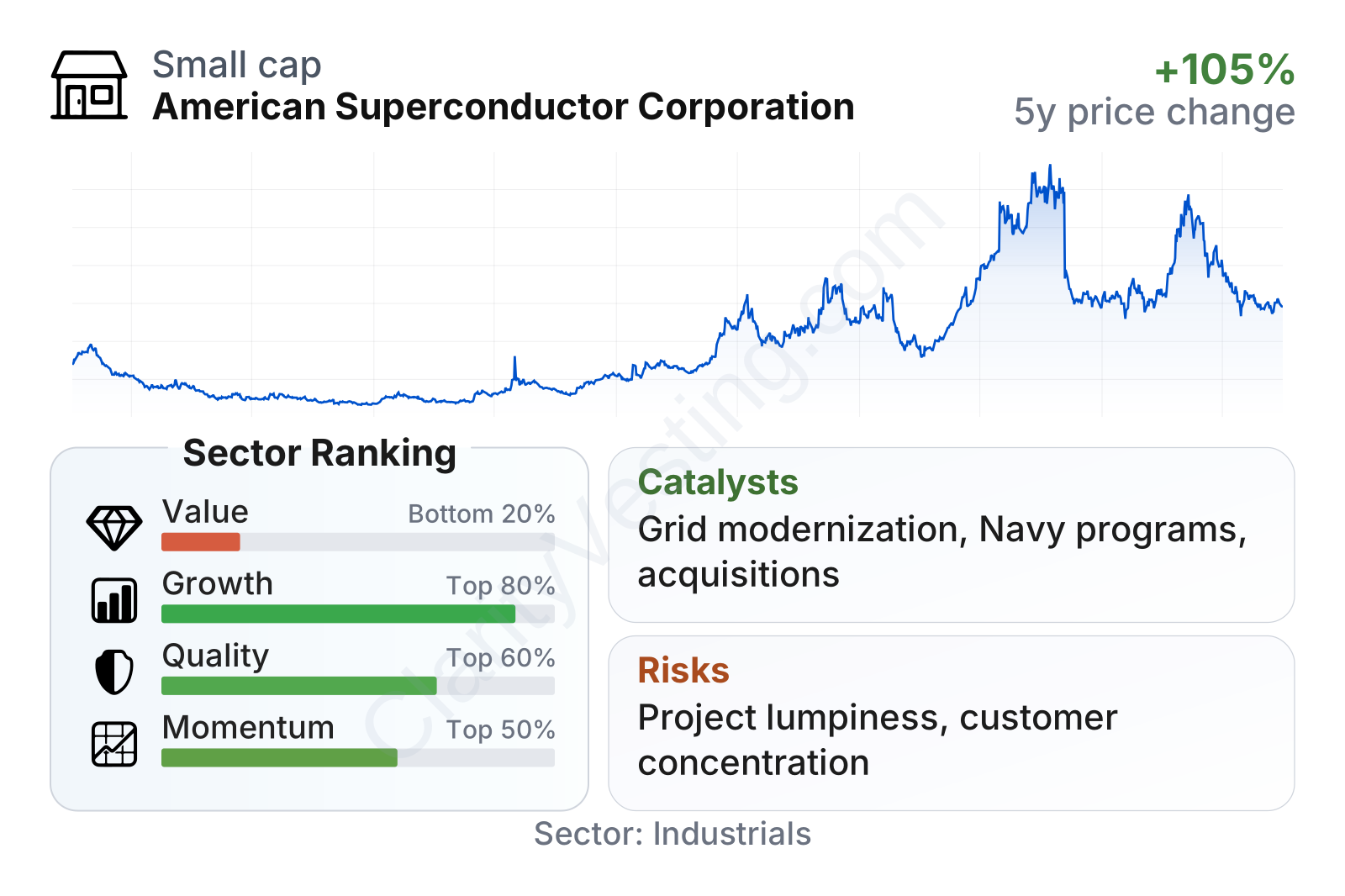
AMSC is a small-cap industrial company with unusually high share-price volatility, reflected in a beta above 3. That means the stock has tended to move much more sharply than the broader market. The factor profile is mixed: growth ranks above much of the sector, quality is somewhat better than average at the moment, while value ranks weaker overall despite a low earnings multiple because cash flow yield and operating earnings relative to enterprise value remain less favorable than many industrial peers. The balance sheet stands out positively, with very little financial debt and net cash rather than net debt.
Growth
AMSC operates in markets with credible long-term demand drivers. Electric grids are under pressure from rising power consumption, renewable energy additions, transmission constraints, and the need for more resilient infrastructure. Utilities and grid operators increasingly need equipment that can improve stability and power quality without waiting for years-long transmission buildouts. That creates room for companies supplying voltage regulation, interconnection, and control equipment. Defense electrification is another support factor, especially where the company already has a position in ship protection systems.
The company’s strategy also looks more coherent than it did several years ago. Instead of relying heavily on wind turbine electronics, AMSC has built a broader Grid platform. Acquisitions such as Neeltran and NWL have expanded its offering into rectifiers, power supplies, and other electrical equipment that can be sold into utility, industrial, semiconductor, and defense markets. That matters because it gives AMSC more ways to win orders and reduces dependence on a single product line.
Revenue growth has been strong. The latest year-over-year pace is around 30%, far above the sector median near 9%, and the last several quarters show repeated double-digit growth, with some periods much higher. Over five years, revenue per share has also compounded faster than the typical industrial peer. This suggests the recent expansion is not just a one-quarter anomaly, even if quarterly timing can still be uneven because project-based orders often move in lumps.
Cash generation has improved materially as well. Free cash flow was negative a few years ago, turned positive in fiscal 2024, and remained positive afterward, even with some moderation from the peak. That shift is important for a company like AMSC because it shows the business is moving away from being purely a turnaround case and toward funding more of its own growth internally.
A recent and particularly important catalyst is the company’s work tied to the military shipbuilding base, especially systems used for the U.S. Navy and submarine supply chain. Another meaningful opportunity comes from grid projects that support renewable integration and power reliability. The combination is attractive because utilities and defense programs tend to involve long project cycles and high technical requirements, which can support multi-year order visibility if execution stays on track.
Risks
This article is for informational purposes only and does not constitute financial advice. Some content is AI-generated. See Disclaimer