Stock Analysis · Amneal Pharmaceuticals Inc (AMRX)
Overview
Amneal Pharmaceuticals is a U.S.-based drug company focused on lower-cost generic medicines, a smaller but growing group of specialty branded products, and pharmaceutical ingredients. In simple terms, it makes widely used medicines after patents expire, while also building a portfolio of higher-margin branded treatments in selected areas such as central nervous system disorders and endocrinology. The company also manufactures active pharmaceutical ingredients, which are the core chemical components used in drugs.
Its business mix is fairly clear, with revenue coming mainly from three operating segments. Based on the latest annual reporting, the ranking is:
- Generics: about 80% to 85% of revenue. This includes oral solid medicines, injectables, biosimilar-related products, and other off-patent drugs sold mainly in the U.S.
- Specialty: about 10% to 15% of revenue. This segment includes branded products such as Parkinson’s and endocrine-related therapies, where pricing and margins can be stronger than in standard generics.
- AvKARE: about 5% to 10% of revenue. This unit distributes pharmaceuticals, medical and surgical products, and services to government agencies and institutional customers.
The broad picture is that Amneal is still primarily a generics manufacturer, but the company is trying to improve profitability by adding more complex products and expanding branded medicines. Revenue has grown meaningfully over the last several years, and gross profit has also moved higher, but interest expense has absorbed a large share of operating progress. That helps explain why the business has looked stronger at the operating level than at the final net income line.
The long-term trend shows a company that has increased sales from a little above $2.0 billion to just above $3.0 billion in recent years, while gross profit has risen as well. Operating income improved sharply in the latest full year, and net income turned positive after several years of losses, a sign that the business mix may be getting healthier even though financing costs remain significant.
Key Figures
| Metric | Value | Sector ⓘ |
|---|---|---|
| Date | Oct 24, 2026 | |
| Context | ||
| Sector | Healthcare | |
| Industry | Drug Manufacturers - Specialty & Generic | |
| Market Cap ⓘ | $7.04B | |
| Beta ⓘ | 1.22 | |
Value (Cheapness) | ||
| P/E Ratio ⓘ | 40.40 | 25.42 |
| P/B Ratio ⓘ | 203.47 | 3.08 |
| FCF Yield ⓘ | 1.18% | 3.12% |
| Dividend Yield ⓘ | N/A | 1.85% |
| EBIT / EV ⓘ | 4.87% | 0.56% |
| PEG ⓘ | N/A | |
Growth (Business expansion) | ||
| Revenue Growth ⓘ | 9.90% | 7.50% |
| RPS Growth (5Y CAGR) ⓘ | -9.39% | 8.60% |
| EPS Growth (5Y CAGR) ⓘ | -5.97% | -17.73% |
| BVPS Growth (5Y CAGR) ⓘ | N/A | 3.72% |
| Margin Growth (5Y Trend) ⓘ | 4.59% | -0.57% |
| FCF Growth (5Y CAGR) ⓘ | 8.60% | 0.96% |
| DPS Growth (5Y CAGR) ⓘ | -46.96% | 6.69% |
Quality (Business durability) | ||
| ROIC (Latest) ⓘ | 16.76% | 3.17% |
| ROA (Latest) ⓘ | 4.27% | 2.98% |
| ROIC (5Y Median) ⓘ | 6.30% | 4.56% |
| ROA (5Y Median) ⓘ | -2.31% | 1.87% |
| Net Debt / EBIT (Latest) ⓘ | 5.82 | 1.34 |
| Net Debt / EBIT (5Y Median) ⓘ | 12.19 | 1.86 |
| Net Debt / EBITDA (Latest) ⓘ | 4.08 | 1.00 |
| Net Debt / Assets ⓘ | 70.55% | 5.06% |
| EBITDA / Interest ⓘ | 2.87 | 9.55 |
| Operating Margin (Latest) ⓘ | 14.69% | 9.25% |
| Operating Margin (5Y Median) ⓘ | 9.04% | 7.33% |
| Debt to Equity (Latest) ⓘ | 8453.73% | 26.68% |
| Profit Margin (Latest) ⓘ | 5.05% | 3.34% |
| Free Cash Flow (Latest) ⓘ | $83.11M | |
Momentum (Price trend) | ||
| 3Y Return ⓘ | +509.52% | +51.61% |
| 12M Return (excl. last month) ⓘ | +95.00% | +19.90% |
| 6M Return ⓘ | +59.75% | +10.10% |
| Price vs. 200-Day MA ⓘ | +32.12% | +6.44% |
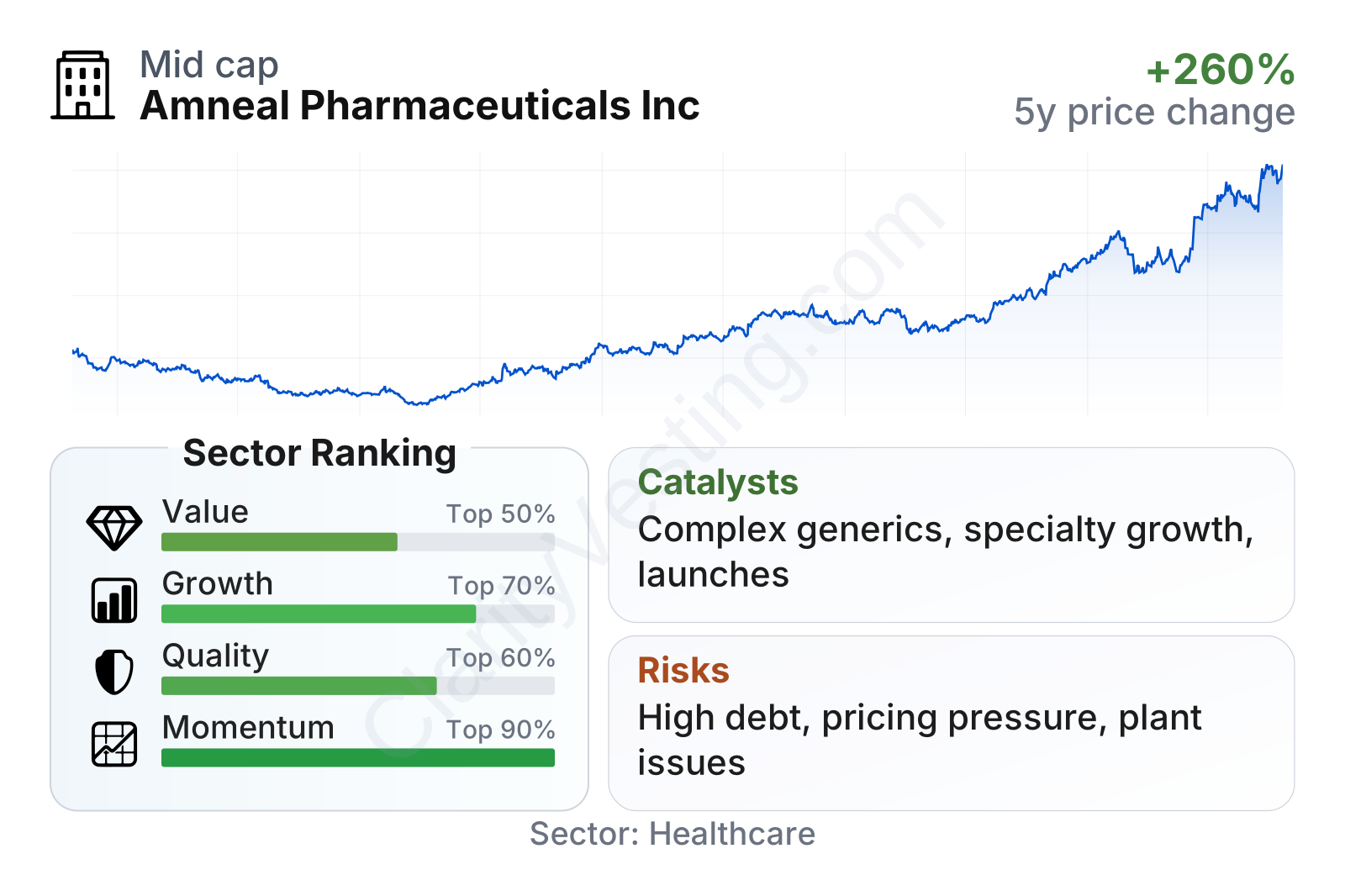
Amneal sits in the mid-cap range within healthcare and has shown very strong stock momentum over the last one-, three-, and six-month periods. On growth and quality, the business looks better than many peers in several operating measures, especially return on invested capital, operating margin, and recent revenue growth. The weaker points are mostly in valuation and balance-sheet metrics: earnings and cash flow multiples are not low, and leverage remains much heavier than the sector norm.
The stock’s large rebound from the lows of 2023 suggests that the market has already recognized the company’s operational improvement. That does not automatically make the shares unattractive, but it does mean expectations are no longer depressed.
Growth
Amneal operates in parts of healthcare that can still grow over long periods, even if not always smoothly. Demand for generic drugs tends to benefit from aging populations, rising prescription volumes, and the healthcare system’s need to control costs. That is an attractive backdrop because cheaper medicines are structurally important for insurers, pharmacies, hospitals, and government payers. At the same time, plain-vanilla generics are highly competitive, so the more interesting growth angle for Amneal is its push into complex generics, injectables, biosimilars, and specialty branded medicines.
The strategy makes sense on paper. Standard generics provide scale and cash generation, while specialty and harder-to-make products can improve margins and reduce direct price competition. Management has repeatedly emphasized product launches, pipeline expansion, and manufacturing capabilities as key levers. This is important because in generic pharmaceuticals, future growth often depends less on one breakthrough product and more on a steady cadence of launches across multiple categories.
Recent revenue growth has generally remained positive, with several quarters showing solid year-over-year gains and the latest pace still running above the healthcare sector median. Growth has cooled from some of the strongest quarters, but it has not disappeared. That suggests Amneal is not relying on a one-quarter spike alone.
Cash generation has also improved materially from earlier periods. Free cash flow remains uneven, which is common in pharmaceutical manufacturing, but the broader direction has been better than the company’s own long-term history. Over a five-year view, free cash flow growth has outpaced much of the sector, which matters because debt reduction and future product investment both depend on cash, not just accounting earnings.
One notable catalyst is the company’s continued buildout in more specialized categories, including injectables and biosimilar-related opportunities, where barriers to entry are usually higher than in basic tablets and capsules. Another favorable point is the specialty segment, which is still smaller than generics but can have an outsized effect on margins if a few products scale successfully. Recent company updates have also highlighted new launches and portfolio expansion, which supports the idea that growth is being built through execution rather than only pricing.
Risks
This article is for informational purposes only and does not constitute financial advice. Some content is AI-generated. See Disclaimer


