Stock Analysis · Ameresco Inc (AMRC)
Overview
Ameresco is an energy solutions company that helps customers reduce energy costs, improve efficiency, and add cleaner power systems. Its clients include federal, state, and local governments, utilities, healthcare systems, universities, schools, commercial businesses, and industrial sites. In practical terms, the company designs, builds, finances, and sometimes operates projects such as building efficiency upgrades, solar facilities, battery storage systems, renewable natural gas plants, and other distributed energy assets.
Its business model is broader than a typical construction contractor. Ameresco earns money from project development and installation, but it also generates recurring revenue from operating assets and providing services after projects are completed. That mix is important because it gives the company both upfront project revenue and longer-duration cash generation tied to owned or managed energy infrastructure.
Based on the company’s latest annual disclosures, revenue is mainly generated from the following activities:
- Energy efficiency and infrastructure projects: approximately 60% to 70% of revenue. This includes engineering, procurement, and construction work tied to energy savings performance contracts, building upgrades, microgrids, and on-site energy systems.
- Renewable energy asset and product sales: approximately 15% to 25% of revenue. This includes solar, storage, and other clean energy systems developed for customers.
- Operations, maintenance, and other energy services: approximately 10% to 15% of revenue. This covers long-term service agreements, facility support, and recurring customer contracts.
- Owned energy assets and fuel-related revenue, including renewable natural gas and electricity sales: approximately 5% to 10% of revenue, though this can vary by year depending on project timing, asset output, and commodity-related factors.
That mix can shift from year to year because Ameresco recognizes a large share of revenue when projects move through construction milestones. As a result, revenue is not always smooth, even when long-term demand remains intact.
Over the last several years, the business has shown a clear pattern: revenue has climbed meaningfully from 2021 through 2025, while gross profit has also expanded. At the same time, interest expense has risen sharply, which helps explain why growth in sales has not translated into equally strong growth in net income.
Key Figures
| Metric | Value | Sector ⓘ |
|---|---|---|
| Date | Oct 17, 2026 | |
| Context | ||
| Sector | Industrials | |
| Industry | Engineering & Construction | |
| Market Cap ⓘ | $1.16B | |
| Beta ⓘ | 2.62 | |
Value (Cheapness) | ||
| P/E Ratio ⓘ | 41.38 | 22.10 |
| P/B Ratio ⓘ | 0.95 | 1.97 |
| FCF Yield ⓘ | -45.22% | 6.38% |
| Dividend Yield ⓘ | N/A | 1.94% |
| EBIT / EV ⓘ | 4.37% | 4.79% |
| PEG ⓘ | 1.27 | |
Growth (Business expansion) | ||
| Revenue Growth ⓘ | 9.10% | 9.30% |
| RPS Growth (5Y CAGR) ⓘ | 11.74% | 7.81% |
| EPS Growth (5Y CAGR) ⓘ | N/A | -13.06% |
| BVPS Growth (5Y CAGR) ⓘ | 9.60% | 6.14% |
| Margin Growth (5Y Trend) ⓘ | -0.96% | 0.88% |
| FCF Growth (5Y CAGR) ⓘ | N/A | 11.01% |
| DPS Growth (5Y CAGR) ⓘ | N/A | 9.48% |
Quality (Business durability) | ||
| ROIC (Latest) ⓘ | 5.13% | 10.84% |
| ROA (Latest) ⓘ | 0.61% | 5.41% |
| ROIC (5Y Median) ⓘ | 6.85% | 9.38% |
| ROA (5Y Median) ⓘ | 1.90% | 4.95% |
| Net Debt / EBIT (Latest) ⓘ | 13.96 | 2.08 |
| Net Debt / EBIT (5Y Median) ⓘ | 14.10 | 2.27 |
| Net Debt / EBITDA (Latest) ⓘ | 7.55 | 1.39 |
| Net Debt / Assets ⓘ | 38.97% | 19.28% |
| EBITDA / Interest ⓘ | 2.54 | 9.58 |
| Operating Margin (Latest) ⓘ | 6.67% | 10.50% |
| Operating Margin (5Y Median) ⓘ | 6.88% | 10.29% |
| Debt to Equity (Latest) ⓘ | 149.61% | 65.48% |
| Profit Margin (Latest) ⓘ | 1.40% | 6.67% |
| Free Cash Flow (Latest) ⓘ | -$526.28M | |
Momentum (Price trend) | ||
| 3Y Return ⓘ | -33.93% | +61.68% |
| 12M Return (excl. last month) ⓘ | -10.72% | +12.58% |
| 6M Return ⓘ | -8.66% | 0.00% |
| Price vs. 200-Day MA ⓘ | -19.93% | +0.02% |
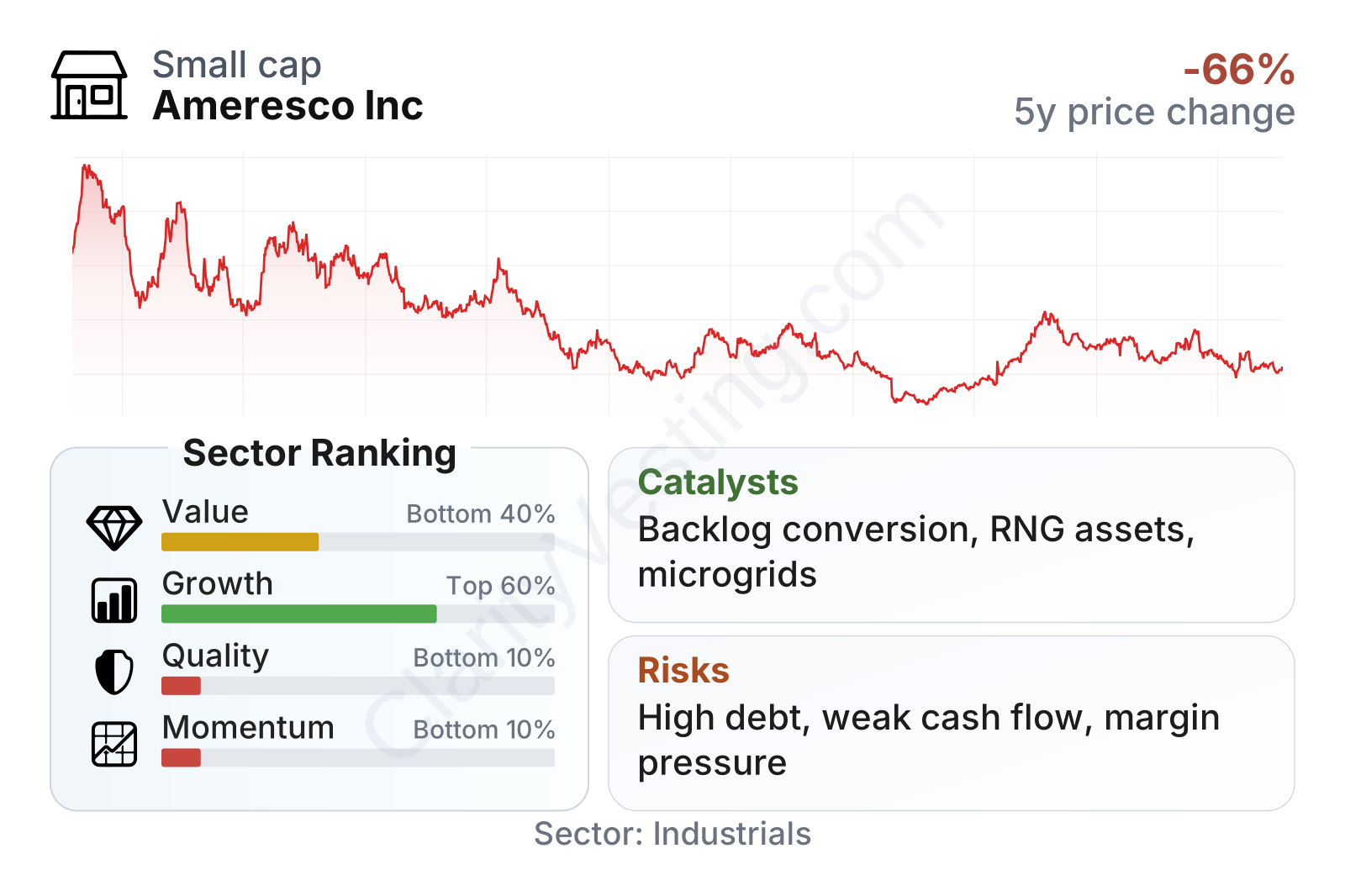
Ameresco is a small-cap industrial company with a stock that has been far more volatile than the broader market, as shown by its high beta. The share price has gone through a major reset since the 2022 peak, reflecting weaker sentiment around leverage, cash flow, and profit conversion rather than a collapse in the company’s end markets.
The latest factor snapshot presents a mixed profile. Growth metrics are around the middle-to-better part of the sector, supported by solid multi-year revenue-per-share expansion. However, quality metrics are weak, with low returns on capital, thin profitability, and elevated debt burdens compared with typical industrial peers. The value picture is also mixed: the stock trades below sector norms on book value, but earnings and cash-flow-based measures do not look inexpensive.
Growth
Ameresco operates in several areas that continue to benefit from long-term structural demand: energy efficiency, grid resilience, distributed generation, battery storage, and renewable natural gas. These are not niche themes anymore. Governments, campuses, hospitals, data-intensive facilities, and utilities increasingly need lower energy costs, backup power, emissions reductions, and modernized infrastructure. That gives the company exposure to a sector with durable tailwinds.
Its strategy also makes sense on paper. Ameresco combines consulting, project development, financing support, construction, and long-term operation. That can make it easier for customers to work with one provider from planning to execution. The company has also built experience in energy savings performance contracts, a model where project economics are tied to measurable savings, which can be attractive for public-sector customers with limited budgets.
Recent revenue growth has normalized after unusually large swings in earlier periods. The latest pace is around high-single-digit to low-double-digit growth, which is close to the sector median. That suggests the business is still expanding, but not at a rate strong enough by itself to erase concerns about margins and financing costs.
One encouraging sign is that free cash flow has remained negative but has improved substantially from the deepest recent lows. For a company that develops and sometimes owns energy assets, cash flow can be heavily affected by project timing and capital spending. Even so, the key issue is not simply that cash flow is uneven; it is that cash use has been large for several years. A sustained move toward better cash generation would be one of the clearest signs that the growth model is maturing.
As for catalysts, Ameresco’s opportunity set appears tied to three main drivers. First, public-sector energy upgrades remain a sizable market, especially where aging facilities need modernization. Second, renewable natural gas and distributed energy projects can create longer-lived revenue streams once assets are operational. Third, rising electricity demand and resilience needs, including backup systems and microgrids, can support more project awards. Company updates in 2026 have continued to point to new contract wins and project development activity, which matters because future revenue often depends on converting backlog into completed work.
Risks
This article is for informational purposes only and does not constitute financial advice. Some content is AI-generated. See Disclaimer


